Table of Contents
- A Musical Moment Amid a Media Firestorm
- What Is the Beating Retreat Ceremony?
- AR Rahman Beating Retreat: The Song Selection
- The Controversy That Preceded the Performance
- Public and Political Reactions
- Art Versus Artist: Can They Be Separated?
- Conclusion
- Sources
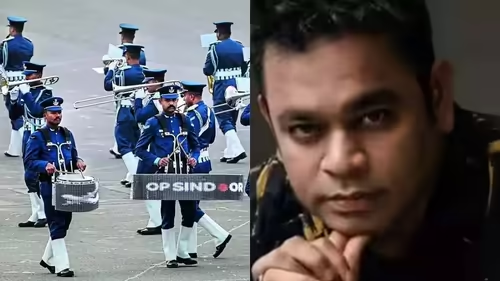
On the evening of January 29, 2026, as the sun dipped behind Raisina Hill, the hauntingly familiar strains of “Jai Ho” echoed across Vijay Chowk in New Delhi. The song—composed by the Oscar-winning maestro AR Rahman for the 2008 film *Slumdog Millionaire*—was part of the official playlist for the Republic Day Beating Retreat ceremony, a solemn and grand military tradition marking the end of India’s Republic Day celebrations [[1]]. But this year, its inclusion wasn’t just a celebration of musical excellence—it became a lightning rod for national debate, coming just days after Rahman found himself embroiled in a heated controversy over remarks interpreted by some as “communal.”
A Musical Moment Amid a Media Firestorm
The juxtaposition was impossible to ignore. On one hand, a globally recognized anthem of triumph and unity—“Jai Ho,” which translates to “Let there be victory”—being performed by the elite bands of the Indian Armed Forces. On the other, a social media storm accusing Rahman of making divisive statements during a recent interview. The decision to feature his work at such a symbolically charged national event sent mixed signals, sparking conversations from Twitter threads to prime-time news debates.
What Is the Beating Retreat Ceremony?
For those unfamiliar, the Beating Retreat is not just a concert—it’s a meticulously choreographed display of military precision and national pride. Held annually on January 29 at Vijay Chowk, it involves massed bands from the Army, Navy, and Air Force, performing a repertoire that blends traditional martial tunes with contemporary patriotic compositions.
Over the years, the ceremony has evolved to include popular Indian film music that carries a strong sense of national identity. Past selections have included classics like “Mere Desh Ki Dharti” and “Sandese Aate Hai.” The inclusion of any song is seen as an implicit endorsement of its spirit—and, by extension, its creator.
AR Rahman Beating Retreat: The Song Selection
This year, three compositions by AR Rahman were featured in the Beating Retreat lineup:
- “Jai Ho” (*Slumdog Millionaire*, 2008)
- “Phir Bhi Dil Hai Hindustani” (*Pukar*, 2000)
- “Bharat Humko Jaan Se Pyara Hai” (*Roja*, 1992)
All three are widely regarded as modern patriotic anthems. “Jai Ho,” in particular, won Rahman two Academy Awards and became a global symbol of Indian cultural resurgence. Its rhythm, energy, and message of collective victory align closely with the ethos of the ceremony [[2]].
Yet, its performance this year carried extra weight. In a climate where public figures are increasingly scrutinized for their personal views, the choice to spotlight Rahman’s music—amid active controversy—raised eyebrows and questions about intent.
The Controversy That Preceded the Performance
The backdrop to this musical moment was a recent podcast interview in which Rahman, while discussing artistic freedom and religious identity, made comments that critics labeled as “communal” or exclusionary. Though Rahman later clarified his remarks on social media, stating he “believes in universal love and unity,” the initial interpretation had already gone viral [[3]].
Several right-wing groups called for a boycott of his music, while others defended him as a misunderstood artist. The Ministry of Defence, which oversees the Beating Retreat program, did not issue any statement explaining the song selection, leaving room for speculation about whether the inclusion was a deliberate act of cultural reaffirmation—or simply a routine programming decision based on musical merit.
Public and Political Reactions
Reactions were sharply divided:
- Supporters hailed the move as a powerful reminder that art transcends politics. “‘Jai Ho’ belongs to every Indian—it’s our global victory song,” tweeted one fan.
- Critics questioned the timing. “How can we celebrate someone whose words hurt national unity?” asked a prominent political commentator on a news panel.
- Neutral observers pointed out that the songs chosen were all explicitly patriotic, suggesting the military was honoring the *music*, not necessarily the man.
Notably, no official from the armed forces commented on the matter, maintaining the institution’s traditional apolitical stance.
Art Versus Artist: Can They Be Separated?
This incident reignites a timeless debate: should we separate the art from the artist? In democratic societies, this question becomes especially complex when national institutions are involved.
According to Dr. Meera Nanda, a cultural historian cited by The Hindu, “State-sponsored events like Beating Retreat carry symbolic weight. Including a controversial figure’s work—even if the work itself is unifying—can be read as taking a stand” [[4]].
On the flip side, many argue that banning or excluding artists based on contested interpretations of their words sets a dangerous precedent for creative freedom. As one film critic noted, “Rahman’s music has soundtracked India’s most triumphant moments for over three decades. That legacy shouldn’t be erased overnight.”
For more on the evolving role of artists in public life, see our deep dive on [INTERNAL_LINK:artists-and-public-discourse].
Conclusion
The playing of “Jai Ho” at the AR Rahman Beating Retreat ceremony was far more than a musical interlude—it was a cultural flashpoint. It forced the nation to confront uncomfortable questions about identity, expression, and the boundaries of patriotism. Whether viewed as a bold statement of inclusivity or a tone-deaf oversight, one thing is clear: AR Rahman’s music remains deeply woven into the fabric of modern India. And in a country as diverse and passionate as ours, that alone guarantees the conversation will continue long after the final drumbeat faded at Vijay Chowk.