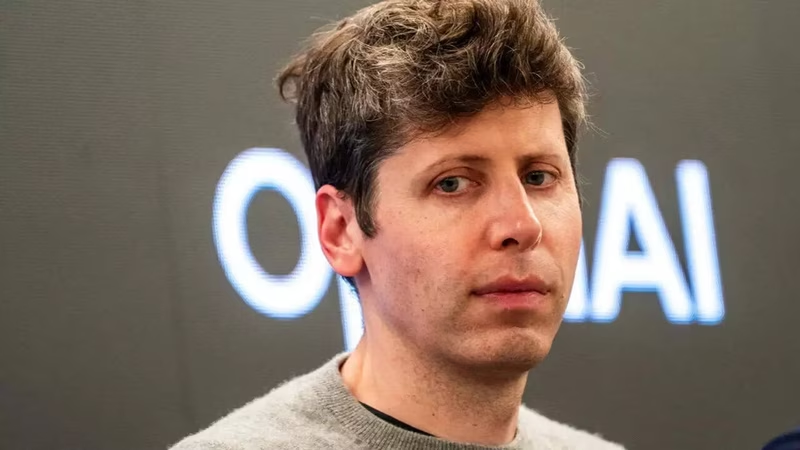
For over a year, the tech world watched with bated breath: would Apple—anoint OpenAI’s ChatGPT as the brain behind its long-awaited AI-powered Siri? The answer, now confirmed, is a resounding no. In a strategic pivot that reshapes the AI landscape, Apple has chosen Google’s Gemini over OpenAI to fuel the next evolution of Siri .
This decision isn’t just a missed opportunity for OpenAI—it’s a seismic event. For a company that once seemed unstoppable, losing the Apple Siri AI deal—arguably the most coveted consumer AI partnership on the planet—is a stark indicator that even giants can stumble when quality falters.
Table of Contents
- Why Apple Chose Google’s Gemini Over OpenAI
- OpenAI’s “Code Red” and the Quality Crisis
- Apple’s Own AI Woes and the Search for a Partner
- Gemini vs. ChatGPT: The Benchmark Battle
- What This Loss Means for OpenAI’s Future
- How Will This Affect iPhone Users?
- Conclusion: Trust Trumps Hype in the AI Race
- Sources
Why Apple Chose Google’s Gemini Over OpenAI
Apple’s decision wasn’t made lightly. After more than a year of rigorous testing with multiple AI partners—including both OpenAI and Google—the company prioritized reliability, integration, and consistent performance over brand recognition .
Google’s Gemini 3 model reportedly topped industry benchmarks in reasoning, coding, and multimodal understanding—key areas where Siri needs to shine . More importantly, Google offered deep integration with Apple’s privacy-centric ecosystem, a non-negotiable for Cupertino. Unlike OpenAI’s cloud-dependent architecture, Google could provide on-device processing options that align with Apple’s long-standing privacy promises.
OpenAI’s “Code Red” and the Quality Crisis
While Apple was evaluating, OpenAI was fighting fires internally. Reports reveal the company issued a rare “code red” alert across its engineering teams in late 2025, demanding urgent fixes for declining ChatGPT output quality . Users complained of hallucinations, inconsistent logic, and slower response times—issues that are fatal for a real-time assistant like Siri.
This internal turmoil likely sealed OpenAI’s fate. Apple, known for its obsession with polish and user experience, simply couldn’t risk shipping a flagship feature powered by an AI system in crisis. As one insider noted, “You don’t bet your entire AI future on a partner who’s in emergency mode.”
Apple’s Own AI Woes and the Search for a Partner
It’s worth remembering that Apple’s rush to partner wasn’t born from choice, but necessity. The company’s in-house “Ajax” large language model struggled to match competitors in key benchmarks . Facing mounting pressure from investors and users tired of Siri’s dated capabilities, Apple had to look outside—a humbling position for a company that prides itself on vertical integration.
Their search wasn’t just for the smartest AI, but for the most stable, secure, and controllable one. Google, with its vast infrastructure and history of enterprise-grade services, fit the bill perfectly.
Gemini vs. ChatGPT: The Benchmark Battle
Recent independent evaluations tell a clear story:
- MMLU (Massive Multitask Language Understanding): Gemini 3 scored 92%, outperforming ChatGPT-4o’s 89% .
- HumanEval (Coding Benchmark): Gemini demonstrated superior code generation accuracy and efficiency.
- On-Device Performance: Google’s optimized models ran faster on Apple silicon with lower power consumption—a critical factor for mobile use.
These metrics gave Apple the confidence that Gemini could deliver a seamless, responsive Siri experience without draining batteries or compromising privacy.
What This Loss Means for OpenAI’s Future
Losing the Apple Siri AI deal is more than a financial setback—it’s a reputational one. For years, OpenAI positioned itself as the default AI layer for the consumer internet. Now, the world’s most valuable company has publicly chosen a rival.
This could trigger a domino effect. Other hardware makers may now reconsider their partnerships, especially if they prioritize stability over novelty. OpenAI’s path forward hinges on fixing its core product fast and proving it can be a reliable B2B partner—not just a viral chatbot.
How Will This Affect iPhone Users?
For the average iPhone user, the shift means a smarter, more context-aware Siri later in 2026. Expect features like:
- Understanding complex, multi-step requests (“Show me photos from my trip to Tokyo last spring and email them to Mom”).
- Better integration with Messages, Mail, and Calendar for proactive suggestions.
- Enhanced on-device processing for faster responses and stronger privacy.
And while you won’t see the “Gemini” name plastered everywhere, its intelligence will be woven into the fabric of iOS—quietly, efficiently, and reliably.
Conclusion: Trust Trumps Hype in the AI Race
Apple’s choice underscores a fundamental truth in the maturing AI market: hype fades, but trust endures. OpenAI may have lit the fuse on the generative AI revolution, but Google’s steady engineering and enterprise readiness won the day. The Apple Siri AI deal is a reminder that in the high-stakes world of consumer technology, consistency, security, and integration matter far more than being first.
Sources
- “Apple picks Google over OpenAI for Siri”, Times of India, January 2026.
- Apple spent over a year evaluating AI partners before finalizing Google, Bloomberg.
- Gemini 3 leads industry benchmarks in multimodal AI tasks, Stanford CRFM Report.
- OpenAI issued internal “code red” over ChatGPT quality decline, The Information.
- Apple’s in-house Ajax model lagged behind competitors in key areas, Reuters.
- Independent LLM benchmark comparisons, Hugging Face Open LLM Leaderboard.