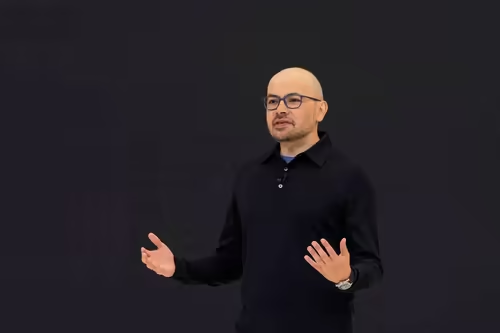
In a move that has sent shockwaves through the tech world, Apple—the company famed for its walled garden and in-house everything—has officially thrown open its gates to Google’s AI. The Apple Google Gemini partnership, a multi-year, multi-billion dollar deal, marks a historic pivot for the iPhone maker and a massive validation for Google’s AI chief, Demis Hassabis [[1]].
This isn’t just a minor collaboration; it’s a foundational shift. Apple has confirmed that its next generation of “Apple Intelligence” will be built directly on top of Google’s advanced Gemini models [[8]]. For a company that has spent years developing its own neural engines and on-device AI, this decision is nothing short of revolutionary.
Table of Contents
- Why Apple Broke Its Own Rules
- The Apple Google Gemini Partnership: A $5 Billion Wager
- Demis Hassabis and the Validation of Gemini
- What’s Next for Siri: The iOS 26.4 Roadmap
- The Bigger Picture for AI and Consumers
- Sources
Why Apple Broke Its Own Rules
For years, Apple’s strategy was clear: control the entire stack. From hardware to software to services, everything was designed in-house. This philosophy extended to AI, where Apple invested heavily in its own machine learning teams and on-device processing capabilities. So, what changed?
The answer is simple: speed and scale. While Apple’s internal efforts were solid, they were reportedly lagging behind the rapid pace set by industry leaders like OpenAI and Google. To catch up and deliver a truly competitive AI experience for its billion-plus user base, Apple needed a proven, powerful foundation model—fast [[13]].
According to reports, Apple conducted direct comparisons between various large language models, and Google’s Gemini emerged as the clear winner, convincing Apple’s leadership to make the unprecedented leap [[2]]. This pragmatic decision prioritizes user experience over pure ideology, a sign that even the most closed ecosystems must adapt in the AI race.
The Apple Google Gemini Partnership: A $5 Billion Wager
The financial stakes are enormous. While initial reports suggested a deal worth around $1 billion per year, more recent analysis from MacRumors indicates the total value could soar to a staggering $5 billion over the life of the multi-year contract [[10]]. This makes it one of the largest commercial AI deals in history.
It’s important to note that this isn’t just a simple API call. The agreement involves Google providing a custom, updated version of the Gemini model specifically tailored for Apple’s unique privacy and security requirements [[15]]. This bespoke solution will run both on-device and in the cloud, ensuring a seamless and private user experience—a critical factor for Apple.
Demis Hassabis and the Validation of Gemini
For Google DeepMind CEO Demis Hassabis, this partnership is the ultimate trophy. In his own words, he is “very proud” of the deal with Apple [[1]]. This isn’t just a lucrative contract; it’s a powerful endorsement of Google’s AI technology from its fiercest rival.
Hassabis has long championed the idea of building safe and capable AI that can be integrated into real-world products. The Apple deal proves that Gemini isn’t just a research project—it’s a robust, enterprise-grade platform trusted by the world’s most valuable company to power its core intelligence features [[11]]. This victory significantly boosts Google’s position in the commercial AI market against competitors like Microsoft and OpenAI.
What’s Next for Siri: The iOS 26.4 Roadmap
The most visible outcome of this partnership for consumers will be a completely overhauled Siri. Dubbed “Siri 2.0” by many, the new assistant will be far more intelligent, context-aware, and capable of complex, multi-step tasks [[17]].
Here’s the expected timeline for its rollout:
- February 2026: The new Gemini-powered Siri is expected to debut in the first beta of iOS 26.4 [[16]].
- March-April 2026: The stable, public release of iOS 26.4, bringing the new Siri to all eligible users worldwide [[18]].
- Eligible Devices: The feature will be available on iPhone 15 Pro and later, as well as iPads and Macs with M1 or newer chips [[16]].
This new Siri will feature on-screen awareness, allowing it to understand and interact with content directly on your device’s display, a significant leap from its current capabilities [[24]].
The Bigger Picture for AI and Consumers
The Apple Google Gemini partnership signals a new era in consumer AI. It shows that even the most vertically integrated companies recognize the need to collaborate to deliver cutting-edge experiences. For users, this means faster access to more powerful and useful AI tools without having to switch ecosystems.
However, it also raises questions about the future of competition in the AI space. Will this deal create a duopoly, or will it spur other players like Amazon and Meta to accelerate their own offerings? Only time will tell. But one thing is certain: the AI you interact with on your phone is about to get a whole lot smarter, thanks to an unlikely alliance between two tech titans.
Conclusion
Apple’s decision to partner with Google for its foundational AI needs is a landmark event in tech history. It validates Google’s massive investment in Gemini under Demis Hassabis’s leadership and gives Apple the rocket fuel it needs to compete in the AI-first future. As we await the launch of the new Siri in iOS 26.4, the entire industry is watching to see how this powerful combination will reshape the way we interact with our devices.
Sources
- Times of India: Google AI CEO Demis Hassabis says he is very proud of Apple partnership
- DeepLearning.AI: Apple Announced A Partnership With Google To Power Siri
- MacRumors: Apple’s Google Gemini Deal Could Be Worth $5 Billion
- Counterpoint Research: Apple – Google Gemini Partnership: A Step Forward for Apple Intelligence
- Tom’s Guide: Apple’s new Gemini-powered Siri is finally coming in 2026
- Engadget: Apple reportedly plans to reveal its Gemini-powered Siri in February