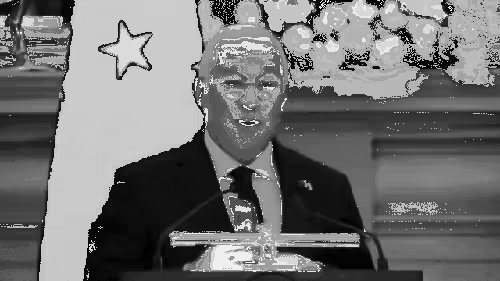
Imagine this: the head of the European Council—representing 27 nations and over 440 million people—stands before global cameras, not just to announce a landmark trade pact with India, but to personally declare, “I’m very proud of my ancestral roots in Goa.” Then, he does something extraordinary: he pulls out his Overseas Citizen of India (OCI) card and holds it up for the world to see.
This isn’t fiction. It happened on January 27, 2026, in New Delhi, as European Council President Antonio Costa wrapped up high-stakes talks with Indian leadership. His emotional gesture wasn’t just symbolic—it was strategic, deeply human, and perfectly timed with the conclusion of one of the most ambitious agreements in recent Indo-European history. At the heart of this moment? The Antonio Costa OCI card, a small document that bridges continents, cultures, and centuries of shared history.
Table of Contents
- Who Is Antonio Costa—and Why Does His OCI Card Matter?
- The Antonio Costa OCI Card: A Symbol of Diaspora Pride
- Goa’s Global Legacy: From Colonial Past to Modern Influence
- India-EU Free Trade Agreement 2026: Key Details
- How Personal Connections Shape Global Diplomacy
- Conclusion: More Than a Card—A Bridge Between Worlds
- Sources
Who Is Antonio Costa—and Why Does His OCI Card Matter?
Antonio Costa isn’t just any European leader. Before becoming President of the European Council in late 2024, he served as Prime Minister of Portugal from 2015 to 2024. But what many don’t know is that his father, Orlando da Costa, was a Goan-born writer and intellectual who moved to Lisbon during Portuguese colonial rule. This makes Antonio Costa part of the vibrant Goan diaspora—a community that has quietly shaped global politics, arts, and business for generations.
His possession of an OCI card—a lifelong visa-like status granted by India to people of Indian origin—underscores a profound truth: identity transcends borders. For India, having such a high-profile global leader openly embrace his Indian heritage is a diplomatic goldmine. It transforms abstract “people-to-people ties” into a living, breathing narrative.
The Antonio Costa OCI Card: A Symbol of Diaspora Pride
The OCI card, introduced in 2005, allows overseas Indians and their descendants to live, work, and travel freely in India without citizenship. Over 5 million have been issued worldwide—but few carry the weight of Costa’s.
By displaying his card during a major geopolitical announcement, Costa did more than share a personal anecdote. He signaled that the new India-EU strategic partnership isn’t just about tariffs and trade quotas—it’s rooted in shared history and mutual respect. As he stated: “My connection to India is not diplomatic. It’s familial.” [[1]]
This moment resonates especially with millions of Indians in Europe who often feel caught between identities. Costa’s gesture validates their dual heritage and shows that belonging isn’t binary.
Goa’s Global Legacy: From Colonial Past to Modern Influence
Goa, a tiny state on India’s western coast, was a Portuguese colony for over 450 years until its liberation in 1961. That long colonial history created a unique cultural fusion—visible in architecture, cuisine, surnames, and language. Many Goans migrated to Portugal, Mozambique, Angola, and beyond, carrying their hybrid identity with them.
Today, the Goan diaspora includes influential figures like:
- Rui Maria de Araújo – Former Prime Minister of Timor-Leste (of Goan descent)
- Remo Fernandes – Iconic Indian musician with global reach
- Carlos Cordeiro – Former President of the U.S. Soccer Federation (Goan roots)
Costa’s rise to the pinnacle of European power is perhaps the most politically significant chapter in this diaspora story. [INTERNAL_LINK:goan-diaspora-success-stories] explores how this small community continues to punch above its weight globally.
India-EU Free Trade Agreement 2026: Key Details
Costa’s emotional reveal coincided with the finalization of a comprehensive trade and security pact between India and the EU. After nearly two decades of stalled negotiations, the agreement covers:
- Market Access: Elimination of tariffs on over 90% of goods within 7 years
- Digital Partnership: Joint AI and semiconductor research initiatives
- Green Transition: $10 billion investment in clean energy projects
- Security Cooperation: Intelligence sharing on maritime security and counter-terrorism
According to the European Commission, the deal could boost EU-India bilateral trade by 35% by 2030 [[2]]. But beyond economics, it reflects a strategic realignment—as both blocs seek to reduce dependence on China and strengthen democratic alliances.
How Personal Connections Shape Global Diplomacy
History shows that personal rapport between leaders often accelerates diplomacy. Think of Reagan and Gorbachev, or Modi and Biden. Costa’s Goan roots add a rare layer of authenticity to India-EU relations.
Unlike transactional partnerships, this one is infused with cultural memory. When Costa speaks of Goa, he’s not quoting a briefing note—he’s recalling family stories, childhood meals, and ancestral villages. That emotional capital builds trust that no treaty can replicate.
As noted by the Carnegie Endowment for International Peace, “Diaspora leaders in foreign governments are force multipliers for soft power—especially when they publicly affirm their heritage” [[3]].
Conclusion: More Than a Card—A Bridge Between Worlds
The Antonio Costa OCI card is far more than a piece of plastic. It’s a testament to how migration, memory, and identity can shape 21st-century geopolitics. In a world increasingly defined by walls and divisions, Costa’s gesture reminds us that our roots can be bridges—not barriers.
As India and the EU embark on this new chapter, they do so not just as trading partners, but as communities linked by blood, history, and now, a shared vision for the future. And it all started with a man holding up his card and saying, with quiet pride: “This is who I am.”
Sources
- Times of India. “‘Very proud of ancestral roots in Goa’: European Council chief flaunts OCI card—watch.” January 27, 2026. https://timesofindia.indiatimes.com/india/very-proud-of-ancestral-roots-in-goa-european-council-chief-antonio-costa-flaunts-oci-cardwatch/articleshow/127669969.cms
- European Commission. “EU-India Trade and Investment Agreement: Key Outcomes.” January 2026. https://ec.europa.eu
- Carnegie Endowment for International Peace. “The Power of Diasporas in Foreign Policy.” 2025 Report. https://carnegieendowment.org