The Day Cricket Defied Convention: All Eleven on the Prowl
In the annals of Test cricket, certain moments transcend mere statistics and become legends. The fourth Test between India and the West Indies at the Antigua Recreation Ground in May 2002 is one such moment. It wasn’t just a drawn match; it was a masterclass in resilience, unconventional strategy, and raw courage. At its heart lies a staggering fact: for the first time in Indian Test history, and only the third time ever globally at that point, all 11 players bowled in a single innings .
Table of Contents
- The Context: A Tour on the Brink
- Kumble’s Courage: The Broken Jaw That Defined Grit
- Ratra’s Record: A Century for the Ages
- Ganguly’s Gamble: Deploying All Eleven
- The Rare Feat: A Look at Cricket History
- Conclusion: Why the Antigua Test Still Matters
- Sources
The Context: A Tour on the Brink
India arrived in the Caribbean for the 2002 tour with high hopes but left with a series loss. After three Tests, they were down 1-0. The fourth Test in Antigua was their last chance to salvage some pride before the final dead rubber. The pitch was typically flat, offering little for the bowlers, and the West Indies’ formidable batting lineup, led by Brian Lara, was in ominous form. Captain Sourav Ganguly knew his team needed something extraordinary.
Kumble’s Courage: The Broken Jaw That Defined Grit
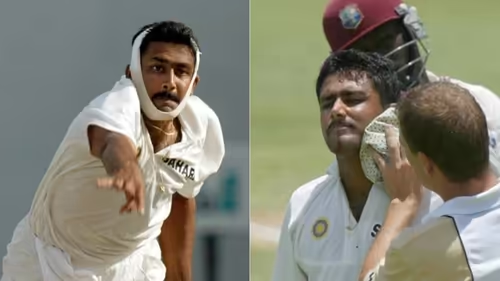
The most iconic image from this match is of Anil Kumble, his face heavily bandaged, steaming in to bowl with a fractured jaw. On the second day, while batting, Kumble was struck by a brutal bouncer from Mervyn Dillon that broke his jaw . The pain was excruciating, yet his commitment was unwavering. In an act of sheer willpower that has become synonymous with his name, Kumble returned to bowl 14 consecutive overs during the West Indies’ chase .
His heroics weren’t just for show; he managed to dismiss the dangerous Brian Lara, becoming the first bowler to do so while operating with a broken jaw . This display of grit wasn’t just a personal triumph; it galvanized his entire team and set the stage for the bizarre tactical move that would follow. His spirit embodied the fighting ethos Ganguly was trying to instill in the Indian side.
Ratra’s Record: A Century for the Ages
While Kumble’s bravery captured headlines, another young Indian was scripting his own piece of history with the bat. Wicketkeeper Ajay Ratra, just 20 years old, walked in with India in a spot of bother. Showing remarkable composure on a foreign pitch against a potent attack, he crafted an unbeaten 115 .
This knock made him the youngest wicketkeeper to score a Test century at the time, a record that highlighted his immense potential . His partnership with VVS Laxman (124*) helped India post a commanding total of 513/9 declared, giving their bowlers a fighting chance on a docile track . Ratra’s contribution was the perfect counterpoint to Kumble’s physical sacrifice—a blend of youthful talent and mature temperament.
Ganguly’s Gamble: Deploying All Eleven
Faced with a flat pitch and a West Indies side that seemed destined for a draw at best, Ganguly, known for his aggressive and sometimes unorthodox captaincy, decided to throw everything at them. He needed to create pressure from every possible angle. So, in a move rarely seen in the sport’s long history, he turned to his entire squad.
Every single player in the Indian XI sent down at least one over in the West Indies’ first innings. This included not just the frontline bowlers like Zaheer Khan and Harbhajan Singh, but also specialist batsmen like Sachin Tendulkar, Rahul Dravid, Virender Sehwag, Wasim Jaffer, and even VVS Laxman and Sadagoppan Ramesh, who offered some gentle off-spin .
The sight of these batting maestros trundling in was a testament to the team’s collective desperation and unity. It was a strategic masterstroke born out of necessity, designed to unsettle the batsmen with constant changes of pace and angle. While it didn’t result in a win, it remains one of the most fascinating examples of a captain using every resource at his disposal. This instance of all 11 players bowled in Test cricket stands as a unique footnote in the game’s tactical evolution .
The Rare Feat: A Look at Cricket History
The 2002 Antigua Test was only the third time in Test history that all eleven players from a single team had bowled in an innings. The first instance occurred way back in 1884 in a match between England and Australia, and the second was in a 1979 Test between South Africa and West Indies, also in Antigua .
This extreme rarity underscores just how unusual the circumstances must be for a captain to resort to such a tactic. It typically requires a combination of a lifeless pitch, a strong opposition batting lineup, and a captain willing to think far outside the box. Ganguly’s decision places him in a very exclusive club of skippers who have dared to use their entire team as a bowling unit.
Conclusion: Why the Antigua Test Still Matters
The fourth Test in Antigua in 2002 is far more than just a drawn match. It’s a rich tapestry woven with threads of extraordinary human spirit, historic milestones, and bold leadership. From Anil Kumble’s legendary act of bowling with a broken jaw to Ajay Ratra’s record-setting century, and capped off by Sourav Ganguly’s unprecedented decision to use all 11 players as bowlers, the match offers a compelling narrative that continues to resonate with cricket fans.
It serves as a powerful reminder that cricket is not just a game of runs and wickets, but a theatre of human drama, resilience, and ingenious strategy. For those interested in the evolution of Indian cricket under Ganguly’s fearless leadership, this match is a must-study. It’s a story that deserves its place in the pantheon of the game’s greatest, albeit unconventional, moments.
Sources
- Times of India: Original Article
- ESPNcricinfo: Match Scorecard [[5], [10]]
- ICC: Anil Kumble’s Grit in Antigua [[12], [13]]
- ESPNcricinfo: Ajay Ratra Profile [[18], [19], [23]]