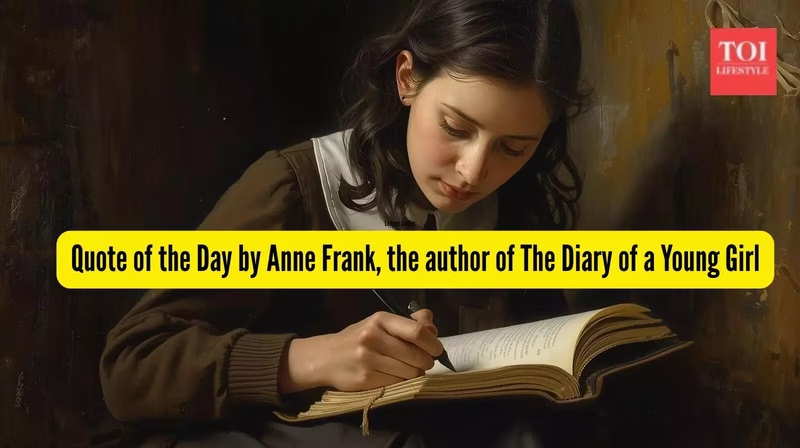
Imagine writing your deepest thoughts in a hidden attic, knowing that discovery could mean death. Now imagine those words—penned by a teenage girl during one of humanity’s darkest chapters—becoming a global symbol of hope, resilience, and faith in human nature.
That’s the miracle of the Anne Frank diary.
On January 6, 2026—a quiet Tuesday like any other—we’re reminded of a quote that cuts through the noise of cynicism: “Everyone has inside of him a piece of good news. The good news is that you don’t know how great you can be!” It’s not a polished slogan. It’s raw, tender, and astonishingly optimistic—written while hiding from the Nazis in Amsterdam. Yet, decades later, it resonates with startling urgency.
In an age of social division, digital alienation, and rising hate, Anne’s belief in the latent goodness within every person isn’t just poetic—it’s a radical act of moral courage. And understanding why her Anne Frank diary remains essential reading today is more important than ever.
Table of Contents
- Who Was Anne Frank—Beyond the Myth?
- The Anne Frank Diary: A Window Into Hidden Life
- Her Most Powerful Quote on Inner Goodness—Explained
- Why the Diary Resonates in Today’s World
- Three Lessons From Anne Frank That Still Hold True
- How to Introduce Anne Frank’s Diary to a New Generation
- Keeping Anne Frank’s Legacy Alive
- Sources
Who Was Anne Frank—Beyond the Myth?
Anne Frank wasn’t a saint. She was a 13-year-old girl—bright, moody, funny, and full of dreams. She argued with her mother, crushed on boys, and dreamed of becoming a writer. When her family went into hiding in July 1942 in a secret annex behind her father’s office, she brought one thing with her: a red-checkered diary, a gift for her 13th birthday.
Over the next 25 months, she filled it with 168 pages of reflections, fears, and philosophical musings. She didn’t know she was writing for history. She was just trying to make sense of a world that had turned against her—and her faith never wavered.
The Anne Frank Diary: A Window Into Hidden Life
Officially titled The Diary of a Young Girl, her journal was published in 1947 by her father, Otto Frank—the only family member to survive the Holocaust. It has since been translated into more than 70 languages and sold over 30 million copies worldwide .
What makes it so powerful isn’t just its historical value—it’s its emotional honesty. Anne writes about boredom, jealousy, hope, and her evolving understanding of human nature. She doesn’t just document the Holocaust; she documents the inner life of a young mind trying to stay whole in a broken world.
Her Most Powerful Quote on Inner Goodness—Explained
Her line—“Everyone has inside of him a piece of good news. The good news is that you don’t know how great you can be!”—is often quoted in schools and self-help books. But its context is crucial.
Anne wrote this in 1944, after two years in hiding, surrounded by fear and tension. She had witnessed adults at their worst—bickering, despairing, losing hope. Yet, she chose to believe in potential over despair. She wasn’t naive; she was defiantly hopeful.
This isn’t blind optimism. It’s a conscious choice to see humanity as capable of growth, even in darkness. That’s the core of the Anne Frank diary—a testament to moral imagination.
Why the Diary Resonates in Today’s World
In 2026, we face our own crises: climate anxiety, political polarization, online toxicity, and a growing sense of isolation. We’re quick to label others as “evil” or “irredeemable.” But Anne’s message flips that script.
She reminds us that cruelty is often situational—but goodness is a choice we can all make, every day. Her diary isn’t just about the past; it’s a mirror for the present. As the United States Holocaust Memorial Museum notes, “Anne’s words help us confront hatred with empathy” .
Three Lessons From Anne Frank That Still Hold True
- Hope is an act of resistance. In confinement, Anne chose to dream of becoming a journalist. Her ambition was her rebellion.
- Self-reflection builds empathy. She constantly examined her own flaws, which allowed her to understand others better—even those who frustrated her.
- Words can outlive walls. She believed her diary might “mean something” someday. Today, it teaches millions the cost of silence and the power of voice.
How to Introduce Anne Frank’s Diary to a New Generation
Many teens today find the diary “old-fashioned” or “depressing.” But it doesn’t have to be. Here’s how to make it relevant:
- Frame it as a coming-of-age story—like a real-life, high-stakes version of a modern teen journal.
- Compare her digital-free reflections to today’s curated social media personas. Anne wrote for herself, not likes.
- Pair readings with discussions on current issues: refugee crises, antisemitism, or online hate. [INTERNAL_LINK:teaching-holocaust-history-in-schools]
Keeping Anne Frank’s Legacy Alive
As the last Holocaust survivors pass away, Anne’s voice becomes even more vital. Her Anne Frank diary isn’t just a historical artifact—it’s a living invitation to choose kindness, question injustice, and believe in our own capacity for good.
On her would-be birthday or any ordinary Tuesday like today, her words challenge us: Will you assume the worst in people—or dare to believe in their hidden greatness? In that question lies the enduring power of her legacy.
Sources
- Times of India: “Quote of the day by Anne Frank’s A Diary of a Young Girl: Everyone has inside of him a piece of good news…”
- Anne Frank House official website: annefrank.org
- United States Holocaust Memorial Museum (USHMM): Educational resources on Anne Frank
- Publishing data from Penguin Random House and UNESCO on global reach of The Diary of a Young Girl