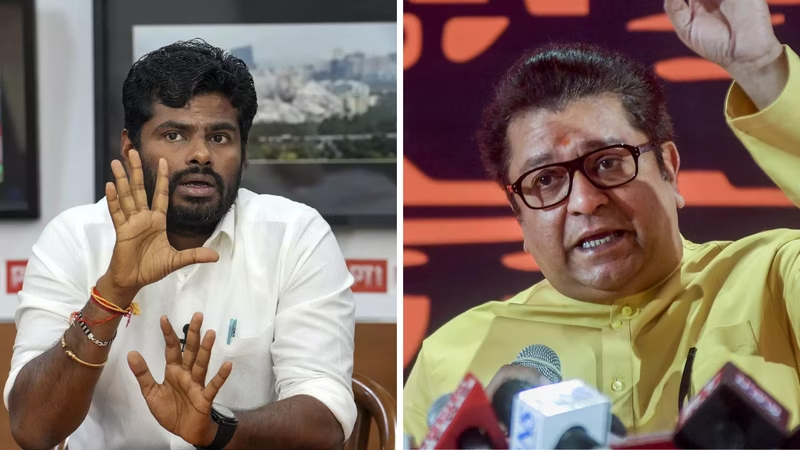
Political fireworks have erupted between Chennai and Mumbai as Tamil Nadu BJP chief K Annamalai launched a blistering counterattack against Maharashtra strongman Raj Thackeray—daring him to physically prevent his entry into the financial capital.
The feud began when Thackeray, in a recent rally, mocked Annamalai’s connection to Mumbai and questioned his right to comment on Maharashtra politics. He also revived his party’s controversial stance against North Indian migrants, vowing to expel those “imposing Hindi” in the state. In response, Annamalai didn’t just hit back—he issued a direct, provocative challenge: “I will come to Mumbai. Let him try cutting my legs.”
Table of Contents
- The Spark: What Did Raj Thackeray Say?
- Annamalai’s Fiery Response: From ‘Rasmalai’ to Legs
- Historical Context of MNS Anti-Migrant Rhetoric
- BJP’s Strategic Position in Maharashtra and Tamil Nadu
- Legal and Security Implications of the Threat
- Public Reaction and Political Fallout
- Conclusion: A Dangerous Game of Regional One-Upmanship
- Sources
The Spark: What Did Raj Thackeray Say?
During a public event in Maharashtra, Raj Thackeray targeted K Annamalai with biting sarcasm, referring to him as a “rasmalai politician”—a dig implying softness and lack of grit, contrasting with the fiery image Thackeray cultivates. He questioned why a leader from Tamil Nadu was commenting on Maharashtra’s internal affairs, especially regarding language and migration.
More significantly, Thackeray reiterated his long-standing demand that people from Bihar and Uttar Pradesh must not “impose Hindi” in Maharashtra. He warned that such migrants would be “shown the door,” echoing the aggressive nativist politics that defined his uncle Bal Thackeray’s Shiv Sena in the 1970s–90s .
Annamalai’s Fiery Response: From ‘Rasmalai’ to Legs
Annamalai, known for his combative style, dismissed the “rasmalai” jab as childish. But he didn’t stop there. In a video statement that quickly went viral, he declared: “If Raj Thackeray has the guts, let him stop me from coming to Mumbai. I’ll land at the airport, walk out—and if he tries to cut my legs, so be it.”
The imagery was deliberate and defiant. By invoking physical violence (“cutting legs”), Annamalai framed Thackeray’s rhetoric as not just political posturing but a potential incitement to real-world aggression. He added, “I’m an Indian citizen. Mumbai is as much mine as it is his.” This assertion directly challenges the ethno-regional exclusivity that underpins MNS ideology .
The Symbolism of Mumbai in Indian Politics
Mumbai isn’t just Maharashtra’s capital—it’s India’s economic nerve center and a melting pot of cultures. Politicians who claim exclusive ownership over it often do so to galvanize regional identity, but such claims risk alienating millions of migrants who power the city’s economy, from taxi drivers to tech workers.
Historical Context of MNS Anti-Migrant Rhetoric
Raj Thackeray founded the MNS in 2006 after splitting from the Shiv Sena, positioning himself as the true heir to Marathi pride. His party gained notoriety for violent campaigns against North Indian street vendors, taxi drivers, and job applicants in the late 2000s.
While such overt violence has decreased, the rhetoric persists—especially during election seasons. Analysts note that Thackeray uses anti-migrant messaging to remain relevant amid the BJP-Shiv Sena dominance in Maharashtra politics .
BJP’s Strategic Position in Maharashtra and Tamil Nadu
This clash puts the BJP in a delicate spot. In Maharashtra, it governs in alliance with Eknath Shinde’s Shiv Sena faction—a party that still trades on Marathi identity. Openly endorsing Annamalai’s defiance could strain that alliance.
Yet in Tamil Nadu, the BJP is trying to build a foothold by championing national unity and opposing Dravidian “anti-Hindi” narratives. Annamalai’s stance reinforces that message. As one strategist noted, “He’s playing to two audiences: asserting federal rights in the South while challenging parochialism in the West.”
Legal and Security Implications of the Threat
While both leaders’ statements fall under political speech, law enforcement is monitoring the situation closely. Maharashtra Police have indicated they will provide security if Annamalai visits, but also warned against inflammatory language.
Under Section 506 of the Indian Penal Code, criminal intimidation can attract up to two years in prison. While unlikely to be invoked here, the exchange highlights how political rhetoric can blur into threats—a growing concern in India’s polarized climate .
Public Reaction and Political Fallout
Social media has split along regional lines:
- Marathi netizens largely support Thackeray’s defense of local identity.
- Tamil users praise Annamalai for standing up to “Maharashtrian chauvinism.”
- National observers warn this fuels dangerous divisions at a time when unity is needed on economic and security fronts.
Opposition parties like Congress and AAP have criticized both leaders for “divisive politics,” while the Shiv Sena (UBT) accused Thackeray of “reviving hate for votes.”
Conclusion: A Dangerous Game of Regional One-Upmanship
The Annamalai Raj Thackeray clash is more than a personal spat—it’s a symptom of deeper tensions between regional identity and national integration in modern India. While Annamalai champions constitutional rights and mobility, Thackeray appeals to cultural preservation. But when political discourse veers into threats of violence—even metaphorical ones—it risks normalizing hostility. As India navigates complex demographic and linguistic realities, leaders must choose: will they build bridges, or burn them?
Sources
- Times of India: ‘Will come to Mumbai, try cutting my legs’: Annamalai fires back at Raj Thackeray
- The Hindu: “The Rise and Relevance of Raj Thackeray’s MNS” (2025)
- Indian Express: “Anti-Migrant Politics in Urban Maharashtra: A Historical Review”
- Ministry of Home Affairs: Guidelines on Hate Speech and Public Order (2024)
- Election Commission of India: Affidavits and Party Manifestos, MNS & BJP (2024)