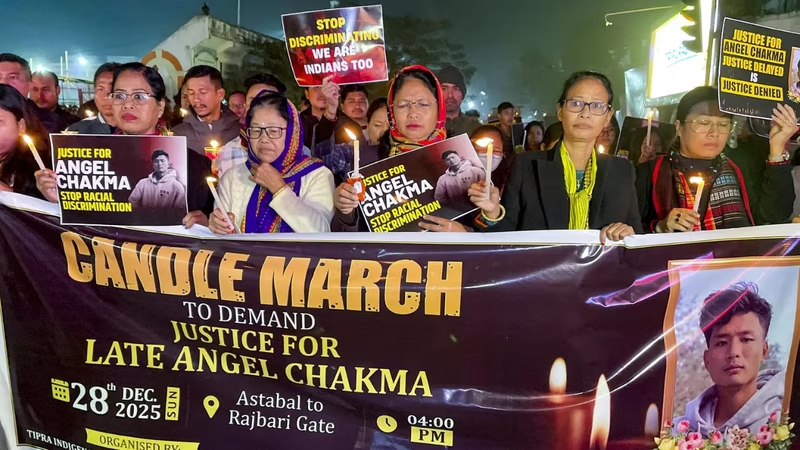
The brutal killing of **Anjel Chakma**, a 24-year-old student from Tripura, has ignited national outrage and exposed deep-seated prejudices that continue to plague India’s cosmopolitan cities. Allegedly the victim of a racially motivated attack in Dehradun, Uttarakhand, Chakma’s death has prompted urgent political intervention—with **Tripura Chief Minister Manik Saha** directly reaching out to **Uttarakhand CM Pushkar Singh Dhami** to demand immediate and impartial justice .
This isn’t just another crime report. It’s a chilling reminder of the vulnerability faced by students from India’s Northeast, who are too often targeted for their distinct features and cultural identities. As investigations unfold and arrests mount, the Anjel Chakma death case has become a flashpoint for conversations about systemic racism, student safety, and inter-state governmental accountability.
Table of Contents
- What Happened to Anjel Chakma?
- CM Manik Saha’s Direct Appeal for Justice
- Current Status of the Investigation
- Why Northeast Students Remain at Risk
- What Comes Next in the Anjel Chakma death case?
- Conclusion: A Call for Systemic Change
- Sources
What Happened to Anjel Chakma?
Anjel Chakma, a bright young woman from the Chakma community in Tripura, was pursuing her studies in Dehradun—a city known for its educational institutions but also, sadly, for recurring incidents of racial abuse against students from the Northeast.
According to police reports, Chakma was attacked in an unprovoked assault that bore clear signs of racial motivation. The incident left her with severe injuries, and she later succumbed to them in hospital . Eyewitnesses and local activists say the attackers made derogatory remarks referencing her ethnicity, a pattern all too familiar to many from the region .
Her death has sent shockwaves through Tripura and across India’s Northeast, where community leaders are calling it not just a murder—but a hate crime.
CM Manik Saha’s Direct Appeal for Justice
In a rare and pointed inter-state move, Tripura Chief Minister Manik Saha personally dialed Uttarakhand CM Pushkar Singh Dhami to express his grief and demand a thorough, transparent investigation .
Saha emphasized that such attacks not only take innocent lives but also deter students from the Northeast from pursuing education in other parts of the country. He urged Dhami to ensure that the perpetrators are brought to justice without delay and that systemic measures are put in place to prevent future incidents.
This high-level intervention underscores the political gravity of the case and the growing pressure on state governments to protect students from marginalized communities.
Current Status of the Investigation
Uttarakhand Police have responded swiftly to the case:
- Five suspects have been arrested in connection with the assault .
- A manhunt is underway for a sixth accused, who remains at large.
- Authorities are also coordinating with Nepalese officials to track down a fugitive believed to have fled across the border .
Police have confirmed the attack was racially charged, and prosecutors are considering whether to invoke provisions under India’s stringent anti-racism guidelines and the Scheduled Castes and Scheduled Tribes (Prevention of Atrocities) Act, although applicability is under legal review .
The case has been fast-tracked, with daily monitoring ordered by senior police officials in Dehradun.
Why Northeast Students Remain at Risk
Despite repeated assurances from central and state governments, students from India’s Northeast continue to face discrimination and violence in major Indian cities. A 2017 committee formed after the murder of Nido Taniam in Delhi had recommended concrete steps—including sensitization programs for police and public—but implementation has been patchy at best .
Common challenges include:
- Lack of cultural awareness among local populations.
- Inadequate police response to hate-based incidents.
- Insufficient hostel security and institutional support in educational hubs like Dehradun, Bengaluru, and Delhi.
[INTERNAL_LINK:northeast-student-safety-india] For more on systemic gaps, read our deep dive on student safety for Northeast communities.
According to data from the North East Support Centre & Helpline, over 200 incidents of racial abuse against Northeasterners were reported in 2024 alone—many of them in educational settings .
What Comes Next in the Anjel Chakma death case?
As public pressure mounts, several developments are likely:
Possible Legal Escalation
Human rights organizations and student bodies are demanding that the case be handed over to the Central Bureau of Investigation (CBI) to ensure impartiality. Given the political sensitivity, this request may gain traction.
Policy Reforms
Both Tripura and Uttarakhand may be pushed to adopt the long-pending recommendations of the Bezbaruah Committee, which include creating special police cells, helplines, and fast-track courts for crimes against Northeasterners .
National Reckoning
The Anjel Chakma death case could become a catalyst for a broader national conversation on racism in India—much like the Nido Taniam case did a decade ago. The difference now? Social media and political will may force faster action.
For expert analysis on hate crime legislation in India, see this comprehensive overview from [EXTERNAL_LINK:https://www.humanrights.gov.in/].
Conclusion: A Call for Systemic Change
The death of Anjel Chakma is more than a tragic news story—it’s a searing indictment of a society that still judges people by their appearance. While the arrest of suspects is a necessary step, true justice will only come when systemic biases are confronted and dismantled.
Tripura CM Manik Saha’s intervention is commendable, but it must be followed by concrete policy changes, not just in Uttarakhand but across the country. Every student, regardless of where they come from, deserves to study in safety and dignity. The Anjel Chakma death case must be the last of its kind—not just another footnote in a long history of ignored pleas for equality.
Sources
- Times of India: Anjel Chakma death case: Tripura CM dials Dhami
- Indian Express: Sixth accused in Anjel Chakma case may have fled to Nepal
- The Wire: Racial Attacks on Northeast Indians: A Persistent Crisis
- Hindustan Times: Legal Recourse in Racially Motivated Crimes in India
- Ministry of Home Affairs (Govt. of India): Bezbaruah Committee Report on Safety of People from Northeast
- North East Support Centre & Helpline Annual Report 2024: Incident Data on Racial Abuse