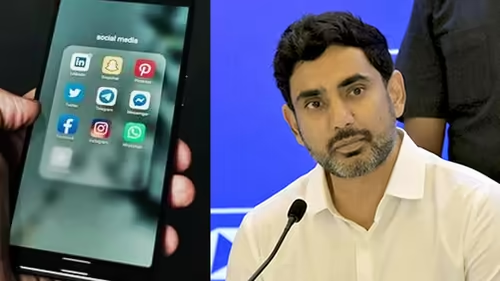
Imagine a world where your 14-year-old can’t scroll through Instagram, post on Snapchat, or even have a Facebook account. It sounds like a digital dystopia to some, but for the Andhra Pradesh government, it’s a potential reality they’re actively exploring. In a significant development aimed at curbing the rampant spread of fake news and protecting vulnerable users, the state has formed a Group of Ministers (GoM) to study the feasibility of a sweeping social media ban for children under the age of 16 .
This isn’t just a knee-jerk reaction. The proposal is directly inspired by a groundbreaking law passed halfway across the globe in Australia. But what does this mean for families in Andhra Pradesh? Is it a necessary shield for our children, or a heavy-handed step that infringes on their digital future? Let’s break it all down.
Table of Contents
- Why Andhra is Considering a Social Media Ban for Children
- The Australian Blueprint: What’s the Model?
- The Andhra Pradesh GoM Plan: Beyond Just a Ban
- Key Players and Their Stance
- The Great Debate: Pros and Cons of a Social Media Ban for Children
- Conclusion: A Complex Challenge Demands a Nuanced Solution
- Sources
Why Andhra is Considering a Social Media Ban for Children
The primary driver behind this move is a growing concern over the toxic online environment. The state government has been alarmed by the surge in:
- Misinformation and Fake News: Viral falsehoods that can incite panic, damage reputations, and even threaten public order.
- Online Abuse and Cyberbullying: Particularly targeting women and children, leading to severe mental health consequences .
- Exposure to Harmful Content: Young minds are often not equipped to process the barrage of inappropriate, violent, or psychologically damaging content readily available online .
The GoM’s mandate is clear: to recommend measures that hold social media platforms accountable for the content on their sites and to create a safer digital space for Andhra’s citizens .
The Australian Blueprint: What’s the Model?
Andhra Pradesh isn’t inventing the wheel; it’s looking to Australia’s recently enacted Online Safety Act 2021 as a template. The key feature of this law is its social media ban for children under 16 .
From December 10, 2025, major social media platforms in Australia will be legally prohibited from allowing users under 16 to create or maintain accounts . Crucially, the onus is not on the child or their parents, but on the tech companies themselves. Platforms must implement robust age-verification systems and face hefty fines if they fail to comply . This shifts the responsibility from the individual user to the corporate gatekeepers of the digital world .
The Andhra Pradesh GoM Plan: Beyond Just a Ban
While the headline-grabbing element is the potential age restriction, the GoM’s scope is far broader. Their mission is to draft comprehensive legislation that tackles the root of the problem. This includes:
- Drafting a State-Level Bill: The GoM is working on a bill that would specifically target the spread of false information and abusive content on digital platforms within the state .
- Platform Accountability: The proposed law aims to make social media companies legally responsible for harmful content that isn’t removed in a timely manner .
- Central Government Coordination: Recognizing that internet regulation is primarily a central subject, the state may use its findings to push for a nationwide framework, urging the Union government to take stronger action .
Key Players and Their Stance
The initiative is being spearheaded by a powerful committee. IT and HRD Minister Nara Lokesh has been a vocal advocate for this move, publicly confirming that the government is studying the Australian model to protect children from harmful online content [[2], [29]]. The Home Minister, Vangalapudi Anitha, has also taken a hard stance, warning of serious legal consequences, including sedition charges, for those who deliberately spread false and inflammatory posts on social media . This unified front from the state’s leadership signals a serious intent to reshape the digital landscape.
The Great Debate: Pros and Cons of a Social Media Ban for Children
Any policy this sweeping is bound to spark intense debate. Here’s a balanced look at both sides of the argument.
The Case For the Ban
- Protection from Irreversible Harm: Young brains are still developing. Shielding them from cyberbullying, predatory behavior, and unrealistic social comparisons can prevent long-term psychological damage.
- Curbing Misinformation at the Source: By limiting the primary audience for viral fake news, the ecosystem that fuels its creation could be weakened.
- Forcing Tech Accountability: As seen in Australia, such a law compels global tech giants to invest in better safety infrastructure, which benefits all users.
The Case Against the Ban
- Enforcement Challenges: How can you effectively verify a user’s age online? Tech-savvy teens will likely find workarounds, rendering the ban ineffective for its most at-risk group.
- Digital Literacy vs. Digital Abstinence: Critics argue that instead of banning access, we should be teaching children critical thinking and digital literacy skills to navigate the online world safely—a more sustainable long-term solution.
- Potential for Overreach: There are concerns that such a law could be misused to stifle legitimate free speech and dissent, especially in a politically charged environment.
For a deeper look at the national conversation, see our analysis on [INTERNAL_LINK:india-digital-regulation-landscape].
Conclusion: A Complex Challenge Demands a Nuanced Solution
The Andhra Pradesh government’s consideration of a social media ban for children is a stark response to a very real and urgent problem. While the Australian model offers a compelling framework for holding tech companies accountable, a simple copy-paste approach may not suffice for India’s unique socio-technical context. The true test will be whether the final legislation focuses not just on restriction, but on building a holistic ecosystem of digital safety that includes education, parental guidance, and robust platform governance. The GoM’s recommendations will be a crucial litmus test for how India balances the need for protection with the principles of a free and open internet.
Sources
- Times of India: ‘Want to curb fake news’: Andhra weighs Australia-style social media ban for children
- Australian Government – eSafety Commissioner: Social media age restrictions
- Parliament of Australia: Online Safety Act 2021
- The Hindu: Andhra Pradesh forms ministerial panel to regulate social media, curb misinformation