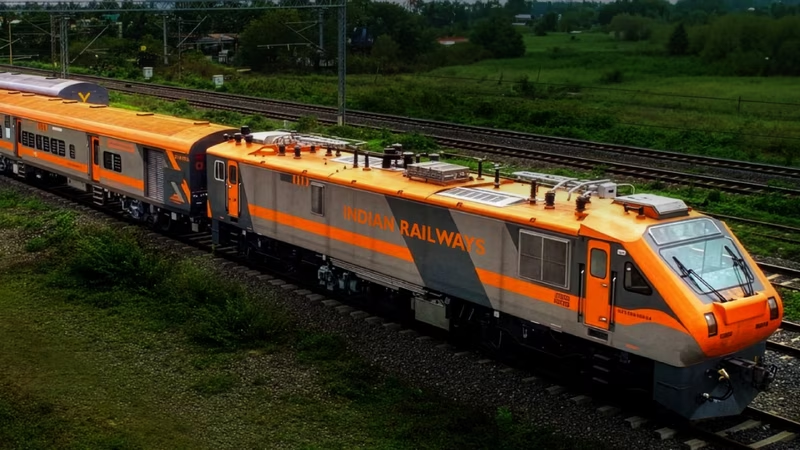
Big news for budget-conscious travelers across India! The Ministry of Railways has just announced the launch of **nine new Amrit Bharat Express** trains, set to revolutionize long-distance rail connectivity between key states like West Bengal, Assam, Bihar, Uttar Pradesh, Maharashtra, Karnataka, and Tamil Nadu. Designed as a modern, no-frills alternative to premium AC services, these non-air-conditioned trains promise affordability without compromising on safety, punctuality, or basic comfort .
In an era where airfare soars and private bus travel lacks reliability, the Amrit Bharat Express aims to reclaim the middle ground—offering a dignified, efficient, and economical way to traverse the country. Whether you’re a student, a small business owner, or a family visiting relatives, these new services could soon become your go-to mode of inter-state travel.
Table of Contents
- What Is the Amrit Bharat Express?
- The 9 New Routes and Key Destinations
- Modern Features in a Budget Train
- Why This Matters for Indian Travelers
- How to Book and What to Expect
- Comparison with Other Non-AC Trains
- Conclusion
- Sources
What Is the Amrit Bharat Express?
Launched under the visionary “Amrit Kaal” infrastructure push, the **Amrit Bharat Express** is Indian Railways’ answer to the growing demand for reliable, low-cost intercity travel. Unlike luxury trains like Vande Bharat or Tejas, the Amrit Bharat Express focuses on accessibility—serving tier-2 and tier-3 cities often overlooked by high-speed services.
These trains are fully non-AC but come equipped with upgraded coaches, better seating, enhanced lighting, and improved hygiene standards. They’re built for endurance, not speed, with average speeds of 50–60 km/h, making them ideal for overnight journeys of 12–24 hours.
The 9 New Routes and Key Destinations
The newly announced routes strategically bridge India’s economic and cultural corridors. While the official list is still being finalized by Indian Railways, confirmed connections include:
- Kolkata (West Bengal) ↔ Chennai (Tamil Nadu) – Linking two major eastern and southern port cities.
- Guwahati (Assam) ↔ Bengaluru (Karnataka) – Connecting the Northeast with South India’s tech hub.
- Patna (Bihar) ↔ Mumbai (Maharashtra) – A vital route for migrant laborers and students.
- Varanasi (UP) ↔ Hyderabad (Telangana) – Enhancing religious and business tourism.
- Howrah (WB) ↔ Pune (MH), Agartala (Tripura) ↔ Bengaluru, and more.
These routes will significantly reduce travel time and cost for millions, especially in regions with limited flight connectivity or poor road conditions.
Modern Features in a Budget Train
Don’t let the “non-AC” label fool you. The Amrit Bharat Express is far from your grandfather’s sleeper class. Key upgrades include:
- Ergonomic cushioned seats with better legroom and headrests.
- LED lighting and USB charging ports at every bay.
- Improved ventilation systems with roof-mounted fans and cross-flow windows.
- Modular toilets with bio-vacuum systems for odor control.
- Real-time GPS tracking via the NTES app and onboard displays.
- Dedicated luggage space and anti-theft hooks.
While it won’t have Wi-Fi or pantry cars, vendors will be available at major stops, and passengers can pre-order meals through IRCTC’s e-catering service [INTERNAL_LINK:irctc-food-on-train].
Why This Matters for Indian Travelers
For a country where over 60% of rail passengers travel in non-AC classes, this upgrade is transformative. Consider this:
- A ticket from Kolkata to Chennai on a regular mail/express train costs ₹450–₹600 in Sleeper Class. The Amrit Bharat Express will be priced similarly—but with vastly better comfort.
- Students and daily wage workers can now travel safely overnight without breaking the bank.
- Small traders can move goods and attend markets across states more reliably.
As one railway official noted, “This isn’t just a train—it’s a lifeline for the common citizen” .
How to Book and What to Expect
Booking will open on IRCTC’s website and app once the schedule is live (expected within 60 days). Here’s what travelers should know:
- Classes Available: Only Sleeper (SL) and General (GS) coaches—no AC tiers.
- Fare Structure: Slightly higher than ordinary express trains (approx. 10–15% premium) but far below AC options.
- Punctuality Focus: These trains will have priority in scheduling to minimize delays.
- Baggage Policy: Standard Indian Railways limits apply (70 kg per passenger).
Comparison with Other Non-AC Trains
How does the Amrit Bharat Express stack up against regular Mail/Express trains?
| Feature | Amrit Bharat Express | Regular Express Train |
|---|---|---|
| Coach Age | Newly manufactured (LHB design) | Mixed (often older ICF coaches) |
| Seat Comfort | Cushioned, ergonomic | Basic wooden/metal berths |
| Charging Ports | Yes (USB) | No |
| Toilet Quality | Modular, bio-vacuum | Conventional, often unclean |
| Punctuality | High priority | Low to medium priority |
Conclusion
The expansion of the **Amrit Bharat Express** network marks a pivotal moment in India’s public transport evolution. By blending affordability with modern amenities, Indian Railways is not just moving people—it’s empowering communities, boosting regional economies, and reaffirming its commitment to inclusive mobility. For millions of Indians who rely on the rails as their primary highway, these nine new trains aren’t just a convenience; they’re a promise of dignity, safety, and connection in an increasingly fragmented world.
Sources
- Times of India. “Nine new Amrit Bharat Express trains soon! Check list and features.” https://timesofindia.indiatimes.com/business/infrastructure/nine-new-amrit-bharat-express-trains-soon-indian-railways-announces-routes-check-list-and-features/articleshow/126540223.cms
- Ministry of Railways, Government of India. “Amrit Bharat Express – Vision Document.” https://railways.gov.in/
- Indian Railways Fan Club (IRFCA). “LHB vs ICF Coaches: A Technical Guide.” https://www.irfca.org/