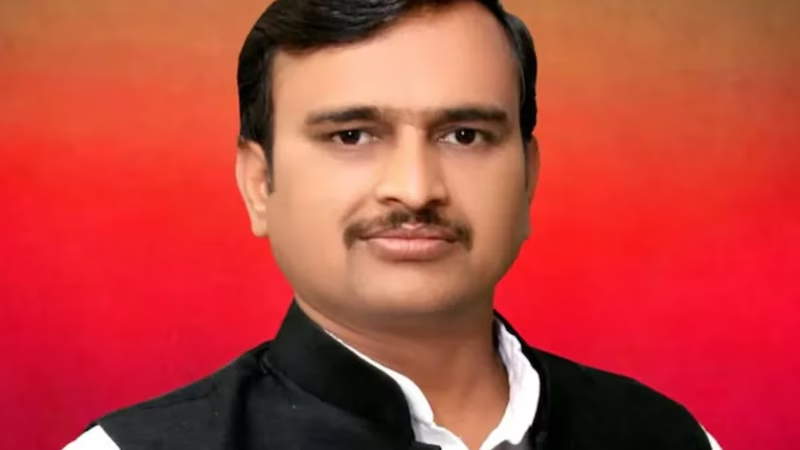
It was supposed to be a quiet evening at home. Instead, Samajwadi Party (SP) leader Amrendra Nishad found himself staring down the barrel of a gun—held by his own cousin. In a chilling incident that blurred the lines between family drama and political violence, Nishad narrowly escaped death when a bullet fired at close range missed his chest at his Gorakhpur residence .
The accused, identified as Ravindra Nishad, was swiftly taken into police custody. But as investigators dig deeper, questions are mounting: Was this a personal grudge? A property dispute? Or something more sinister tied to Uttar Pradesh’s volatile political landscape? The Amrendra Nishad shooting isn’t just a crime—it’s a potential flashpoint in a state already on edge.
Table of Contents
- What Happened: The Gorakhpur Shooting Incident
- Who Is Amrendra Nishad? A Political Profile
- The Accused: Ravindra Nishad – Motive and Background
- Amrendra Nishad Shooting: Political Implications in UP
- Family Feuds and Political Violence in India
- What Happens Next: Legal and Security Ramifications
- Conclusion: A Wake-Up Call for Political Security
- Sources
What Happened: The Gorakhpur Shooting Incident
According to police reports, the incident occurred at Amrendra Nishad’s residence in Gorakhpur late Monday night . His cousin, Ravindra Nishad, allegedly arrived unannounced and, in a sudden confrontation, pulled out a firearm and fired a single shot.
Miraculously, the bullet missed Nishad’s chest—likely saving his life—and he was unharmed physically. Eyewitnesses confirmed the altercation, and local police responded within minutes. Ravindra was arrested on the spot, and a country-made pistol was recovered from him .
Investigators are now probing whether this was premeditated and whether other individuals were involved. No formal motive has been confirmed, but sources suggest a long-standing family dispute may be at the root.
Who Is Amrendra Nishad? A Political Profile
Amrendra Nishad is a prominent grassroots leader of the Samajwadi Party in eastern Uttar Pradesh. While not a sitting MLA or MP, he wields significant influence in Gorakhpur and surrounding districts—areas that have seen intense political competition between the SP, BJP, and BSP .
His community ties, organizational reach, and ability to mobilize voters make him a valuable asset for the SP, especially as Uttar Pradesh gears up for upcoming municipal and state-level contests. Any threat to such a figure sends ripples through the party’s local machinery.
The Accused: Ravindra Nishad – Motive and Background
Ravindra Nishad, the suspect, is not just a distant relative—he’s a first cousin, sharing the same grandfather. Police sources indicate the two had been embroiled in a bitter property dispute over ancestral land in Gorakhpur’s Khajani area .
In many parts of rural UP, land and inheritance conflicts can escalate into violence, especially when political clout is involved. The fact that Amrendra held sway in local circles may have intensified the resentment. However, authorities are not ruling out other angles, including possible political instigation—a common tactic in India’s competitive political theater .
Amrendra Nishad Shooting: Political Implications in UP
The timing of this attack is particularly sensitive. With the 2027 Uttar Pradesh Assembly elections on the horizon, every local leader counts. The SP, under Akhilesh Yadav, is aggressively rebuilding its base after losing power in 2017 and 2022.
An attack on a loyalist—even if personal—can be weaponized for political messaging. The SP may use this incident to highlight “insecurity under BJP rule,” while the ruling party could downplay it as a private family matter. Either way, the Amrendra Nishad shooting has already become a talking point in political circles.
Family Feuds and Political Violence in India
This case underscores a disturbing trend: the intersection of kinship and political power in India. According to data from the National Crime Records Bureau (NCRB), over 30% of violent crimes in rural UP involve family or clan disputes—many exacerbated by political affiliations .
When a family member holds political office or influence, disputes over land, money, or status can quickly turn deadly. The mixing of personal vendettas with public roles creates a dangerous cocktail that law enforcement often struggles to disentangle.
What Happens Next: Legal and Security Ramifications
Ravindra Nishad is currently in police custody and will likely be charged under Section 307 (attempt to murder) and the Arms Act. If convicted, he could face life imprisonment.
Meanwhile, Amrendra Nishad has reportedly requested enhanced security from the state government. Given the incident occurred at his private residence, questions are being raised about the adequacy of protection for mid-level political figures—especially those in high-risk regions like Gorakhpur.
For more on political safety protocols in India, see our analysis on [INTERNAL_LINK:security-for-political-leaders-india].
Conclusion: A Wake-Up Call for Political Security
The Amrendra Nishad shooting is a grim reminder that violence in Indian politics doesn’t always come from rival parties—it can emerge from within one’s own family. While the immediate threat appears contained, the broader implications for political culture, security, and kinship dynamics in Uttar Pradesh cannot be ignored.
As investigations continue, one thing is clear: in a state where politics is personal, personal conflicts can become public crises overnight.
Sources
- Times of India: “UP Samajwadi Party leader Amrendra Nishad narrowly escapes after being shot at by cousin”
- ABP News: “Samajwadi Leader Shot by Cousin in Gorakhpur; Accused Arrested”
- The Wire: “Political Networks in Eastern Uttar Pradesh”
- Local Police Statement, Gorakhpur District, December 30, 2025
- NCRB Crime in India Report 2024