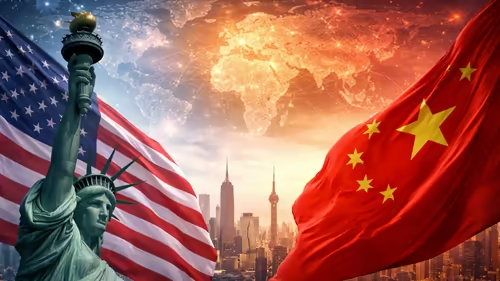
For over a decade, the relationship between the United States and China has been framed as an existential battle—a new Cold War where compromise is weakness and engagement is surrender. Politicians from both parties have stoked fears of a rising “Red” menace, painting a picture of inevitable conflict. But what if the American people are no longer buying it?
A stunning new report from the Chicago Council on Global Affairs reveals a dramatic and largely unreported shift in the Americans view of China. The data paints a picture of a public that is weary of confrontation, skeptical of economic decoupling, and surprisingly open to the idea that a Chinese-led world might not be the catastrophe they’ve been told to expect.
Table of Contents
- The Surprising 2025 Chicago Council Survey Findings
- From Fear to Pragmatism: Why Attitudes Are Shifting
- Americans View of China Overtaking the US
- The Washington Consensus vs. The American Public
- What This Means for the Future of US-China Relations
- Conclusion: A Quiet Revolution in Public Opinion
- Sources
The Surprising 2025 Chicago Council Survey Findings
The 2025 Chicago Council Survey, a highly respected and long-running public opinion poll, has uncovered a seismic change in how ordinary Americans think about their nation’s most significant geopolitical rival [[3]].
Gone is the near-universal hostility. In its place is a complex, nuanced, and often pragmatic outlook that stands in stark contrast to the hawkish rhetoric emanating from Capitol Hill. Here are the key takeaways:
- Engagement Over Confrontation: A clear majority of Americans (53%) now believe the U.S. should adopt a policy of cooperation and engagement with China, a significant increase from previous years [[14]].
- Rejection of Economic Warfare: The public is firmly against the use of tariffs as a weapon. Most respondents oppose higher tariffs on Chinese goods, recognizing the direct cost to their own wallets [[6]].
- No Appetite for Military Conflict: There is overwhelming opposition to any military action or escalation that could lead to a direct conflict with China [[7]].
- End of Bipartisan Hawkishness: The survey notes that the once-bipartisan consensus on aggressive competition with China “no longer holds among the public” [[3]].
This isn’t just a minor fluctuation; it’s a fundamental reorientation of public sentiment. As one analysis put it, “United States politicians who embrace disengaging from and limiting China are no longer in step with the American public” [[2]].
From Fear to Pragmatism: Why Attitudes Are Shifting
So, what’s driving this remarkable change? Several factors are at play.
First, the constant drumbeat of anti-China rhetoric has failed to translate into tangible benefits for the average American. Decades of promises that tough policies would bring back manufacturing jobs have largely gone unfulfilled. Instead, consumers see the prices of everyday goods rise due to tariffs.
Second, there’s a growing sense of war-weariness. After two decades of conflict in the Middle East, the American public is deeply skeptical of entering into another open-ended strategic rivalry that could have catastrophic consequences. The potential for a conflict with a nuclear-armed power like China is a risk most are unwilling to take.
Third, the world has changed. Global challenges like climate change and future pandemics require international cooperation. Many Americans intuitively understand that solving these problems is impossible without working alongside China, the world’s second-largest economy. This pragmatic view is a far cry from the ideological purity of the “Red Scare.” For more on the global context of this shift, see our deep dive on [INTERNAL_LINK:global-power-dynamics-in-2026].
Americans View of China Overtaking the US
Perhaps the most profound finding is the changing attitude towards China’s economic rise. For years, the prospect of China’s GDP surpassing America’s was treated as a national emergency. But the new data suggests a surprising level of acceptance.
While a majority of Americans still believe the U.S. is the world’s leading economic power, the fear associated with China’s ascent has noticeably diminished [[20]]. The question is no longer just “Will China overtake the US?” but rather, “Would our lives actually get worse if it did?”
This subtle but critical shift in perspective indicates that many Americans are beginning to separate economic leadership from their personal quality of life. They are less convinced by the zero-sum narrative that a stronger China automatically means a weaker America. This pragmatic assessment is a key driver behind the move towards engagement.
The Washington Consensus vs. The American Public
The chasm between the views of the political elite in Washington and the general public has never been wider on this issue. In the capital, a bipartisan coalition continues to push for technological decoupling, massive military spending in the Pacific, and a containment strategy reminiscent of the Cold War.
Yet, the Chicago Council data shows this approach lacks a popular mandate. The American public is signaling a desire for a more balanced and realistic foreign policy—one that protects core interests without seeking to isolate or contain China. This disconnect presents a significant challenge for policymakers who must either find a way to align their strategies with public sentiment or risk a growing crisis of legitimacy in their foreign policy decisions.
What This Means for the Future of US-China Relations
This shift in the Americans view of China could have far-reaching implications. If sustained, it could create political space for the next administration to pursue a more stable and predictable relationship with Beijing.
We might see a move away from blanket tariffs and towards targeted negotiations on specific issues like intellectual property or market access. It could also lead to a renewed focus on areas of mutual interest, such as climate cooperation or global health security.
However, powerful vested interests in the defense and tech sectors, along with a media ecosystem that often thrives on conflict, will likely resist this change. The path from public opinion to actual policy is rarely a straight line.
Conclusion: A Quiet Revolution in Public Opinion
The era of the simplistic “Red Scare” may be coming to an end, at least in the minds of the American people. The 2025 Chicago Council Survey reveals a public that is more sophisticated, pragmatic, and peace-oriented than its leaders often assume. They are not naive about the challenges posed by China, but they are also not willing to sacrifice their economic well-being or risk global stability on the altar of an abstract geopolitical rivalry. This quiet revolution in public opinion is a crucial development that anyone interested in the future of US-China relations cannot afford to ignore.
Sources
- Chicago Council on Global Affairs. “Americans Reverse Course on US-China Competition.” October 28, 2025. https://globalaffairs.org/research/public-opinion-survey/americans-reverse-course-us-china-competition [[3]]
- China Daily. “US public sees China in more positive light.” November 12, 2025. https://www.chinadaily.com.cn/a/202511/12/WS6914a039a310d6866eb292c4.html [[2]]
- People’s Daily. “US think tank survey finds majority of Americans say…” October 29, 2025. https://en.people.cn/n3/2025/1029/c90000-20383345.html [[9]]
- Chicago Council on Global Affairs. “American Views of China Hit All-Time Low.” October 24, 2024. https://globalaffairs.org/research/public-opinion-survey/american-views-china-hit-all-time-low [[20]]