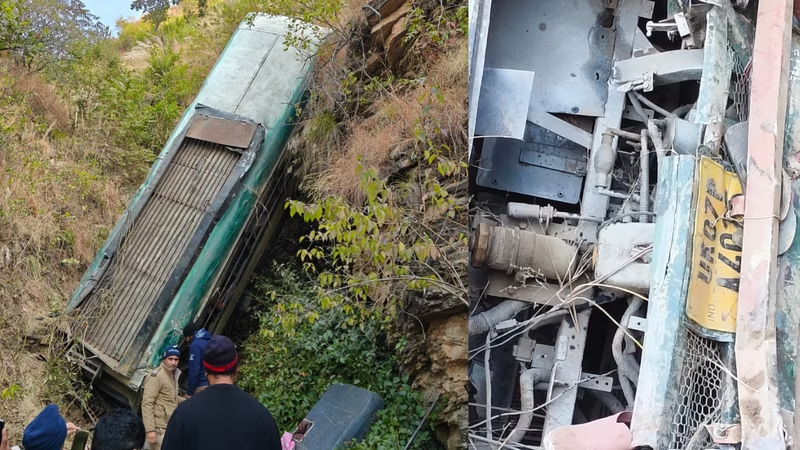
A serene morning in the Kumaon hills turned into a scene of horror on Tuesday when a passenger bus lost control on a narrow mountain road near Sailapani in Almora district, Uttarakhand, and plunged into a deep gorge. The tragic **Almora bus accident** has left at least six people dead and several others critically injured, triggering a large-scale rescue operation in one of the most challenging terrains in northern India. As emergency teams rappel down steep cliffs and local villagers assist with stretchers, questions are mounting about road safety on Himalayan routes that millions depend on daily.
Table of Contents
- The Tragic Incident: What Happened in Almora?
- Almora Bus Accident: Rescue Challenges in Mountain Terrain
- Victims and Survivors: Who Was on the Bus?
- Why Uttarakhand Roads Are So Dangerous
- Government Response and Road Safety Reforms
- Conclusion: A Call for Safer Himalayan Travel
- Sources
The Tragic Incident: What Happened in Almora?
According to preliminary reports from Uttarakhand police, the ill-fated bus was traveling from Dwarahat to Ramnagar—a common inter-district route through the Kumaon region—when it veered off the road near Sailapani around mid-morning . Eyewitnesses described hearing a loud crash followed by silence, then cries for help echoing from the gorge . The vehicle, carrying over 30 passengers, tumbled down a steep ravine estimated to be 200–300 feet deep, leaving it mangled beyond recognition .
Local residents were the first responders, rushing to the site with ropes and basic medical supplies before official teams arrived. “We could see the bus hanging off a ledge—it was terrifying,” said one villager who assisted in the initial evacuation .
Almora Bus Accident: Rescue Challenges in Mountain Terrain
Rescue operations were immediately hampered by the area’s extreme topography. Narrow, unpaved access paths, unstable soil, and dense forest cover made it impossible for ambulances or heavy machinery to reach the crash site directly . Teams from the State Disaster Response Force (SDRF), local police, and even forest department personnel had to descend on foot with stretchers and medical kits.
Helicopters from the Indian Air Force were deployed for aerial assessment and to airlift the most critical survivors once they were brought to a clearing. “This is one of the most difficult extrication missions we’ve handled this season,” said an SDRF officer on site . The operation continued well into the night, with thermal drones scanning the gorge for any missed survivors.
Victims and Survivors: Who Was on the Bus?
While the full passenger manifest is still being verified, local officials confirm that the deceased include men, women, and possibly children from rural Almora and neighboring districts . Many were daily wage laborers, students, and elderly residents traveling for medical appointments or family visits—routine journeys that ended in catastrophe.
Survivors, some with multiple fractures and head injuries, have been rushed to district hospitals in Almora and Haldwani. Relatives have gathered outside emergency wards, anxiously awaiting news. “My brother was going to sell vegetables in Ramnagar. He called me just before—then nothing,” shared one distraught family member .
Why Uttarakhand Roads Are So Dangerous
This **Almora bus accident** is not an isolated event. Uttarakhand records some of India’s highest road fatality rates per kilometer, especially on mountain highways. Contributing factors include:
- Narrow, winding roads with minimal guardrails or signage.
- Landslide-prone slopes exacerbated by deforestation and unregulated construction.
- Aging public transport fleet with poor maintenance standards.
- Monsoon and winter weather that erodes road surfaces and reduces visibility.
- Lack of enforcement of speed limits and vehicle safety checks in remote areas.
The Comptroller and Auditor General (CAG) of India has repeatedly flagged these risks in its infrastructure audits, urging urgent investment in hill road engineering .
Government Response and Road Safety Reforms
In the wake of the crash, Uttarakhand Chief Minister Pushkar Singh Dhami expressed deep sorrow and announced ex-gratia compensation of ₹5 lakh to the families of the deceased and ₹50,000 for the injured . More importantly, he directed the Public Works Department to conduct an immediate safety audit of all hill routes in Almora and neighboring districts.
Activists and transport unions are now renewing calls for systemic change, including:
- Mandatory installation of GPS and speed governors in all inter-district buses.
- Construction of retaining walls and crash barriers at high-risk curves.
- Regular geotechnical monitoring of landslide zones.
- Community-based early warning systems for local drivers.
Conclusion: A Call for Safer Himalayan Travel
The **Almora bus accident** is a heart-wrenching reminder that development in ecologically fragile regions must prioritize human safety over speed or cost-cutting. For the people of Uttarakhand, mountain roads are lifelines—not just scenic routes. As rescue efforts wind down and mourning begins, the true measure of response will be whether this tragedy sparks lasting reform. Until then, every bus that winds through the Kumaon hills carries not just passengers, but the weight of systemic neglect.
Sources
- Times of India: Uttarakhand road mishap: 6 dead as bus falls into gorge in Almora
- Uttarakhand Police & SDRF Official Statements: , , , , , , ,
- CAG Reports on Hill Road Safety:
- Government of Uttarakhand Press Release: