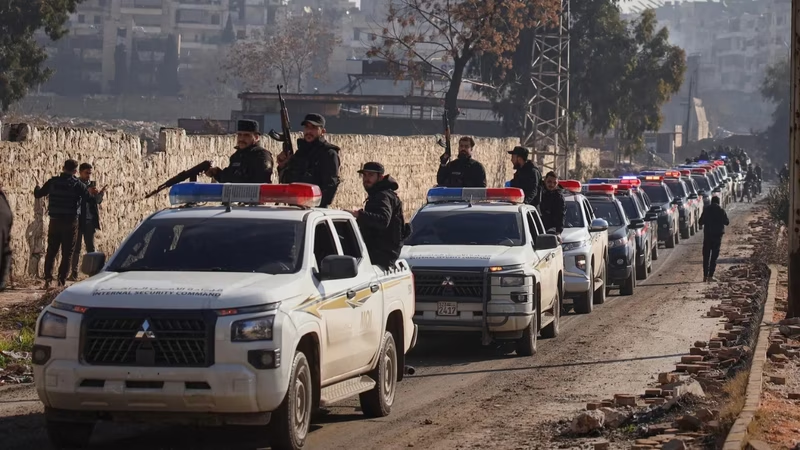
The dust is barely settling over Aleppo, but the political landscape of Syria has already been irrevocably altered. In a swift and brutal military operation, the Syrian government has seized control of Sheikh Maqsoud, the final district in the city that had remained outside its grasp for years. This victory not only marks the end of an era for the embattled metropolis but also raises urgent questions about the fate of its Kurdish population and the broader trajectory of the Syrian civil war.
Table of Contents
- The Fall of Aleppo’s Last Holdout
- Who Lives in Sheikh Maqsoud? A History of Resilience
- The Evacuation Deal and the Detentions
- What This Means for Syria’s Civil War
- Conclusion: A City Unified, But At What Cost?
- Sources
The Fall of Aleppo’s Last Holdout
For over a decade, the sprawling neighborhood of Sheikh Maqsoud stood as a defiant island of Kurdish self-administration in the heart of a city torn apart by conflict. Its capture on January 10, 2026, by Syrian government forces signifies the complete consolidation of state authority over all of Aleppo for the first time since the early days of the civil war . The operation, which followed days of intense bombardment and street fighting, culminated in the Syrian Army announcing the “completion of clearing operations” in the district . This development effectively ends a long-standing, albeit fragile, status quo that had kept the neighborhood semi-autonomous.
Who Lives in Sheikh Maqsoud? A History of Resilience
Understanding the significance of this event requires looking back. Sheikh Maqsoud is not just any neighborhood; it’s one of Aleppo’s largest and has been a traditional stronghold for the city’s Kurdish community . During the height of the civil war, while other parts of Aleppo were battlegrounds between rebels and the regime, Sheikh Maqsoud and its neighbor Ashrafieh were largely controlled by local branches of the YPG (People’s Protection Units), the main component of the Syrian Democratic Forces (SDF) . This unique position made it a strategic pressure point, caught between various warring factions . Its geography and demographics have long defined its complex role in the conflict, serving as a key buffer zone.
The Evacuation Deal and the Detentions
The government’s advance was not without negotiation. After issuing ultimatums and setting deadlines for civilians and fighters to leave , a deal was reportedly struck to facilitate the evacuation of Kurdish fighters. On Sunday, January 11, 2026, the last of these fighters, who had been holed up in a hospital, withdrew from the city under this agreement . The governor of Aleppo confirmed that the final SDF elements had departed, leaving the Syrian army in full control .
However, this apparent resolution is marred by a deeply troubling development. As their forces moved in, Syrian security personnel detained approximately 300 Kurds, including members of the local Asayish (security) forces . This mass detention casts a long shadow over the government’s claims of restoring order and raises serious concerns about potential reprisals against the civilian population that remains.
What This Means for Syria’s Civil War
The fall of Sheikh Maqsoud is a major strategic and symbolic win for President Bashar al-Assad’s government. It demonstrates a renewed capacity for large-scale military operations in urban centers and a willingness to challenge even its former, uneasy allies like the SDF. This move could be seen as part of a broader strategy to reassert central government control over all of Syria’s major population centers, a goal that seemed distant just a few years ago.
This shift has significant regional implications:
- For the SDF: Losing their foothold in Aleppo, a major economic hub, is a severe blow to their influence in western Syria and could force them to consolidate their power further east, primarily in their core territories along the Euphrates.
- For Turkey: Ankara, a staunch opponent of the SDF/YPG, may view this development with cautious optimism, seeing a rival weakened. However, it will also be wary of an empowered Damascus on its southern border.
- For civilians: While the immediate fighting has ceased, the future for the residents of Sheikh Maqsoud is uncertain. Years of damaged infrastructure combined with the recent detentions create an atmosphere of fear and instability.
For more on the complex web of alliances in the Syrian conflict, see our deep dive on [INTERNAL_LINK:syria-alliances-explained].
Conclusion: A City Unified, But At What Cost?
The Syrian government now flies its flag over every corner of Aleppo. The chapter of a divided city appears to be closed. Yet, the cost of this unification is high. The forced evacuation of its defenders and the detention of hundreds of its Kurdish citizens suggest that the peace in Aleppo may be one of submission rather than reconciliation. The world must now watch closely to see if this victory leads to a genuine stabilization or merely plants the seeds for the next phase of conflict in a war that has already lasted far too long.
Sources
[1] Syrian Observatory for Human Rights. (2026, January). January 2026 Aleppo clashes.
[3] Syrian Arab News Agency (SANA). (2026, January 10). Syrian Army Announces Completion of Clearing Operations in Sheikh Maqsoud Neighborhood of Aleppo.
[10] Reuters. (2026, January 11). Last Kurdish fighters leave Syria’s Aleppo city after days of fighting.
[14] Al Jazeera. (2026, January 11). Syria live: SDF fighters pull out of Aleppo after deadly battles.
[18] Middle East Institute. (2023). Kurdish Neighborhoods in Aleppo Under Attack as Conflict Escalates.
[20] Al Jazeera. (2016, August 3). Conflict within a conflict: Aleppo’s Sheikh Maqsoud.
[22] Journal of Borderlands Studies. (2020). Case Study | Creation of Borders in Wartime Aleppo.
[23] The Times of Israel. (2026, January). Civilians flee Aleppo as clashes between Syrian government and Kurdish forces intensify.
[24] Syria Direct. (2023, June 17). Aleppo: The continued siege of Sheikh Maqsood and Ashrafieh.