Introduction
Imagine a country so consumed by fear of invasion that it builds a concrete bunker for nearly every two of its citizens—even though it has no enemies on its border. That’s not fiction. That’s **Albania** during the Cold War.
From the 1960s to the 1980s, under the iron-fisted rule of dictator Enver Hoxha, Albania became the most isolated nation on Earth. It broke ties with the USSR, turned its back on China, and declared itself an atheist state while fortifying every hill, beach, and village with small, dome-shaped concrete structures known as “Albania bunkers.” Over 750,000 were built—more per square kilometer than any other country in history [[1]].
Today, decades after communism collapsed, these ghostly remnants still litter the countryside—some repurposed as cafes or art installations, others slowly being swallowed by nature. But their origin story is one of the strangest chapters of 20th-century geopolitics.
Table of Contents
- The Rise of Albania’s Extreme Isolation
- Why Albania Built Over 750,000 Bunkers
- Life Inside the Bunker State
- What Happened to the Bunkers After Communism?
- Albania’s Bunkers Today: Tourism and Memory
- Conclusion
- Sources
The Rise of Albania’s Extreme Isolation
After World War II, Albania fell under communist rule led by Enver Hoxha—a Stalinist hardliner who initially aligned with Yugoslavia, then the Soviet Union. But by the 1960s, Hoxha grew suspicious of de-Stalinization under Khrushchev and severed ties with Moscow [[2]].
He then pivoted to Maoist China—only to break with them too in the late 1970s when China began opening up to the West. By 1980, Albania stood alone: officially non-aligned but practically hermetically sealed. Foreign travel was banned. Religion was outlawed. Even owning a typewriter required police permission [[3]].
This self-imposed exile wasn’t just ideological—it was militarized. Hoxha believed NATO, the Warsaw Pact, and even neighboring Yugoslavia were plotting to invade. His solution? Turn the entire country into a fortress.
Why Albania Built Over 750,000 Bunkers
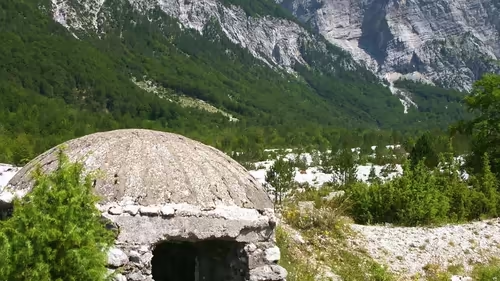
The iconic “Albania bunkers” are called *bunk’erët* locally. Most are small, mushroom-shaped concrete domes—about 2.5 meters wide—designed to hold one or two soldiers with a machine gun. They were mass-produced using a standardized design known as “Type QZ” (Qendra Zjarri, or “firing point”) [[4]].
Between 1967 and 1986, an estimated **750,000 to 1 million** of these structures were built across the country—despite Albania having a population of only about 3 million at the time [[1]]. To put that in perspective: the U.S. built around 20,000 nuclear fallout shelters during the same period.
The cost was staggering. Historians estimate that up to **70% of Albania’s military budget** went toward bunker construction—diverting funds from housing, healthcare, and infrastructure. Cement meant for schools was poured into hillsides instead.
Life Inside the Bunker State
For Albanian citizens, the bunkers were both a symbol of protection and oppression. Schoolchildren practiced “invasion drills,” running to assigned bunkers during air raid sirens. Families were told to keep weapons ready. Yet, no invasion ever came.
Ironically, the bunkers offered little real defense. Their small size made them easy targets, and many lacked proper ventilation or supplies. Worse, their placement often blocked roads, farmland, and coastal access—hindering development long after Hoxha’s death in 1985 [[5]].
What Happened to the Bunkers After Communism?
When communism fell in 1991, Albania opened its borders—and its people began dismantling the symbols of their oppression. Many bunkers were blown up, buried, or repurposed:
- Some became **sheep pens** or **storage sheds**.
- Others were turned into **pizza ovens**, **art galleries**, or **beach changing rooms**.
- A few near Tirana now house **museums** documenting the communist era.
But removing them all proved impossible. Their reinforced concrete shells are incredibly durable—and expensive to demolish. So they remain: silent witnesses to a paranoid past.
Albania’s Bunkers Today: Tourism and Memory
Now, the Albania bunkers have become unexpected tourist attractions. The “Bunk’Art” museums in Tirana—one built inside a massive underground command center—are among the country’s most visited sites [[6]]. Travelers hike through mountains dotted with decaying domes, capturing photos that blend surrealism with history.
Yet for older Albanians, these structures evoke trauma—not curiosity. As one survivor told the BBC: “We didn’t fear bombs. We feared the regime that made us build them.”
Conclusion
The story of Albania’s bunkers is more than a Cold War oddity—it’s a cautionary tale about how fear, when weaponized by authoritarianism, can reshape an entire nation’s landscape and psyche. Over 750,000 concrete ghosts still stand, not as shields against invaders, but as monuments to isolation, paranoia, and the human cost of ideological extremism. In a world still grappling with division and distrust, Albania’s hidden fortifications remind us: sometimes the greatest threat isn’t outside your borders—it’s within.
Sources
- Times of India: A country that isolated itself and built thousands of hidden bunkers [[1]]
- Britannica: Communist Albania and Enver Hoxha [[2]]
- Radio Free Europe: How Albania Became the World’s Most Isolated Country [[3]]
- Atlas Obscura: The Bunkers of Albania [[4]]
- BBC Travel: Albania’s Concrete Mushrooms [[5]]
- Bunk’Art Museum: Official Website [[6]]
- [INTERNAL_LINK:cold-war-hidden-structures-around-the-world] [[7]]