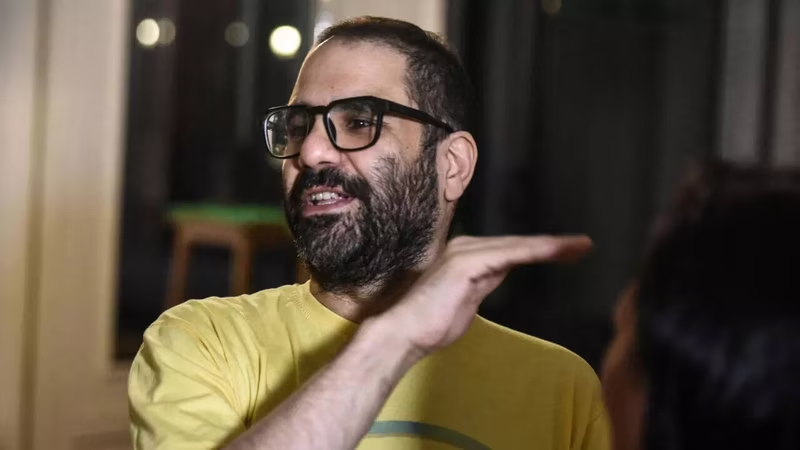
He was once the global face of a democratic uprising—a coder, writer, and activist whose imprisonment became a symbol of Egypt’s crackdown on dissent. Now, after his release and return to the UK, Alaa Abd el-Fattah finds himself not on a victory tour, but at the heart of a heated national debate. His arrival has reignited questions about accountability, historical context, and whether liberal democracies can—or should—separate a dissident’s past from their present. Welcome to one of the most complex political dilemmas Britain has faced in recent memory.
Table of Contents
- Who Is Alaa Abd el-Fattah?
- From Tahrir to Tora Prison
- Alaa Abd el-Fattah and His UK Return
- The Social Media Controversy Explained
- British Citizenship and the Vetting Debate
- Why This Matters for Liberal Democracies
- Conclusion
- Sources
Who Is Alaa Abd el-Fattah?
Born in 1981 in Cairo, Alaa Abd el-Fattah comes from a family deeply rooted in Egypt’s intellectual and activist traditions. His father, Ahmed Seif al-Islam, was a prominent human rights lawyer, and his aunt, Ahdaf Soueif, is an acclaimed novelist and political commentator. Trained as a software developer, Abd el-Fattah quickly merged his tech savvy with his passion for social justice .
Long before the Arab Spring, he was a vocal critic of the Mubarak regime, using blogs and early social media platforms to organize and expose state abuses. His ability to articulate dissent in both Arabic and English made him a bridge between local movements and international audiences.
From Tahrir to Tora Prison
Abd el-Fattah rose to global prominence during the 2011 Egyptian revolution. He was a key figure in the Tahrir Square protests and continued to advocate for democratic reforms even after Mubarak’s fall. But as Egypt’s political landscape shifted—from military rule to the brief presidency of Mohamed Morsi and then the authoritarian consolidation under Abdel Fattah el-Sisi—Abd el-Fattah became a repeated target.
He has spent much of the last decade behind bars on charges widely condemned by groups like Amnesty International and Human Rights Watch as politically motivated. His hunger strikes and the international campaign for his release—including from UK MPs and UN officials—made him a cause célèbre for human rights defenders worldwide .
Alaa Abd el-Fattah and His UK Return
In late 2025, following diplomatic pressure and likely a behind-the-scenes deal, Egypt released Abd el-Fattah, allowing him to return to the United Kingdom, where his family resides and where he holds British citizenship through his mother . His return was initially met with relief and celebration from human rights groups.
However, that goodwill quickly soured. British media outlets began revisiting a series of old social media posts—some dating back to the early 2010s—that have been interpreted by critics as anti-Semitic or supportive of anti-Western violence. The resurfaced content sparked outrage, leading to intense scrutiny of how someone with such a digital footprint could be granted citizenship.
The Social Media Controversy Explained
The controversy centers on tweets and Facebook posts from over a decade ago, during a period of intense regional turmoil. Some posts referenced Israeli military actions in Gaza in inflammatory language. Others expressed solidarity with Palestinian resistance in terms that, when viewed out of context, appear to endorse violence.
Supporters argue these posts must be understood in their historical and political context—written in the heat of war, by a young activist living under an oppressive regime, using the emotional language common in activist circles at the time. They point out that Abd el-Fattah has since clarified his views and consistently condemned all forms of violence and hate.
Critics, however, insist that such rhetoric—regardless of when it was posted—crosses a red line in a society committed to combating hate speech and ensuring public safety. This tension has created a stark divide in public opinion.
British Citizenship and the Vetting Debate
The core of the UK controversy isn’t just about past tweets—it’s about process. How did the Home Office approve Abd el-Fattah’s citizenship application without flagging these posts? This has led to calls for a review of the vetting procedures for high-profile political asylum seekers and dual nationals.
Key questions being raised include:
- Should historical social media activity be a disqualifying factor for citizenship?
- How do authorities distinguish between legitimate political dissent and hate speech?
- Does the UK’s humanitarian commitment to political prisoners override concerns about past rhetoric?
This debate cuts to the heart of what it means to be a liberal democracy in the digital age—one that upholds both **free speech** and social cohesion.
Why This Matters for Liberal Democracies
The Alaa Abd el-Fattah case is more than a UK-specific issue; it’s a litmus test for liberal democracies everywhere. In an era of global surveillance, permanent digital footprints, and rising nationalism, how do societies balance compassion for persecuted dissidents with the need to uphold their own civic values?
On one hand, rejecting someone like Abd el-Fattah could signal a retreat from Britain’s historical role as a safe haven for the oppressed. On the other, ignoring troubling past statements risks normalizing language that undermines the very pluralism these societies claim to protect.
As one MP noted, “This isn’t just about one man. It’s about who we are as a nation.” For deeper insights into the ethics of asylum in the 21st century, see our analysis on [INTERNAL_LINK:asylum-and-free-speech].
Conclusion
Alaa Abd el-Fattah’s return to the UK has turned a story of liberation into a national reckoning. Once a straightforward symbol of resistance, he now embodies the messy, uncomfortable gray areas that define modern politics. The debate over his past, his citizenship, and his place in British society isn’t just about him—it’s about the future of liberal values in a world where every word is archived and every act is scrutinized. How the UK navigates this will set a precedent far beyond its shores.
Sources
- Amnesty International: Egypt – Alaa Abd el-Fattah must be released immediately
- Times of India: Explained: Who is Alaa Abd el-Fattah, and why is his return to the UK making headlines
- The Guardian: Alaa Abd el-Fattah: Egyptian activist freed after hunger strike
- Human Rights Watch: Egypt: Alaa Abd el-Fattah’s Arbitrary Detention