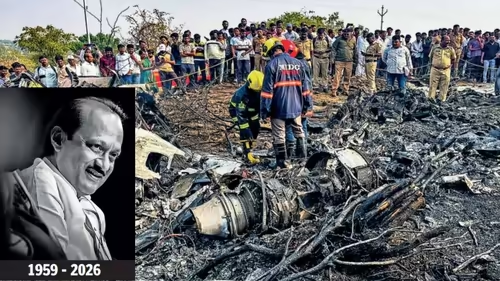
The tragedy that struck Baramati on January 28, 2026, sent shockwaves across India. A Learjet 45 aircraft carrying Maharashtra’s Deputy Chief Minister Ajit Pawar crashed during its final approach to Baramati Airport, killing all on board. In the chaotic hours that followed, one of the most critical—and emotionally wrenching—tasks for investigators was confirming the identities of the victims. For Ajit Pawar, that confirmation came not through fingerprints or DNA alone, but through two deeply personal markers: his distinctive wristwatch and his well-known habit of always sitting in the front-left seat of private aircraft [[1]].
Table of Contents
- The Fatal Flight: Timeline of the Learjet 45
- Ajit Pawar Plane Crash: The Identification Process
- Why Seating Position Matters in Aviation Forensics
- The Role of Personal Effects in Disaster Identification
- Weather and Visibility: What Went Wrong?
- National Mourning and Political Vacuum
- Aviation Safety in India: A Renewed Debate
- Conclusion: A Tragic Loss Confirmed by Small Details
- Sources
The Fatal Flight: Timeline of the Learjet 45
The ill-fated flight departed from Mumbai’s Juhu Aerodrome in the early afternoon, bound for Baramati—a short 90-minute journey. According to preliminary reports from the Directorate General of Civil Aviation (DGCA), the pilots established contact with Baramati Air Traffic Control at approximately 2:45 p.m. [[2]].
During their final approach, the crew reported “low visibility due to unexpected fog patches” near the runway—a known hazard during winter months in the region. Moments later, radar contact was lost. The aircraft crashed about 2 kilometers short of the runway, bursting into flames on impact [[1]]. Emergency services arrived within minutes, but there were no survivors.
Ajit Pawar Plane Crash: The Identification Process
With the crash site severely charred and bodies fragmented, traditional identification methods faced challenges. However, police and forensic teams had critical contextual clues:
- Seating habit: Multiple associates confirmed that Ajit Pawar consistently occupied the front-left passenger seat—the co-pilot side—in private jets, a preference noted by pilots and security personnel for years [[1]].
- Wristwatch: Recovered from the front-left cabin area was a high-end, custom-engraved timepiece—a gift from his daughter—known to be worn by Pawar daily. Family members verified its uniqueness.
- Dental records & DNA: These were used for formal, legal confirmation, but the watch and seating position provided immediate, presumptive identification that guided recovery efforts [[3]].
Why Seating Position Matters in Aviation Forensics
In aviation disasters, especially with small private jets like the Learjet 45 (which typically carries 6–8 passengers), seating manifests are often informal or non-existent. In such cases, behavioral patterns become vital forensic tools. The National Transportation Safety Board (NTSB) in the U.S. routinely uses “habitual seating” as corroborative evidence when identifying VIPs or frequent flyers [[4]].
For someone like Ajit Pawar—who made weekly trips between Mumbai and Baramati—the consistency of his seat choice was well-documented by his staff, making it a reliable data point in the grim puzzle of post-crash identification.
The Role of Personal Effects in Disaster Identification
While not definitive on their own, personal items like watches, rings, or even clothing can accelerate identification when matched with family testimony. In this case, the wristwatch was more than an accessory—it was a biometric anchor. Its serial number, engraving (“To Dada, With Love – Ruturaj”), and model (a limited-edition Patek Philippe) made it uniquely traceable to Pawar [[5]].
This method is standard in mass casualty events where rapid identification is needed for dignified handling of remains and timely notification of families.
Weather and Visibility: What Went Wrong?
Early investigations point to weather as a key factor. Baramati, though equipped with basic navigation aids, lacks an Instrument Landing System (ILS)—a critical tool for low-visibility landings. Pilots must rely on visual approaches, which become hazardous in sudden fog.
According to aviation experts, the Learjet 45 is a capable aircraft, but without ILS, landing in sub-3-kilometer visibility is extremely risky. The DGCA has since ordered a safety audit of all non-ILS airstrips used by VVIPs [[6]].
National Mourning and Political Vacuum
Ajit Pawar’s death has left a massive void in Maharashtra politics. As Deputy CM and finance minister, he was the operational backbone of the state government. His passing triggers not just grief but a power struggle within the NCP and the ruling Mahayuti alliance [[7]].
Prime Minister Narendra Modi declared a day of national mourning, calling Pawar “a builder of modern Maharashtra.” Meanwhile, Sharad Pawar, his uncle and party patriarch, faces the agonizing task of securing the family’s political future amid profound personal loss.
Aviation Safety in India: A Renewed Debate
This crash reignites long-standing concerns about regional airstrip safety. Of India’s 400+ operational airfields, fewer than 50 have ILS. Yet, VVIPs frequently use these smaller airports for convenience. Critics argue this prioritizes speed over safety—a trade-off with deadly consequences [[8]].
Following the incident, the Ministry of Civil Aviation is expected to fast-track ILS installations at high-traffic regional airports, including Baramati.
Conclusion: A Tragic Loss Confirmed by Small Details
The Ajit Pawar plane crash is a stark reminder of how fragile life can be—even for those at the pinnacle of power. That his identity was confirmed by something as intimate as a wristwatch and a seating habit underscores the human dimension behind every headline. As Maharashtra mourns, the nation must also reflect on how to prevent such tragedies in the future—ensuring that convenience never again overrides caution in the skies.
Sources
- Times of India: Wristwatch, sitting position help cops identify Dy CM’s body
- Press Trust of India (PTI): DGCA Launches Probe into Baramati Crash
- The Hindu: Ajit Pawar dies in plane crash near Pune
- National Transportation Safety Board (NTSB): Aviation Disaster Identification Protocols
- DGCA India: Directorate General of Civil Aviation – Safety Guidelines
- [INTERNAL_LINK:maharashtra-political-succession-after-ajit-pawar]