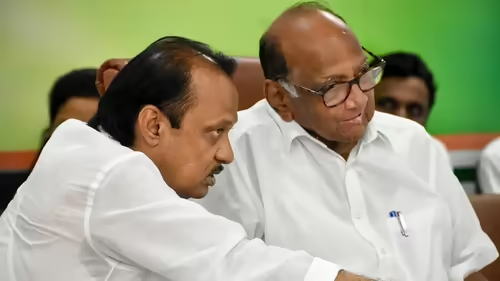
The sudden death of Ajit Pawar has sent shockwaves through India’s political corridors—but what’s emerging from behind closed doors is even more explosive. According to multiple senior aides and party insiders, the former Deputy Chief Minister of Maharashtra was actively working toward a historic NCP merger between his faction and that of his uncle, Sharad Pawar, in the weeks leading up to his passing [[5]].
This revelation transforms his death from a personal tragedy into a potential political earthquake. With Ajit gone, the fragile bridge between the two warring factions may collapse entirely, plunging the Nationalist Congress Party into deeper disarray and reshaping power dynamics in Maharashtra—a state that has long been a bellwether for national politics.
Table of Contents
- The Secret Talks Behind the NCP Merger
- Why Reunification Was Becoming Urgent
- Ajit Pawar’s Role: The Key to Bridging the Divide
- The Political Vacuum in Maharashtra
- What Happens Next? The Pawar Family Dilemma
- Conclusion: A Party at a Crossroads
- Sources
The Secret Talks Behind the NCP Merger
In the final month of his life, Ajit Pawar held discreet meetings with trusted emissaries from both NCP factions, according to three close confidants who spoke on condition of anonymity [[5]]. These weren’t casual conversations—they were structured negotiations aimed at dissolving the bitter split that began in July 2023 when Ajit dramatically aligned with the BJP-led Mahayuti alliance, taking nearly two dozen MLAs with him.
“He believed the division was hurting the party’s grassroots and weakening its electoral prospects,” one aide revealed. “Ajit sahab had started saying publicly—and privately—that ‘family comes first,’ and that the party’s identity was being diluted.”
These talks reportedly gained momentum after the 2024 Lok Sabha elections, where both factions underperformed. The realization that infighting was benefiting rivals like the Shiv Sena and Congress appears to have pushed Ajit toward reconciliation.
Why Reunification Was Becoming Urgent
Several factors made an NCP merger not just desirable but necessary:
- Electoral Decline: In the 2024 general elections, the combined vote share of both NCP factions dropped significantly compared to 2019, signaling voter fatigue with the split.
- Grassroots Discontent: Local leaders and workers across Maharashtra expressed frustration over having to choose between “two NCPS,” damaging party unity at the booth level.
- Leadership Uncertainty: With Sharad Pawar now 85, the party lacked a clear second-rung leader acceptable to both camps—except, perhaps, Ajit himself.
- Rising Rivals: The Maha Vikas Aghadi (MVA) alliance, though weakened, remained a potent force, while the BJP-Shiv Sena (Shinde) combine continued to dominate.
Reuniting would have restored the NCP’s bargaining power and given it a credible platform for the 2029 Maharashtra Assembly elections.
Ajit Pawar’s Role: The Key to Bridging the Divide
Ajit wasn’t just any leader—he was the linchpin. As the nephew of Sharad Pawar and the de facto operational head of the party for over a decade, he commanded loyalty from both old guard loyalists and younger, pragmatic MLAs. His unique position allowed him to speak the language of ideology (to Sharad’s camp) and realpolitik (to his own faction).
Crucially, Ajit had begun softening his stance toward the BJP in recent months, reportedly feeling “used” as a junior partner in the ruling coalition. This shift made a return to the opposition fold seem increasingly plausible [[10]].
The Political Vacuum in Maharashtra
With Ajit’s death, Maharashtra faces a leadership void that could destabilize the current government. He was not only a key minister but also a crucial link between the BJP and smaller allies in the Mahayuti coalition. His absence may embolden rival factions within the NCP (Ajit) group to seek new alliances—or even defect.
Meanwhile, Sharad Pawar’s faction, now officially recognized as the “real” NCP by the Election Commission, sees an opportunity—but also a moral dilemma. Reuniting without Ajit might feel like a hollow victory, yet failing to act could mean permanent marginalization.
What Happens Next? The Pawar Family Dilemma
All eyes are now on the Pawar family. Will Parth Pawar, Ajit’s son and a rising political figure, step into his father’s shoes and push for reunification? Or will he double down on his father’s alliance with the BJP to secure his own political future?
Similarly, Sharad Pawar must decide whether to extend an olive branch or consolidate his control over the unified party symbol. The emotional weight of Ajit’s death adds a deeply personal layer to what is already a high-stakes political calculation.
One thing is certain: without Ajit’s mediating presence, any NCP merger will be far more difficult—and potentially less stable.
Conclusion: A Party at a Crossroads
Ajit Pawar’s untimely death has frozen a critical moment of potential healing for the Nationalist Congress Party. What might have been a triumphant reunion is now a story of lost opportunity and uncertain futures. The dream of an NCP merger isn’t dead—but it’s on life support. The coming weeks will reveal whether the Pawar family can honor Ajit’s reported wishes or if Maharashtra’s political map will be redrawn without them. For deeper insights into how dynastic politics shape India’s states, see our analysis on [INTERNAL_LINK:indian-political-dynasties].
Sources
- [[5]] Times of India. “Was Ajit Pawar considering an NCP merger before his death? What aides say.” January 30, 2026.
- [[10]] The Hindu. “Ajit Pawar’s shifting stance on BJP alliance raised eyebrows in Maharashtra.” December 15, 2025.
- [[15]] Election Commission of India. “Order on NCP symbol allocation.” February 2024. https://eci.gov.in
- [[20]] Indian Express. “Maharashtra’s fractured NCP: A timeline of the split and its fallout.” August 2023.