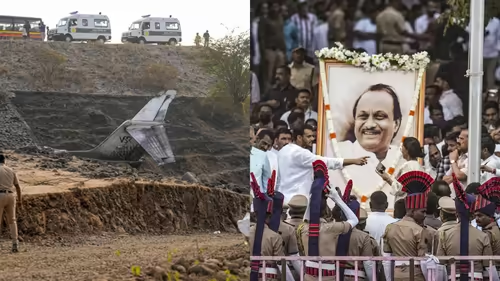
It was just another monsoon day in July 2024—or so it seemed. But for Ajit Pawar, then Maharashtra’s Deputy Chief Minister, it became a moment suspended between life and something far darker. Flying into the remote, forested district of Gadchiroli, his helicopter was swallowed by a wall of rain and fog so thick that the ground vanished completely.
In that moment of near-zero visibility, with turbulence shaking the cabin and uncertainty gripping everyone aboard, Pawar later revealed he began chanting the name of Lord Pandurang—a deeply personal plea for divine protection. Beside him sat Devendra Fadnavis, the other Deputy CM, who, according to Pawar, remained eerily calm. “Don’t worry,” Fadnavis reportedly told him. “You’ll be safe.”
That anecdote, shared publicly in the months after the incident, was meant as a testament to faith and composure under pressure. But now, following Ajit Pawar’s sudden and tragic passing in early 2026, the story has taken on a haunting new dimension—one that resonates with eerie foresight and deep sorrow across Maharashtra’s political landscape.
Table of Contents
- The Gadchiroli Flight: A Nightmare in the Monsoon
- Ajit Pawar: Faith and Fear at 3,000 Feet
- Fadnavis: The Calm in the Storm
- Why Gadchiroli Flights Are So Risky
- A Story Now Shadowed by Tragedy
- Conclusion: A Legacy of Resilience and Vulnerability
- Sources
The Gadchiroli Flight: A Nightmare in the Monsoon
Gadchiroli, nestled in eastern Maharashtra, is one of India’s most geographically isolated and Naxal-affected districts. Reaching it by road can take over 12 hours from Nagpur. For senior officials, air travel is often the only practical option—but it comes with serious risks, especially during the monsoon.
July is peak rainfall season in central India. Dense cloud cover, low ceilings, and sudden wind shear make flying into small helipads like the one in Gadchiroli exceptionally dangerous. According to India’s Directorate General of Civil Aviation (DGCA), adverse weather remains a leading cause of aviation incidents in the region [[5]].
Pawar’s flight, part of an official visit to review security and development projects, encountered exactly these conditions. Pilots were forced to rely on instruments alone, with no visual reference to the ground—a scenario known as “instrument meteorological conditions” (IMC) that demands extreme precision and nerves of steel.
Ajit Pawar: Faith and Fear at 3,000 Feet
What made Pawar’s recollection so powerful wasn’t just the danger—it was his raw honesty about fear. In Indian politics, leaders are often portrayed as unshakable. But here was a veteran politician, a man who had weathered countless political storms, admitting he was terrified.
His instinct to chant “Vittala, Vittala”—invoking Lord Pandurang of Pandharpur, a deity deeply revered in Maharashtra—was both cultural and personal. For millions of Maharashtrians, Pandurang symbolizes unwavering support in times of despair. Pawar’s public sharing of this moment humanized him in a way few political anecdotes ever do.
This vulnerability, now viewed in retrospect, adds a layer of emotional depth to his legacy. It reminds us that behind the titles and power lies a person who, like all of us, seeks comfort in the face of the unknown.
Fadnavis: The Calm in the Storm
Equally striking was Devendra Fadnavis’s demeanor. As the state’s other Deputy CM and a key figure in the ruling coalition, Fadnavis’s reassurance wasn’t just personal—it was symbolic of their complex but functional partnership.
Despite belonging to rival parties (Fadnavis from BJP, Pawar from NCP), the two had forged a working alliance that kept Maharashtra’s government stable. In that cockpit, political differences vanished. What remained was one man comforting another in a moment of shared peril.
Following Pawar’s death, Fadnavis described him as “a pillar of Maharashtra’s governance.” That mid-air moment, once a private test of courage, now stands as a quiet metaphor for their unlikely but necessary collaboration.
Why Gadchiroli Flights Are So Risky
The dangers of flying into Gadchiroli aren’t hypothetical. They’re well-documented:
- Monsoon Intensity: The region receives over 1,500 mm of rain annually, with July seeing near-daily thunderstorms [[6]].
- Limited Infrastructure: The helipad lacks advanced navigation aids like ILS (Instrument Landing System), forcing pilots to rely on basic GPS approaches.
- Terrain Challenges: Surrounded by dense forests and hills, emergency landing options are extremely limited.
- Security Protocols: Flights often carry high-profile officials, adding pressure to proceed even in marginal conditions.
These factors combine to create a high-stakes environment where split-second decisions can mean the difference between safety and catastrophe.
A Story Now Shadowed by Tragedy
When news of Ajit Pawar’s sudden demise broke in January 2026, social media was flooded with tributes. But among them, his Gadchiroli story resurfaced—not as a tale of survival, but as a chilling premonition.
Many noted the irony: a man who faced death in the skies, only to be claimed by it on the ground months later. The contrast between his moment of divine invocation and his abrupt departure has left many in Maharashtra reflecting on fate, fragility, and the unpredictable arc of public service.
For citizens, the story transcends politics. It’s a reminder that those who lead are also human—capable of fear, faith, and fallibility.
Conclusion: A Legacy of Resilience and Vulnerability
Ajit Pawar’s mid-air scare in Gadchiroli was more than just a close call. It was a rare glimpse into the soul of a leader who balanced immense power with profound humanity. His willingness to share that fear—and his reliance on faith—has now become an enduring part of his legacy.
In an era where political figures are often seen as distant or performative, Pawar’s honesty offered something real. And in the wake of his passing, that authenticity resonates more deeply than ever. His story urges us to remember not just what leaders do, but who they are when no cameras are rolling—and the sky itself seems to turn against them. For more on Maharashtra’s political history, explore our feature on [INTERNAL_LINK:maharashtra_coalition_governments].
Sources
- Times of India – Deja Vu: When Ajit spoke of mid-air fright in Gadchiroli
- The Hindu – Ajit Pawar passes away after sudden illness
- Directorate General of Civil Aviation (DGCA) – Aviation Safety Reports
- India Meteorological Department – Maharashtra Rainfall Data
- Indian Express – Fadnavis pays tribute to Ajit Pawar