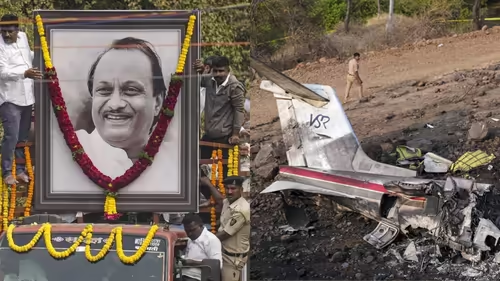
The morning of January 28, 2026, started like any other for a high-profile politician. But within minutes, a routine charter flight from Delhi to Baramati turned into a national tragedy. The Learjet 45XR carrying Maharashtra’s Deputy Chief Minister Ajit Pawar and four others crashed on landing, killing everyone on board [[7]].
While the nation mourns, a more urgent question emerges from the wreckage: Is the system that governs VIP charter flights in India fundamentally broken? The answer, from experts and insiders, is a resounding and terrifying ‘yes.’ The incident has exposed a perfect storm of operational pressure, inadequate infrastructure, and soft regulatory oversight that turns every VIP charter flight into a potential gamble with fate.
Table of Contents
- The Fatal Recipe for Disaster
- VIP Charter Flight Safety: The Hidden Risks
- The Baramati Factor: A Runway of Risk
- The Regulatory Gap: DGCA and Oversight
- What Needs to Change Now
- Conclusion: A Call for Accountability
- Sources
The Fatal Recipe for Disaster
Three key ingredients combined to create this catastrophe. First, the relentless pressure of political schedules. VIPs operate on tight, non-negotiable timelines. Delays are not an option, which can lead pilots to make risky calls—like attempting a landing in marginal weather or at an ill-equipped airfield [[3]].
Second, the nature of the aircraft itself. The Learjet 45XR is a capable machine, but it operates under the Non-Scheduled Operators (NSOP) permit, a segment of Indian aviation that has seen explosive growth but not a corresponding increase in safety scrutiny [[11]].
Third, the destination: Baramati. An airstrip more than a full-fledged airport, it lacked critical infrastructure like a functional Air Traffic Control (ATC) tower, advanced navigation aids, and even a fire tender at the time of the crash [[6]]. The Indian Air Force had to be called in to provide basic emergency services.
VIP Charter Flight Safety: The Hidden Risks
The myth of private jet infallibility is just that—a myth. While they offer convenience and privacy, VIP charter flight safety is contingent on a chain of factors that are often compromised in the Indian context:
- Operational Pressure: Pilots may feel immense pressure to fly, even when conditions aren’t ideal, to meet the demands of their powerful passengers [[3]].
- Aircraft Maintenance: While major operators adhere to strict norms, the sheer volume of new players in the NSOP space can lead to corners being cut on maintenance schedules.
- Crew Fatigue: On-demand flying can lead to unpredictable and long duty hours for crew, increasing the risk of human error [[1]].
The Baramati Factor: A Runway of Risk
Baramati isn’t an isolated case. It represents a class of small, often privately-owned or politically-connected airstrips across India that are used frequently by VVIPs but lack the safety net of a commercial airport. These airfields often have:
- No Instrument Landing System (ILS) for poor visibility.
- Minimal or no ATC services, relying on basic radio communication.
- Inadequate emergency response capabilities, as starkly revealed in this crash [[6]].
Flying into such locations, especially in a fast-moving jet like the Learjet, requires near-perfect conditions and exceptional pilot skill. Any deviation becomes exponentially more dangerous.
The Regulatory Gap: DGCA and Oversight
The Directorate General of Civil Aviation (DGCA) is the watchdog, but its bark may be worse than its bite. A parliamentary panel had already flagged “weak oversight” and “DGCA capacity gaps” in the charter aviation sector months before this tragedy [[21]]. The regulator, while having issued simplified norms for NSOPs in 2025, is often stretched thin trying to monitor a rapidly expanding fleet of private aircraft [[15]].
The system relies heavily on self-reporting and scheduled audits, which can miss real-time operational pressures and on-the-ground realities at remote airfields. This creates a dangerous gap between the rulebook and actual practice.
For more on how government oversight impacts public safety, see our analysis on [INTERNAL_LINK:infrastructure_safety_oversight].
What Needs to Change Now
This tragedy cannot be just another statistic. It must be a catalyst for systemic reform. Experts and safety advocates are calling for immediate action:
- Mandatory Infrastructure Audit: No VIP charter should be permitted to land at an airfield that doesn’t meet a minimum, publicly disclosed safety standard for emergency services, navigation, and ATC.
- Strengthened DGCA Powers: The regulator needs more resources, personnel, and authority to conduct unannounced, on-the-spot inspections of both aircraft and operating procedures.
- Clear “No-Go” Protocols: Establish and enforce absolute protocols that empower pilots to refuse a flight or landing without fear of reprisal, regardless of passenger status.
- Transparency in NSOP Licensing: Publicly available data on the safety records and audit history of all NSOP holders.
Conclusion: A Call for Accountability
The death of Ajit Pawar is a profound loss. But if it leads to a serious reckoning with the inherent dangers of India’s current VIP charter flight safety framework, it could prevent countless future tragedies. The convenience of a private jet must never come at the cost of human life. It’s time for the government, the DGCA, and the operators themselves to prioritize safety over speed, and accountability over influence. The skies over India must be made safe for everyone, not just the privileged few who can afford to charter them.
Sources
- Times of India: What Ajit Pawar’s death reveals about VIP air travel risks
- Economic Times: Ajit Pawar dies in crash; spotlight on poor charter safety
- Sunday Guardian: Lack of ATC, fire tender at Baramati airport
- The New Indian Express: Ajit Pawar’s tragic air crash and the lessons it teaches us
- News18: House Panel Flagged Safety Gaps In Charter Planes
- DGCA: Non Scheduled Operators Regulations