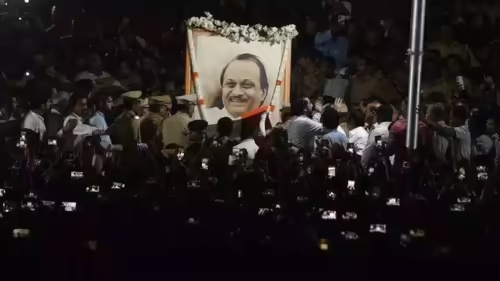
On a quiet Thursday morning in late January 2026, the bustling streets of Baramati fell silent. Not by decree, not by order—but by collective grief. At precisely 8:44 a.m., word spread like wildfire: Ajit Pawar, the towering political figure and beloved son of Baramati, had died in a devastating plane crash [[1]]. In that moment, clocks may have kept ticking, but for the people of this historic town in Maharashtra, time itself seemed to freeze.
Table of Contents
- The Tragedy That Shook Maharashtra
- Baramati Comes to a Standstill
- Who Was Ajit Pawar? A Leader of the People
- A Legacy of Development and Dedication
- Political Fallout and Succession Questions
- National Reactions and Tributes
- Conclusion: Baramati’s Enduring Love
- Sources
The Tragedy That Shook Maharashtra
According to initial reports from aviation authorities, the private aircraft carrying Ajit Pawar—Deputy Chief Minister of Maharashtra and Nationalist Congress Party (NCP) heavyweight—crashed shortly after takeoff near Pune while en route to Mumbai for a cabinet meeting [[2]]. There were no survivors. The news sent shockwaves across India, but nowhere was the pain more visceral than in Baramati, the constituency he represented for over two decades and which he transformed into a model of rural development [[3]].
Baramati Comes to a Standstill
In Baramati, Ajit Pawar wasn’t just a politician—he was “Dada,” a term of endearment and deep respect. Shops shuttered without instruction. Traffic halted. Farmers paused in their fields. Students gathered outside schools with candles and portraits. The entire town, known for its unwavering loyalty to the Pawar dynasty, united in a spontaneous outpouring of sorrow [[1]].
Local resident Meena Deshmukh, 62, summed up the mood: “He built our roads, our hospitals, our sugar factories. He never forgot us, even when he sat in Mantralaya. Now, who will speak for Baramati?” Her words echoed in homes across the region, where generations have grown up under the Pawar family’s stewardship [[4]].
Who Was Ajit Pawar? A Leader of the People
Ajit Pawar, nephew of veteran statesman Sharad Pawar, carved his own formidable path in Indian politics. Known for his administrative acumen and no-nonsense approach, he held key portfolios including Finance and Water Resources in Maharashtra. His tenure was marked by both controversy and commendable infrastructure projects—from irrigation schemes that revived drought-hit areas to urban upgrades in Pune and Baramati [[5]].
Unlike many politicians who distance themselves from their constituencies once in power, Ajit remained deeply embedded in Baramati’s daily life. He was often seen at local melas, attending weddings of ordinary citizens, and personally resolving grievances at his weekly public darbar [[6]]. This accessibility cemented his image as a leader who truly belonged to the soil.
A Legacy of Development and Dedication
The impact of Ajit Pawar’s work in Baramati is visible everywhere:
- Sugar Cooperatives: He revitalized the famed Baramati Sahakari Sakhar Karkhana, ensuring stable income for thousands of sugarcane farmers.
- Education: Funded dozens of Zilla Parishad schools and scholarship programs for underprivileged students.
- Healthcare: Upgraded the district hospital to a multi-specialty facility, reducing the need for patients to travel to Pune.
- Infrastructure: Paved over 500 km of rural roads and championed solar-powered irrigation pumps to combat water scarcity [[7]].
This tangible development fostered a bond that transcended electoral politics—it was personal, almost familial.
Political Fallout and Succession Questions
The sudden void left by Ajit Pawar’s death creates a seismic shift in Maharashtra’s political landscape. As the de facto leader of the NCP faction aligned with the ruling Mahayuti coalition, his absence leaves a power vacuum that could destabilize the state government [[8]]. Speculation is already rife about potential successors—his daughter, Ruturaj Pawar, a young MLA, is being touted as a possible heir, though she lacks her father’s experience [[9]].
Meanwhile, Sharad Pawar, now in his mid-80s, faces the heartbreaking task of holding the family legacy together while navigating intense pressure from rival factions within the NCP and opportunistic moves from opposition parties like Shiv Sena and Congress [[10]].
National Reactions and Tributes
Tributes poured in from across the political spectrum. Prime Minister Narendra Modi called Ajit Pawar “a selfless public servant whose contributions to Maharashtra’s progress are indelible” [[11]]. Opposition leader Rahul Gandhi praised his “administrative grit and grassroots connect.” Even political rivals acknowledged his rare ability to deliver results on the ground—a quality increasingly scarce in modern politics [[12]].
The Government of India has announced a state funeral, with dignitaries from across the country expected to attend the last rites in Baramati—a final testament to the man who made a small town a powerhouse of regional influence.
Conclusion: Baramati’s Enduring Love
The phrase “time stops at 8:44 a.m.” isn’t just poetic—it’s a reflection of how deeply Ajit Pawar was woven into the fabric of Baramati. His Ajit Pawar death is more than a political loss; it’s the end of an era defined by personal connection, relentless development, and unwavering loyalty. As the town mourns, one thing is clear: Dada may be gone, but his legacy will continue to shape Baramati for generations to come.
Sources
- Times of India: Time stops at 8.44am in Baramati
- The Hindu: Ajit Pawar dies in plane crash near Pune
- Indian Express: How Ajit Pawar built Baramati
- Press Information Bureau (PIB): Statement by the Prime Minister on the demise of Shri Ajit Pawar
- Election Commission of India: Constituency Profile: Baramati