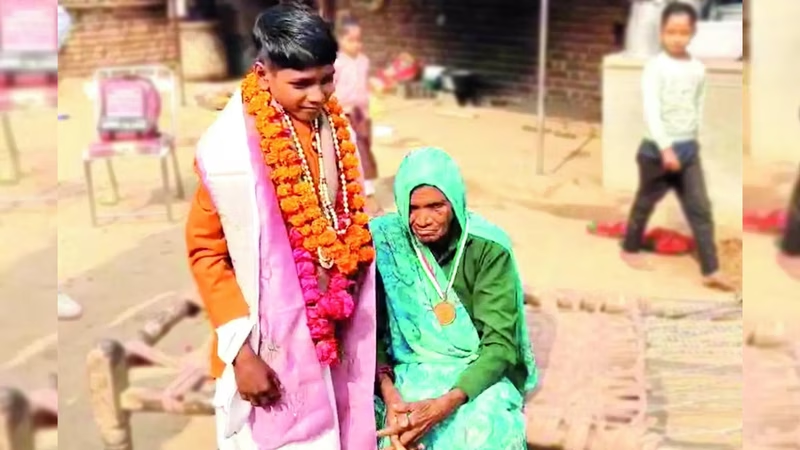
It was an ordinary day on the banks of the Chambal river—until it wasn’t. In a moment that would define his young life, nine-year-old Ajay Raj Nishad transformed from a village boy into a national hero. When a massive crocodile clamped its jaws around his father’s leg, dragging him into the murky water, most adults would have frozen in terror. But Ajay didn’t hesitate. Armed only with a wooden stick, he charged at the predator and struck its eye—forcing it to release his father and retreat.
That single act of raw, instinctive bravery didn’t just save a life—it ignited a dream. Now honored with the prestigious Pradhan Mantri Rashtriya Bal Puraskar, Ajay isn’t resting on his laurels. “I want to join the Army and protect my country,” he declared after receiving the award from the President of India.
His story is more than just heart-stopping courage—it’s a powerful reminder that heroism has no age limit, and that the values of duty, sacrifice, and patriotism can blossom even in the most unexpected places.
Table of Contents
- The Day the Chambal River Tested a Boy’s Courage
- How Ajay Raj Nishad Fought a Crocodile with a Stick
- National Honor: The Pradhan Mantri Bal Puraskar
- From Village Hero to Future Soldier
- Why the Chambal River Is So Dangerous
- Inspiring a Generation of Young Indians
- Conclusion
- Sources
The Day the Chambal River Tested a Boy’s Courage
The incident unfolded in Etawah, Uttar Pradesh, a region known for its rugged terrain and the wild Chambal river—a waterway infamous not just for dacoits of yesteryear, but for its thriving population of mugger and gharial crocodiles.
Ajay and his father, Rajkumar Nishad, were near the riverbank when the attack happened in broad daylight. “My father screamed,” Ajay later recalled in a soft but steady voice. “I saw blood. I didn’t think—I just ran.”
While bystanders stood stunned, the nine-year-old grabbed a nearby stick and began beating the crocodile’s head, specifically targeting its eyes—a move that, whether by instinct or observation, is known to deter reptiles.
How Ajay Raj Nishad Fought a Crocodile with a Stick
Crocodiles have one of the strongest bite forces in the animal kingdom—over 3,700 psi—but their eyes are among their most vulnerable spots. Experts from the World Wildlife Fund (WWF) India note that wild animals often retreat when their eyes are threatened, as it compromises their ability to hunt.
Ajay’s quick thinking likely saved his father’s life. Rajkumar suffered severe lacerations but survived thanks to immediate medical attention and his son’s fearless intervention. Doctors later said a few more seconds in the crocodile’s grip could have been fatal.
National Honor: The Pradhan Mantri Bal Puraskar
In January 2025, Ajay Raj Nishad was among 21 children awarded the Pradhan Mantri Rashtriya Bal Puraskar—India’s highest civilian honor for children under 18. Instituted to recognize exceptional achievement in categories like bravery, innovation, and social service, the award comes with a medal, a cash prize of ₹1 lakh, and a certificate signed by the President.
At the Rashtrapati Bhavan ceremony, Ajay stood tall in his neatly pressed kurta, his eyes reflecting a maturity far beyond his years. “He didn’t just save his father,” said a Ministry of Women and Child Development official. “He showed the spirit of India’s future defenders.”
From Village Hero to Future Soldier
When asked what he wants to do next, Ajay’s answer was immediate: “I want to join the Indian Army.”
His inspiration? Soldiers he’s seen on television, stories from his grandfather, and now, his own lived experience of protecting a loved one. “If I can fight a crocodile, I can fight for my country,” he said with quiet determination.
[INTERNAL_LINK:indian-army-recruitment-for-youth] outlines the pathways for young Indians to enter the armed forces through NDA, Sainik Schools, and other programs—paths that may one day welcome Ajay.
Why the Chambal River Is So Dangerous
The Chambal isn’t just a river—it’s a biodiversity hotspot and a conservation success story. Thanks to decades of protection, it now hosts one of India’s healthiest crocodile populations. But that success brings risk.
- Over 500 muggers and gharials inhabit the National Chambal Sanctuary.
- Human-crocodile conflicts are rising as villages expand closer to riverbanks.
- Many locals still depend on the river for washing, fishing, and livestock—increasing exposure.
Wildlife authorities are now working on awareness drives in districts like Etawah and Bhind to prevent future attacks—using stories like Ajay’s to teach both courage and caution.
Inspiring a Generation of Young Indians
Ajay’s story has gone viral across schools, social media, and even military academies. Teachers in UP have begun using his example in moral science classes. “He proves that bravery isn’t about size or strength—it’s about heart,” said a principal in Kanpur.
More importantly, Ajay represents a shift in the narrative around rural children—not as passive victims of circumstance, but as active agents of change and courage.
Conclusion
Ajay Raj Nishad may be just nine years old, but his actions have left an indelible mark on the nation’s conscience. From a terrifying encounter on the Chambal to the hallowed halls of Rashtrapati Bhavan, his journey is a testament to what’s possible when instinct, love, and courage collide. And as he dreams of donning the uniform of the Indian Army, one thing is clear: India’s future is in good hands—hands that once held nothing but a stick, yet moved mountains.