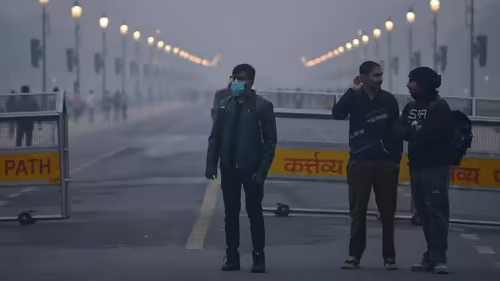
Imagine this: one arm of your government says toxic air killed more than a million people in a single year. Another says there’s simply ‘no conclusive evidence’ to prove it. This isn’t a plot twist from a political thriller—it’s happening right now in India.
The issue of air pollution deaths India has ignited a fierce debate between two key authorities: the Indian Council of Medical Research (ICMR) and the Union Ministry of Environment, Forest and Climate Change. Their conflicting stances aren’t just bureaucratic squabbles—they’re shaping national policy, public awareness, and, ultimately, lives.
Table of Contents
- The ICMR Report: Alarming Numbers
- Environment Ministry’s Skeptical Stance
- Why the Disagreement Matters
- What Global Science Says
- What Citizens Can Do Right Now
- Sources
The ICMR Report: Alarming Numbers
In a landmark 2018 study published in collaboration with global health experts, the Indian Council of Medical Research (ICMR)—India’s apex medical research body—delivered a sobering verdict: in 2017 alone, **air pollution was responsible for 1.24 million premature deaths** in India [[3]].
This figure wasn’t pulled from thin air. It was based on rigorous epidemiological modeling that linked exposure to fine particulate matter (PM2.5) and ambient ozone to diseases like stroke, heart attack, lung cancer, and chronic respiratory conditions. The study, part of the Global Burden of Disease project, placed India among the countries with the highest pollution-related mortality in the world [[6]].
Even more concerning? The ICMR noted that if air pollution levels were reduced to below the WHO’s recommended safe limit (5 µg/m³ annual mean), life expectancy in India could increase by an average of 1.7 years [[3]]. That’s not just data—it’s millions of lost birthdays, anniversaries, and family moments.
Environment Ministry’s Skeptical Stance
Yet, in stark contrast, the Union Ministry of Environment, Forest and Climate Change has repeatedly downplayed the direct link between air pollution and mortality. In official statements, including responses to parliamentary questions, the ministry has claimed there is “no conclusive data” to establish that air pollution causes deaths in India [[3]].
Instead, the ministry emphasizes that while poor air quality is a “health concern,” attributing specific fatalities to it is “scientifically complex.” They argue that comorbidities, lifestyle factors, and lack of real-time health monitoring make causal attribution difficult.
This position has drawn sharp criticism from public health experts, who say it undermines urgent action. “You don’t need a death certificate that says ‘killed by PM2.5’ to know dirty air is lethal,” said Dr. Arun Sharma, a former ICMR scientist. “The epidemiological evidence is overwhelming.”
Why the Disagreement Matters
This isn’t just academic. When government agencies contradict each other on a public health emergency, it creates confusion—and delays action.
Consider the implications:
- Policy paralysis: If the environment ministry won’t acknowledge the death toll, why invest billions in clean energy or stricter emission norms?
- Public apathy: Mixed messages lead citizens to believe the threat isn’t real, reducing compliance with measures like odd-even car schemes or mask-wearing.
- Global credibility: India’s stance weakens its negotiating power in climate forums where health co-benefits are key arguments for decarbonization.
Meanwhile, cities like Delhi, Ghaziabad, and Patna regularly rank among the world’s most polluted. Children are developing asthma. Elderly patients are hospitalized during winter smog spikes. And yet, the official narrative remains muddled.
What Global Science Says
Globally, the scientific consensus is clear. The World Health Organization (WHO) states that **air pollution is the single biggest environmental health risk**, causing an estimated 7 million premature deaths worldwide each year [[11]].
Studies from Harvard, Lancet Planetary Health, and the Global Burden of Disease all confirm that long-term exposure to PM2.5 significantly increases mortality risk—even at levels once considered “moderate.” There’s no credible scientific body that disputes this link today.
So why does India’s environment ministry resist? Experts speculate it’s tied to economic priorities: acknowledging the death toll could force costly regulations on industries, vehicles, and construction—sectors driving GDP growth. But as the ICMR data shows, the human cost may already outweigh the economic benefits.
What Citizens Can Do Right Now
While waiting for policy alignment, individuals aren’t powerless. Here’s how to protect yourself:
- Monitor air quality daily using apps like AirVisual or SAMEER.
- Use N95 masks when AQI exceeds 200.
- Install indoor air purifiers with HEPA filters, especially in bedrooms.
- Advocate locally—push municipal corporations to reduce waste burning and improve public transport.
- Support [INTERNAL_LINK:clean-air-initiatives-india] and citizen science projects tracking pollution sources.
More importantly, demand transparency. Ask your elected representatives why two wings of the government can’t agree on whether the air you breathe is killing you.
Conclusion: Clarity Saves Lives
The disconnect between the ICMR and the Environment Ministry on air pollution deaths India isn’t just confusing—it’s dangerous. One agency sees a public health catastrophe; the other sees statistical uncertainty. Until they align, effective national action will remain stalled.
But the science is settled. The data is clear. And for the 1.24 million families who lost someone in 2017, the answer isn’t “can’t say”—it’s tragically, undeniably “yes.”
Sources
- Times of India: Foul air causing deaths in India? ‘Yes’, ‘can’t say’: 2 govt arms take differing stands
- Lancet Planetary Health (2018): Health and economic impact of air pollution in India
- World Health Organization: Ambient (outdoor) air pollution – Key facts
- ICMR India State-Level Disease Burden Initiative: Official Reports