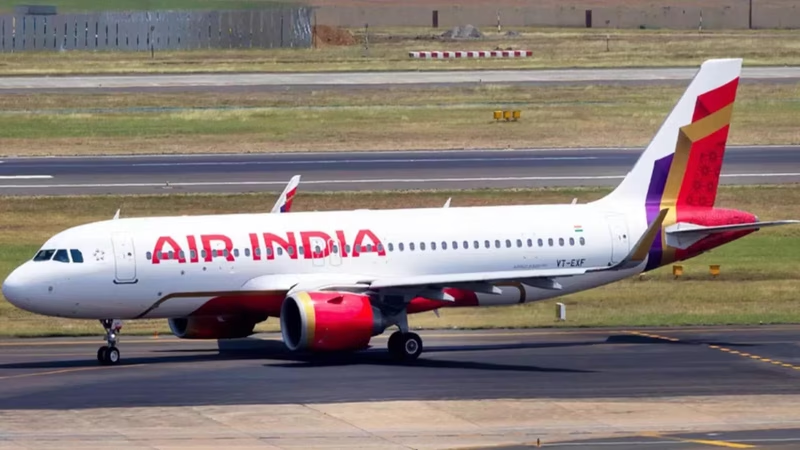
It’s every passenger’s worst nightmare: trusting your life to a pilot who’s supposed to be razor-sharp, only to learn they were under the influence of alcohol. This is the chilling reality that unfolded at Vancouver International Airport on December 23, 2025, involving an Air India flight crew. Now, the fallout has escalated to a diplomatic and regulatory crisis, with Transport Canada issuing a stark, non-negotiable ultimatum to the Indian flag carrier: “Act by Jan 26.”
The incident, which has sent shockwaves through the global aviation community, centers on an Air India pilot who allegedly failed a breathalyser test just hours before he was scheduled to operate a flight. His immediate removal from duty averted a potential catastrophe, but the damage to Air India’s hard-earned post-revival reputation is already severe. The Air India tipsy pilot scandal is no longer just an internal HR issue—it’s a matter of international flight safety and regulatory compliance.
Table of Contents
- The Vancouver Incident: What Happened on Dec 23?
- Canada’s Ultimatum: Why Jan 26 Is a Hard Deadline
- Air India’s Response and DGCA Involvement
- Global Aviation Rules on Pilot Alcohol Consumption
- Historical Precedents: Similar Incidents in Aviation
- The Stakes for Air India: Reputation and Operations
- What Passengers Need to Know About Flight Safety
- Conclusion: A Crisis of Trust and Accountability
- Sources
The Vancouver Incident: What Happened on Dec 23?
On the morning of December 23, 2025, routine pre-flight checks for an Air India flight departing from Vancouver took a dramatic turn. According to Canadian authorities, concerns were raised about the fitness of one of the pilots. A breathalyser test was administered, a standard protocol when impairment is suspected, and the results were unequivocal: the pilot was over the legal alcohol limit for flight crew .
Acting with zero tolerance, Transport Canada officials immediately removed the pilot from duty. The flight was delayed as a replacement crew was arranged, but a major safety breach had been averted. The incident was not a minor lapse; it was a direct violation of the most fundamental tenet of aviation: the absolute sobriety of the flight deck crew.
Canada’s Ultimatum: Why Jan 26 Is a Hard Deadline
Transport Canada, the nation’s civil aviation authority, did not treat this as an isolated, internal Air India matter. They have formally demanded a detailed action plan from the airline, with a firm deadline of January 26, 2026—a date that is literally just weeks away from the incident .
This hard deadline is a clear signal of Canada’s seriousness. Failure by Air India to provide a satisfactory response could lead to severe consequences, including:
- Operational Restrictions: Limiting the number of flights Air India can operate to and from Canada.
- Increased Scrutiny: Mandating more frequent and stringent checks on Air India crew and operations at Canadian airports.
- Reputational Damage: A formal black mark on the airline’s international standing, which could trigger similar reviews by other countries’ aviation regulators like the UK’s CAA or the European Union Aviation Safety Agency (EASA) .
Air India’s Response and DGCA Involvement
Air India has confirmed it has launched a “thorough internal investigation” into the matter. In a statement, the airline emphasized its “zero-tolerance policy towards any violation of safety and security protocols” . Crucially, they have also informed India’s own aviation regulator, the Directorate General of Civil Aviation (DGCA), about the incident.
The DGCA’s role is now pivotal. They are responsible for the licensing and discipline of Indian pilots. Standard procedure would involve suspending the pilot’s license pending the outcome of the investigation and potentially imposing heavy penalties, including a permanent ban, if the charges are proven. The speed and transparency of the DGCA’s and Air India’s joint response will be critical in placating their Canadian counterparts.
Global Aviation Rules on Pilot Alcohol Consumption
The rules are unambiguous and universally enforced. The International Civil Aviation Organization (ICAO), the UN’s aviation body, sets the global standard: a blood alcohol concentration (BAC) of 0.04% or higher is a strict no-go for flight crew. Many countries, including Canada and the US, enforce an even stricter “bottle-to-throttle” rule, prohibiting any alcohol consumption within 12 hours of a scheduled flight .
These rules exist for a simple, terrifying reason: alcohol impairs judgment, slows reaction times, and reduces cognitive function—all of which are catastrophic in the high-stakes environment of a cockpit. A single lapse can cost hundreds of lives.
Historical Precedents: Similar Incidents in Aviation
Unfortunately, this is not the first time such an incident has occurred. The aviation industry has a documented history of these serious breaches:
- In 2019, an Air India pilot was arrested in London for being drunk before a flight, leading to a 22-month prison sentence.
- In 2017, two pilots for a low-cost carrier in Europe were found intoxicated before their shift, resulting in immediate terminations and industry-wide bans.
Each incident serves as a grim reminder of the constant vigilance required. For a deeper look at aviation safety culture, see our analysis on [INTERNAL_LINK:aviation-safety-protocols-explained].
The Stakes for Air India: Reputation and Operations
Air India is in the midst of a massive, high-profile turnaround under its new Tata Group ownership. Billions have been invested in new aircraft, improved service, and a global rebranding effort to shed its old image of inefficiency. The Air India tipsy pilot scandal is a direct assault on this carefully constructed new identity.
Beyond the immediate Canadian threat, the incident raises questions about the airline’s internal culture, crew management, and pre-flight screening processes. If they are seen as lax on such a critical safety issue, it could undermine passenger confidence globally and jeopardize their ambitious expansion plans.
What Passengers Need to Know About Flight Safety
While this incident is alarming, it’s important for passengers to understand that the system worked as designed. The checks and balances in place—suspicious colleagues, vigilant ground staff, and proactive regulators—successfully prevented a compromised pilot from taking control of an aircraft. Aviation remains one of the safest modes of transport precisely because of this multi-layered safety net and the severe consequences for its violation.
Conclusion: A Crisis of Trust and Accountability
The “Air India tipsy pilot” incident is a stark wake-up call. It’s a crisis that goes beyond one individual’s poor judgment. It’s a test of Air India’s leadership, its safety culture, and its ability to be a responsible global aviation partner. The January 26 deadline from Transport Canada is not just a date on a calendar; it’s a judgment day that will determine whether the airline can swiftly and credibly restore the trust that is the very foundation of safe flight.