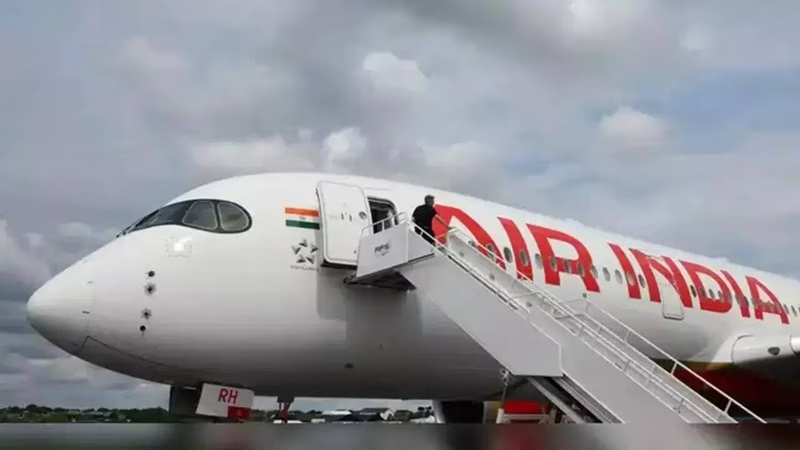
Imagine boarding a 14-hour international flight, trusting your life to a team of professionals in the cockpit—only to learn that one of them was allegedly under the influence of alcohol before takeoff. That chilling scenario became reality for passengers on Air India flight AI186 on December 23, 2025, when Canadian authorities intervened at Vancouver International Airport (YVR) and removed a pilot from duty after he failed a sobriety check. The incident, confirmed by Air India in an official statement, has ignited a global conversation about aviation safety, crew accountability, and the robustness of pre-flight screening protocols. This isn’t just a personnel matter—it’s a potential systemic failure with far-reaching implications.
Table of Contents
- What Happened on Flight AI186?
- Air India Pilot Drunk: Official Response and Investigation
- Aviation Safety Laws: Alcohol and the Cockpit
- Impact on Passengers and Flight Delays
- How Do Airlines Screen Pilots for Alcohol?
- Historical Precedents and Industry Standards
- What This Means for Air India and Traveler Confidence
- Conclusion: A Wake-Up Call for Global Aviation
What Happened on Flight AI186?
On the morning of December 23, 2025, Air India’s Boeing 777 was preparing for its scheduled departure from Vancouver to New Delhi—a critical long-haul route connecting Canada and India. As part of standard pre-flight procedures, Canadian transportation and airport security officials conducted a routine check on the cockpit crew. During this process, one of the pilots allegedly exhibited signs of intoxication. A breathalyzer test was administered, and the results confirmed the presence of alcohol in his system well above the legal limit for operating an aircraft.
Under Canadian aviation law, any detectable blood alcohol concentration (BAC) above 0.04% for flight crew is a serious violation. The pilot was immediately removed from duty and handed over to local authorities. His removal caused a significant delay—over five hours—as Air India scrambled to arrange a replacement crew qualified for the long-haul flight . Passengers, many of whom were holiday travelers, were left stranded and frustrated, unaware of the gravity behind the delay.
Air India Pilot Drunk: Official Response and Investigation
Following the incident, Air India issued a formal statement expressing “deep regret” over the event. The national carrier confirmed that the pilot in question had been “taken off flying duties with immediate effect” and that a “thorough internal investigation” had been initiated in coordination with Canadian authorities.
“Air India maintains a zero-tolerance policy towards the consumption of alcohol by its flight crew within the stipulated no-alcohol window before a flight,” the statement read. “We are fully cooperating with the relevant authorities and will take strict disciplinary action based on the findings of the probe.”
This swift response is standard protocol, but it raises deeper questions: How did the pilot pass internal checks before arriving at the airport? Was this a one-off lapse, or a symptom of a larger cultural or procedural flaw within the airline’s crew management system?
Aviation Safety Laws: Alcohol and the Cockpit
Globally, aviation regulators enforce strict rules regarding alcohol consumption by flight crew. The International Civil Aviation Organization (ICAO) recommends a minimum 12-hour “bottle-to-throttle” window, though many countries—including Canada, the U.S., and India—mandate an 8- to 12-hour abstinence period before flight duty.
In Canada, Transport Canada’s Aeronautics Act is explicit: operating an aircraft while impaired is a criminal offense. The penalties can include license suspension, fines, and even imprisonment. Similarly, India’s Directorate General of Civil Aviation (DGCA) has stringent guidelines under its Civil Aviation Requirements (CAR), which prohibit any crew member from consuming alcohol within 12 hours of a scheduled flight .
Impact on Passengers and Flight Delays
For the 300+ passengers on AI186, the delay was more than an inconvenience—it was a breach of trust. While Air India provided meal vouchers and accommodation for those affected, the psychological impact of learning that their pilot was intoxicated is harder to quantify. In an era where air travel safety is taken for granted, such incidents can severely damage passenger confidence.
This event also highlights the operational fragility of long-haul routes. Finding a replacement pilot with the necessary aircraft rating and rest compliance in a foreign country is logistically complex—a vulnerability airlines must now address with better contingency planning.
How Do Airlines Screen Pilots for Alcohol?
Most major international airlines have multi-layered screening processes:
- Pre-flight self-declaration: Pilots must confirm they are fit for duty.
- Random testing: Some carriers use unannounced breathalyzer tests.
- Airport security checks: As seen in Vancouver, local authorities often have the final say.
- Peer monitoring: Co-pilots and crew are trained to report signs of impairment.
Yet this incident suggests gaps may still exist. For instance, if Air India relies solely on self-reporting and peer observation without mandatory pre-departure testing at overseas stations, a determined individual could slip through.
Historical Precedents and Industry Standards
This is not the first time a major airline has faced such a scandal. In 2019, a Lufthansa pilot was arrested in Canada for being drunk before a flight. In 2022, a Japan Airlines co-pilot was found with a BAC of 0.59%—nearly 15 times the legal limit—in Scotland. Each case led to internal reviews and policy tightening .
The aviation industry learns from these failures. Leading carriers like Singapore Airlines and Emirates have implemented mandatory alcohol testing at crew reporting points worldwide—a standard that may now be under scrutiny for other airlines, including Air India.
What This Means for Air India and Traveler Confidence
For Air India, which is undergoing a massive modernization and rebranding effort under the Tata Group, this incident is a reputational setback. Travelers choosing between Air India, Qatar Airways, or Emirates on the India-Canada route may now hesitate. As noted by [INTERNAL_LINK:aviation-safety-reputation], a single safety lapse can undo years of brand-building.
The airline’s response will be critical. Full transparency, disciplinary action, and the implementation of universal pre-flight alcohol testing could turn this crisis into an opportunity to demonstrate renewed commitment to safety.
Conclusion: A Wake-Up Call for Global Aviation
The Air India pilot drunk incident is more than a disciplinary issue—it’s a stark reminder that human factors remain a critical vulnerability in aviation safety. While technology has made flying incredibly safe, the integrity of the crew is equally vital. This case should prompt not just Air India, but regulators worldwide, to re-examine crew screening protocols, especially on international routes. Passengers deserve to fly with absolute confidence that everyone in the cockpit is fully capable, focused, and sober. Anything less is unacceptable.