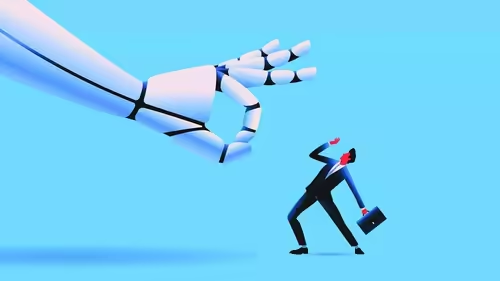
The robots are coming for our jobs. Again. This time, the warning bell is ringing from one of the most powerful financial institutions in the world: Goldman Sachs. Their latest analysis paints a stark picture—AI could automate a quarter of all work hours, potentially displacing 6-7% of the entire workforce .
It’s a headline that’s easy to panic over. But before you start updating your resume for a post-apocalyptic gig economy, let’s take a deep breath and look at the full picture. Because while **AI job displacement** is a real and present concern, the story doesn’t end with mass unemployment. In fact, it might just be the beginning of a whole new chapter in the world of work.
Table of Contents
- The Goldman Sachs AI Job Displacement Report: What It Actually Says
- Historical Lessons: Why Technology Hasn’t Killed Jobs (Yet)
- The New AI Economy: What Jobs Are Being Created?
- Who Is Most at Risk (and Who Isn’t)?
- How to Future-Proof Your Career in the Age of AI
- Conclusion: Disruption, Not Destruction
- Sources
The Goldman Sachs AI Job Displacement Report: What It Actually Says
Released in August 2025, the Goldman Sachs report is a sobering yet nuanced take on the AI revolution. The key takeaway is that AI won’t simply replace entire jobs overnight. Instead, it will automate specific tasks within a wide range of occupations, effectively making a significant portion of current work hours redundant .
This distinction is crucial. It means that for many workers, their role won’t vanish—it will transform. An analyst might spend less time on data crunching and more on strategic interpretation. A writer might use AI for research and first drafts, focusing their energy on high-level editing and creative direction.
However, for a segment of the workforce—estimated at 6-7%—the automation of their core tasks could indeed lead to their positions being eliminated . The report emphasizes that this is a significant labor market shift, but stops short of predicting a full-blown employment crisis.
Historical Lessons: Why Technology Hasn’t Killed Jobs (Yet)
This isn’t the first time we’ve stood at the precipice of a technological cliff. From the steam engine to the personal computer, every major innovation has sparked fears of widespread job loss. And yet, the long-term trend has been one of net job creation and rising living standards .
Why? Because technology doesn’t just destroy; it also builds. It creates entirely new industries, demands new skills, and generates a wave of supporting roles that were unimaginable before. The rise of the automobile didn’t just kill the blacksmith; it created millions of jobs in manufacturing, sales, repair, and road construction.
As one analysis of historical data confirms, while new technologies like industrial robots have had a significant impact on specific labor markets, they have not resulted in a negative net employment effect over the past decades . The challenge has always been the transition period—the time it takes for workers to adapt and for the new economy to fully emerge.
The New AI Economy: What Jobs Are Being Created?
So, what does the new AI-driven economy look like? It’s already taking shape, and it’s filled with roles that didn’t exist a decade ago. The World Economic Forum (WEF) forecasts that while AI and other technologies may displace 92 million jobs by 2030, they are expected to create a staggering 170 million new ones .
Here’s a glimpse into the future of work, with some of the most in-demand AI-created roles:
- Prompt Engineer: These professionals are the “whisperers” who craft the perfect instructions to get the best output from AI models.
- AI Ethicist: As AI makes more decisions, we need experts to ensure these systems are fair, unbiased, and aligned with human values.
- AI Trainer & Auditor: Someone has to teach AI systems using quality data and then audit them to ensure they’re performing correctly and ethically .
- AI Maintenance Specialist: Complex AI systems require ongoing monitoring, troubleshooting, and optimization.
- AI-Assisted Healthcare Technician: A new breed of medical professional who leverages AI for diagnostics, patient monitoring, and personalized treatment plans .
These aren’t just theoretical positions. They are real jobs with real salaries, and they represent a massive opportunity for those willing to adapt and learn. [INTERNAL_LINK:future-of-work-skills] explores the key competencies needed to thrive in this new landscape.
Who Is Most at Risk (and Who Isn’t)?
The impact of AI won’t be felt equally across all sectors or demographics. Goldman Sachs’ analysis suggests that younger tech workers, particularly those in their 20s and 30s, are already feeling the initial pressure, with unemployment rates in AI-exposed roles showing an uptick in 2025 .
Jobs that involve highly repetitive, predictable tasks—whether in data entry, basic customer service, or even certain aspects of coding—are most vulnerable to automation. On the flip side, roles that demand high levels of creativity, emotional intelligence, complex problem-solving, and physical dexterity in unstructured environments are far more resilient.
This highlights a critical point: the future belongs to uniquely human skills. AI is a powerful tool, but it cannot replicate the empathy of a nurse, the strategic vision of a leader, or the innovative spark of a true artist.
How to Future-Proof Your Career in the Age of AI
Facing the reality of **AI job displacement** doesn’t mean resigning yourself to obsolescence. It means becoming proactive. Here’s how:
- Embrace Lifelong Learning: The half-life of a skill is shrinking. Commit to continuous upskilling and reskilling, especially in areas where humans have a clear advantage over machines.
- Learn to Work *With* AI: Don’t see AI as a competitor; see it as a collaborator. Learn how to leverage AI tools to amplify your own productivity and creativity.
- Focus on Your Human Edge: Double down on your soft skills—communication, critical thinking, leadership, and adaptability. These are your superpowers in the AI era.
- Stay Informed: Keep a close eye on industry trends and how AI is being integrated into your specific field. [INTERNAL_LINK:ai-industry-trends] can be a great resource for this.
Conclusion: Disruption, Not Destruction
The Goldman Sachs report on **AI job displacement** is a vital wake-up call, not a death knell for the workforce. Yes, a significant transition is coming, and it will be challenging for many. But history and current trends strongly suggest that the ultimate outcome won’t be a barren job market, but a transformed one.
The key to navigating this shift is to move beyond fear and towards agency. By understanding the risks, embracing the opportunities, and actively preparing for the future, both individuals and businesses can not only survive the AI revolution but thrive in it. The goal isn’t to stop the tide of technology, but to learn how to surf the wave.
Sources
- Times of India: Goldman Sachs analysts warn 25% of all work hours could be automated by AI
- Goldman Sachs Research: Various public reports and summaries from August 2025 [[1], [4], [5], [8]].
- World Economic Forum: The Future of Jobs Report 2025 .
- Hötte, K. (2023). Technology and jobs: A systematic literature review .
- Saoudi, H. (Year). Report – The Impact of New Technologies on Employment .