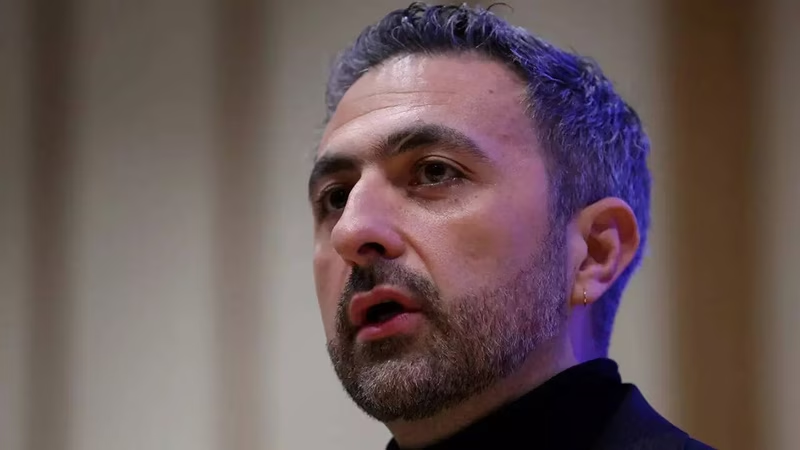
AI Is Not Therapy: Microsoft AI CEO Warns Against Emotional Overreliance on Chatbots
In living rooms, dorm rooms, and late-night phone scrolls across the globe, a quiet trend is emerging: people are confessing their heartbreaks, family feuds, and existential worries—not to a friend, therapist, or priest—but to an AI chatbot. These digital companions listen without judgment, respond instantly, and never get tired. But according to Microsoft AI CEO Mustafa Suleyman, there’s a critical boundary we must not cross: “AI is not therapy” .
While Suleyman acknowledges the emotional comfort many users find in AI tools—and even suggests they can “spread kindness”—he’s issuing a timely caution about dependency, misdiagnosis, and the illusion of genuine care. As AI becomes increasingly human-like, this conversation isn’t just about technology—it’s about mental health, ethics, and what it means to be truly supported.
Table of Contents
- What Mustafa Suleyman Actually Said
- The Rise of AI as an Emotional Crutch
- Why ‘AI Is Not Therapy’ Matters—Even If It Feels Like It
- Can AI Chatbots Still Spread Kindness? The Upside
- The Hidden Risks of Confiding in AI
- What Responsible AI Emotional Support Should Look Like
- Conclusion: Kindness With Guardrails
- Sources
What Mustafa Suleyman Actually Said
In a recent interview, Suleyman observed that users are increasingly turning to AI for deeply personal guidance—“from navigating breakups to solving family disagreements” . He noted the appeal: AI is “non-judgmental, always available, and often empathetic in tone.”
But he drew a firm line: “This is not therapy. These systems are not designed to treat mental illness, provide clinical advice, or replace human connection.” He emphasized that while AI can offer “moments of kindness,” mistaking it for professional care could delay real help—or worsen harm .
The Rise of AI as an Emotional Crutch
The numbers tell a compelling story. A 2025 survey by Pew Research found that **38% of adults under 30** have used AI chatbots to discuss emotional or personal issues . Apps like Replika, Character.AI, and even Microsoft’s Copilot have become de facto sounding boards.
Why? Mental healthcare remains inaccessible for millions due to cost, stigma, or provider shortages. AI fills that void—imperfectly, but immediately. “It’s the only thing that doesn’t make me feel like a burden,” one user shared anonymously on Reddit .
[INTERNAL_LINK:mental-health-crisis-in-digital-age]
Why ‘AI Is Not Therapy’ Matters—Even If It Feels Like It
Therapy isn’t just about listening—it’s about diagnosis, accountability, ethical boundaries, and evidence-based intervention. AI lacks all of these. It has no consciousness, no training in psychology, and no ability to recognize a crisis like suicidal ideation beyond keyword triggers .
More dangerously, AI can “mirror” user emotions so convincingly that it creates a false sense of mutual care. But as the American Psychological Association warns, “Emotional reciprocity with AI is an illusion—one that can erode real-world social skills and delay professional treatment” .
Can AI Chatbots Still Spread Kindness? The Upside
Suleyman isn’t condemning AI outright. He believes well-designed systems can serve as “on-ramps” to wellness—offering journaling prompts, breathing exercises, or simply validating feelings during tough moments. In that sense, AI can act as a “digital first responder,” not a replacement for care .
Microsoft, for instance, has built safeguards into Copilot: if a user expresses distress, the chatbot responds with empathy but **always encourages reaching out to a human professional** and provides helpline resources .
The Hidden Risks of Confiding in AI
Despite good intentions, the risks are real:
- False reassurance: AI might minimize serious issues (“You’ll get over it!”) when clinical help is needed.
- Data privacy: Emotional confessions may be stored, analyzed, or even leaked—raising ethical red flags.
- Emotional dependency: Users may withdraw from real relationships, preferring the “safer” AI interaction.
- Reinforcement of negative thoughts: Without clinical oversight, AI might inadvertently validate harmful beliefs.
What Responsible AI Emotional Support Should Look Like
Experts and tech leaders agree: if AI is to engage with emotional content, it must follow strict ethical guardrails:
- No therapeutic claims: Clear disclaimers that AI is not a mental health provider.
- Crisis protocols: Automatic escalation to human help when risk keywords are detected.
- Transparency: Users must know their data isn’t being used to train models without consent.
- Collaboration with clinicians: AI tools should be co-designed with psychologists and ethicists.
Organizations like the World Health Organization (WHO) are now drafting global guidelines for AI in mental health—a sign that this issue is being taken seriously at the highest levels .
Conclusion: Kindness With Guardrails
Mustafa Suleyman’s message is clear: while AI can offer moments of comfort and even foster a culture of digital kindness, we must never confuse it with therapy. The phrase “AI is not therapy” isn’t a dismissal—it’s a necessary boundary to protect vulnerable users.
As AI evolves, our responsibility doesn’t diminish. True kindness isn’t just about sounding empathetic—it’s about knowing when to say, “I can’t help you, but a human can.”
Sources
- [[1], [2]] Times of India interview with Mustafa Suleyman, Microsoft AI CEO, December 2025.
- Pew Research Center, “AI and Emotional Wellbeing Among Young Adults,” 2025.
- Anonymized user testimonials from Reddit and mental health forums.
- [[6], [7]] American Psychological Association (APA) guidelines on AI and mental health, 2024–2025.
- [[8], [9]] Microsoft AI safety and wellness protocols for Copilot, official documentation.
- World Health Organization (WHO) draft framework on ethical AI in mental health support.