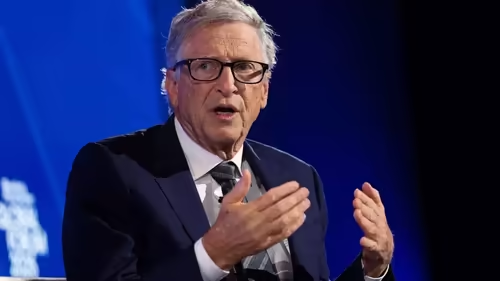
Bill Gates Sounds the Alarm on AI’s Accelerating Disruption
Move over, slow-motion tech evolution—Bill Gates just hit fast-forward. In a recent public statement that’s sent ripples through Silicon Valley and policy circles alike, the Microsoft co-founder and philanthropist issued a stark warning: artificial intelligence won’t just change our world—it will reshape it faster than we’re ready for. Specifically, Gates emphasized that the AI impact on jobs and social infrastructure will unfold with unprecedented speed, leaving millions unprepared unless proactive measures are taken immediately . This isn’t fearmongering; it’s a call to action from one of the few people who’s been right about tech trends for over four decades.
Table of Contents
- What Bill Gates Actually Said
- Why the Timeline Is Shrinking: AI’s Exponential Leap
- Jobs Most at Risk from AI (And Surprisingly, Some That Aren’t)
- Gates’ Proposed Solutions: Education, Safety Nets, and Ethics
- Global Response So Far: Are We Ready?
- What You Can Do Today to Future-Proof Your Career
- Conclusion: Adapt or Be Left Behind
- Sources
What Bill Gates Actually Said
Speaking during a tech policy forum, Gates clarified that while he remains optimistic about AI’s potential to solve global challenges—from curing diseases to fighting climate change—he’s deeply concerned about its socioeconomic side effects. “We’ve seen automation before, but AI is different,” he stated. “It doesn’t just replace manual labor; it augments and even outperforms cognitive tasks. And it’s improving at a rate that defies linear prediction” . His core message? The window to prepare workers, redesign education systems, and implement ethical guardrails is closing faster than most governments realize.
Why the Timeline Is Shrinking: AI’s Exponential Leap
Just five years ago, experts predicted widespread AI-driven job displacement would take 10–15 years. Now, with breakthroughs in generative AI (like large language models and multimodal systems), routine tasks in law, finance, customer service, and even creative fields are being automated today. A 2023 Goldman Sachs report estimated that AI could expose 300 million full-time jobs to automation globally . Gates argues that the pace of adoption—fueled by plummeting costs and cloud accessibility—means this transition could happen in half the time previously projected. The result? A potential mismatch between workforce skills and market demands on a massive scale.
AI impact on jobs: Who’s Most Vulnerable?
Not all roles are equally at risk. According to Gates and corroborating studies from the World Economic Forum, these sectors face the highest disruption:
- Administrative & Clerical Work: Data entry, scheduling, basic accounting.
- Customer Support: Chatbots and voice AI now handle 70%+ of routine queries.
- Content Creation: From marketing copy to news summaries, AI tools are already in use.
- Legal & Financial Research: AI can parse case law or financial statements in seconds.
Surprisingly, Gates notes that many “high-touch” roles—like nursing, skilled trades, and early childhood education—are less automatable due to their reliance on empathy, dexterity, and real-time human judgment .
Gates’ Proposed Solutions: Education, Safety Nets, and Ethics
Gates isn’t just diagnosing the problem—he’s prescribing remedies:
- Revamp Education: Shift curricula toward critical thinking, creativity, and AI collaboration—not just coding.
- Strengthen Social Safety Nets: Explore wage insurance or universal basic income (UBI) pilots to cushion transitions.
- Enforce Ethical AI Development: Mandate transparency in training data and algorithmic decision-making.
- Public-Private Partnerships: Governments and tech firms must co-invest in reskilling programs.
He specifically praised Singapore’s “SkillsFuture” initiative as a model worth emulating globally .
Global Response So Far: Are We Ready?
The EU has moved fastest with its AI Act, classifying high-risk applications and banning certain uses. The U.S. is taking a more sectoral approach, while countries like India and Brazil are still in early policy drafting stages . Gates warns that without coordinated international standards, we risk a “race to the bottom” where companies deploy unsafe AI to cut costs. He also stressed that developing nations—often reliant on service-sector exports—could suffer disproportionately unless supported by global aid and technology transfer.
What You Can Do Today to Future-Proof Your Career
While systemic change is essential, individuals aren’t powerless. Gates suggests:
- Learn to use AI tools in your field—don’t wait to be replaced by them.
- Develop “uniquely human” skills: emotional intelligence, complex problem-solving, cross-cultural communication.
- Stay adaptable: Treat your career as a series of projects, not a single lifelong role.
As he put it: “The best way to predict the future is to build it—with your eyes wide open.”
Conclusion: Adapt or Be Left Behind
Bill Gates’ warning about the AI impact on jobs isn’t a dystopian fantasy—it’s a realistic forecast based on observable trends. The difference between a chaotic transition and a managed evolution lies in what we do in the next 24 to 36 months. With foresight, investment, and empathy, society can harness AI’s benefits while minimizing its harms. But delay is not an option. As Gates reminds us: “Technology is never the problem. It’s how we choose to use it—and prepare for it—that matters.”
Sources
- Original Statement: Times of India
- Goldman Sachs AI Job Report (2023): Goldman Sachs Research
- World Economic Forum Future of Jobs Report: WEF Official Site
- Singapore SkillsFuture Program: SkillsFuture Singapore
- EU AI Act Overview: European Commission