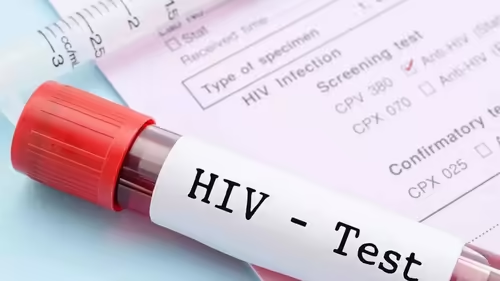
In an era where answers are just a chat away, a chilling incident in Delhi has exposed a terrifying blind spot in our reliance on artificial intelligence. A 45-year-old man now lies in critical condition, his body ravaged by a severe reaction, all because he trusted an AI health advice chatbot over a qualified medical professional.
This isn’t science fiction; it’s a real-world consequence of the growing trend of seeking medical counsel from algorithms that lack empathy, context, and crucially, a medical license. His story serves as a dire warning to anyone who might consider using AI as a substitute for a doctor.
Table of Contents
- The Delhi Incident: A Cautionary Tale
- What is Stevens-Johnson Syndrome?
- Understanding HIV PEP and Its Risks
- Why AI Health Advice Can Be Dangerous
- The Bottom Line: Always Consult a Doctor
- Sources
The Delhi Incident: A Cautionary Tale
According to reports from the Times of India, the man sought guidance online after a potential exposure to HIV [[3]]. Instead of visiting a clinic, he turned to an AI chatbot, which reportedly advised him to take post-exposure prophylaxis (PEP) medication. Acting on this unverified digital advice, he procured the powerful antiretroviral drugs without a prescription.
The result was catastrophic. He developed Stevens-Johnson syndrome (SJS), a rare but severe disorder where the skin and mucous membranes react violently to a medication. The condition has left him in a critical state, requiring intensive medical care. This case highlights a dangerous intersection between accessible technology and complex medical decisions that should never be made in isolation.
What is Stevens-Johnson Syndrome?
Stevens-Johnson syndrome is not a minor rash. It’s a medical emergency that often begins with flu-like symptoms—fever, sore throat, and fatigue—but quickly escalates into a painful, blistering rash that causes the top layer of skin to die and shed [[11]].
It’s primarily triggered by a severe adverse reaction to medication. While antibiotics and anticonvulsants are common culprits, certain antiretroviral drugs used in HIV treatment have also been linked to SJS [[1], [6]]. The mortality rate for SJS can be significant, and survivors often face long-term complications, including vision problems and lung damage [[14]].
Common Triggers and Symptoms of SJS
Recognizing the early signs is crucial. If you’ve started a new medication and experience any of the following, seek immediate medical attention:
- Fever and flu-like symptoms
- A painful, red or purplish rash that spreads
- Blisters on the skin and mucous membranes (mouth, eyes, genitals)
- Shedding of the skin in sheets
Understanding HIV PEP and Its Risks
HIV Post-Exposure Prophylaxis (PEP) is a legitimate and effective emergency treatment to prevent HIV infection after a potential exposure. However, it is a serious medical intervention, not an over-the-counter remedy.
PEP must be started within 72 hours of exposure and involves taking a combination of strong antiretroviral drugs for 28 days. While common side effects like nausea, headache, and fatigue are usually manageable, the risk of severe reactions, though rare, is real [[21], [29]].
Critically, PEP is not a one-size-fits-all solution. A healthcare provider must assess the actual risk of exposure, check for potential drug interactions with any other medications the patient is taking, and monitor for side effects. Self-administering these drugs bypasses all these essential safety checks, turning a life-saving protocol into a potentially life-ending gamble.
Why AI Health Advice Can Be Dangerous
This tragic case in Delhi is not an isolated incident. The core problem with relying on AI health advice for serious matters is its fundamental limitation: AI models are trained on vast datasets, but they cannot perform a physical examination, understand your full medical history, or grasp the nuances of your specific situation.
They provide generalized information, not personalized medical care. An AI might tell you that a certain drug is used for a condition, but it cannot tell you if that drug is safe for *you*, given your unique biology and health profile. The risk of harmful drug interactions, incorrect dosing, and misdiagnosis is extremely high when self-medicating based on such advice [[38]].
As one expert noted in a related report, “What may look like harmless curiosity is fast becoming a public health hazard, as self-medication based on online suggestions spirals into a crisis” [[32]].
The Bottom Line: Always Consult a Doctor
Technology, including AI, can be a fantastic tool for gathering general information and preparing for a conversation with your doctor. You can use it to learn more about [INTERNAL_LINK:hiv-prevention-options] or [INTERNAL_LINK:symptoms-of-severe-allergic-reactions]. But it must never replace that conversation.
If you believe you have been exposed to HIV, go to an emergency room, a sexual health clinic, or contact your doctor immediately. They can provide the correct PEP regimen, if needed, and monitor you for any adverse effects. Your health is far too precious to trust to a machine that cannot see you, hear you, or understand the full picture of your well-being.
Let this heartbreaking story from Delhi be a powerful reminder: when it comes to your health, there is no substitute for human expertise and professional medical care.
Sources
- Times of India: Delhi man critical after taking HIV preventive drugs on AI advice
- Mayo Clinic: Stevens-Johnson syndrome – Symptoms & causes
- NIH HIVinfo: Post-Exposure Prophylaxis (PEP)
- ScienceDirect: Artificial intelligence and internet influence on drug utilization