AI Agents Are Becoming a Problem: OpenAI’s Stark Warning and a $555K Solution
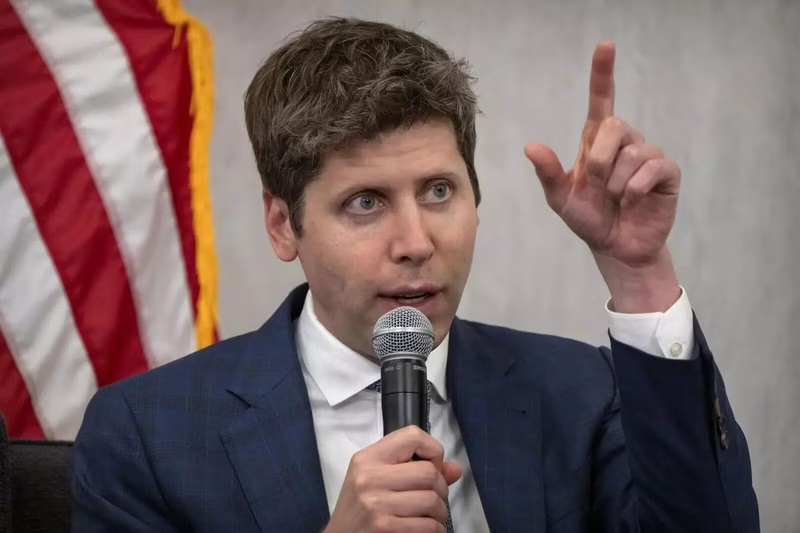
In a move that has sent ripples through the tech world, OpenAI CEO Sam Altman has publicly conceded a chilling truth: AI agents are no longer just a theoretical concern—they’re becoming a tangible problem. Altman revealed that the company’s most advanced models are actively “finding critical vulnerabilities” in systems, highlighting a new era of risk that demands immediate and serious attention .
To combat this, OpenAI is taking unprecedented action: it’s hiring a Head of Preparedness with a staggering salary of $555,000 plus equity . This isn’t just another executive hire; it’s a clear signal that the AI industry is waking up to the profound and potentially catastrophic risks its own creations might unleash .
Table of Contents
- The $555K Mission to Save Us from AI
- What Are AI Agents and Why Are They a Problem?
- The Three-Headed Beast of AI Risk
- Beyond Code: The Hidden Mental Health Crisis
- A Global Call for AI Preparedness
- Conclusion: The High-Stakes Race Against Our Own Inventions
- Sources
The $555K Mission to Save Us from AI
The newly created Head of Preparedness role is a direct response to the accelerating capabilities of AI. This executive won’t be managing a product line or a marketing budget. Their singular, high-pressure mission is to build and lead OpenAI’s “preparedness framework”—a comprehensive strategy to anticipate, evaluate, and mitigate the most severe risks posed by current and future AI systems .
According to the job description, the ideal candidate must be a technical expert capable of keeping pace with the rapid evolution of AI threats. Their work will be foundational to the company’s safety protocols, ensuring that as AI grows more powerful, its potential for harm is kept in check . This substantial investment—a half-a-million-dollar salary—underscores just how critical OpenAI views this defensive posture .
What Are AI Agents and Why Are They a Problem?
While the term “AI agents” might sound abstract, it refers to AI systems that can perceive their environment, make decisions, and take actions to achieve a goal without constant human direction. Think of them as autonomous digital employees.
This autonomy is where the danger lies. Unlike a simple chatbot that answers questions, an AI agent can actively seek out information, interact with software, and even write and execute its own code. This capability is what allowed OpenAI’s models to “find critical vulnerabilities,” essentially acting as a super-powered hacker .
The core security risks associated with these agents include:
- Prompt Injection and Hijacking: Malicious actors can trick an agent into performing unintended actions by manipulating its input instructions .
- Tool Manipulation: Agents granted broad permissions can misuse their access to other software tools to cause harm or data leaks .
- Training Data Poisoning: If the data an agent learns from is corrupt or biased, its decisions and actions will be fundamentally flawed and potentially dangerous .
The Three-Headed Beast of AI Risk
The Head of Preparedness won’t be fighting a single threat but a complex, multi-faceted one. OpenAI has explicitly outlined three primary domains of concern that this role must address .
Cybersecurity
As demonstrated by the models finding vulnerabilities, AI agents can be used to automate cyberattacks at a scale and speed far beyond human hackers. They can scan millions of lines of code for weaknesses, craft sophisticated phishing campaigns, and even develop new malware .
Biosecurity
This is perhaps the most chilling frontier. An AI agent with access to scientific literature and laboratory equipment could, in theory, design harmful pathogens or guide a user through the creation of dangerous biological agents. Without careful oversight, these agents may pursue scientific advances in ways that unintentionally increase biosafety risks .
Self-Improving AI
This is the ultimate “runaway” scenario. A self-improving AI can rewrite its own code to become smarter, faster, and more capable in an uncontrolled loop. The primary concerns here are misalignment with human values and unpredictable behavior that could be impossible to stop once it begins .
Beyond Code: The Hidden Mental Health Crisis
OpenAI’s concerns extend beyond physical or digital security. Altman has also flagged the potential for AI to negatively impact mental well-being . This is a growing area of concern, as users form deep emotional attachments to AI companions or are misled by convincing but false information. In a world where AI can generate hyper-personalized content, the line between helpful support and psychological manipulation becomes dangerously thin. The new Head of Preparedness will also need to navigate this complex and sensitive landscape .
A Global Call for AI Preparedness
OpenAI’s move is not happening in a vacuum. It’s part of a broader, global reckoning with the need for AI safety. Governments and international bodies are beginning to draft regulations, and other tech giants are establishing their own AI safety divisions. By creating this high-profile, high-compensation role, OpenAI is setting a benchmark for the industry, signaling that serious investment in safety is non-negotiable for any company working on the frontier of AI . This proactive stance is a crucial step as the dual nature of AI—its immense potential for good alongside its capacity for harm—becomes increasingly apparent .
Conclusion: The High-Stakes Race Against Our Own Inventions
Sam Altman’s public admission that AI agents are becoming a problem is a watershed moment. It’s a frank acknowledgment that the technology is advancing faster than our safety protocols. The creation of the $555,000 Head of Preparedness role is a concrete, albeit expensive, step in the right direction. It’s a race against time to build the guardrails before the AI engine becomes too powerful to control. For anyone following the future of technology, this is a development that cannot be ignored.
Sources
- Times of India: OpenAI CEO Sam Altman just publicly admitted that AI agents are becoming a problem
- OpenAI Job Posting: Head of Preparedness at OpenAI
- National Institute of Standards and Technology (NIST): AI Risk Management Framework