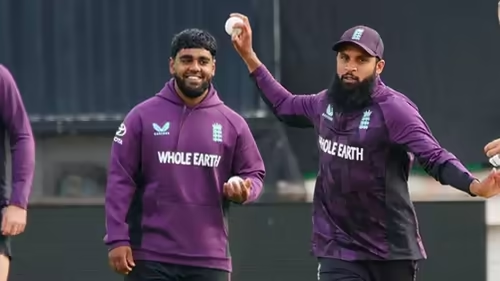
Just weeks before the start of the highly anticipated T20 World Cup 2026 in India, a potential diplomatic and logistical crisis has been averted—thanks to swift action by the International Cricket Council (ICC). The global governing body has confirmed that Indian visas have now been granted to multiple Pakistan-origin players representing teams like England and the Netherlands, ending days of uncertainty.
This development comes after growing concerns that bureaucratic delays might prevent key athletes from participating in cricket’s biggest T20 spectacle. With the ICC setting a hard deadline of January 31, 2026, for all visa clearances, the successful resolution marks a critical win for tournament organizers—and fans worldwide.
Table of Contents
- Why T20 World Cup Visas Became a Contentious Issue
- ICC Steps In to Resolve the Impasse
- Which Players and Teams Are Affected?
- The Road Ahead to the T20 World Cup
Why T20 World Cup Visas Became a Contentious Issue
India and Pakistan have long had strained diplomatic relations, and this tension often spills into the realm of sports. While the two nations still compete on the cricket field, off-field logistics—especially travel and visas—remain sensitive.
The complication this time? Several star players in non-Pakistan squads were born in Pakistan or hold dual heritage. For instance, England’s squad includes players like Moeen Ali and Adil Rashid, both of Pakistani descent. Similarly, the Netherlands team features athletes with strong familial ties to Pakistan.
Historically, Indian authorities have subjected such individuals to enhanced scrutiny when applying for visas—particularly for high-profile events. While no official policy bars them, processing times can stretch unpredictably, raising fears of last-minute exclusions.
With the T20 World Cup set to begin in February 2026 across venues like Mumbai, Chennai, and Kolkata, teams needed certainty well in advance to plan training camps, acclimatization schedules, and security protocols.
ICC Steps In to Resolve the Impasse
Recognizing the risk to the tournament’s integrity, the ICC launched a direct coordination effort with the Indian Ministry of External Affairs and the Board of Control for Cricket in India (BCCI).
According to an ICC spokesperson, “We’ve been working closely with Indian authorities to ensure all eligible players and officials receive timely visa clearances, regardless of their country of origin or heritage.” The council emphasized that the event must remain inclusive and free from political interference—a core principle of international sport.
By mid-January 2026, the first wave of approvals came through: England’s entire contingent, including its Pakistan-origin players, received visas. Shortly after, the Netherlands team confirmed their players’ clearances as well. Other nations with similar cases—including Scotland and possibly Canada—are expected to receive decisions by the ICC’s self-imposed January 31 deadline.
This proactive intervention underscores the ICC’s growing role not just as a regulator of rules, but as a diplomatic facilitator in an increasingly complex global sports landscape.
Which Players and Teams Are Affected?
While the ICC hasn’t released a full list of names for privacy reasons, credible reports confirm the following:
- England: All players, including Moeen Ali (born in Birmingham to Pakistani parents) and Adil Rashid (of Pakistani-Kashmiri descent), have secured visas .
- Netherlands: Key players like Sybrand Engelbrecht and Tim Pringle—both with documented Pakistani heritage through family—have also been cleared .
- Other Teams: Officials from Scotland, Namibia, and Canada are still awaiting final confirmation, though the ICC is “confident” all will be resolved by month-end .
Notably, the Pakistan national team itself is not participating in the India-hosted matches due to ongoing bilateral tensions—but their absence doesn’t negate the visa challenges faced by diaspora players representing other nations.
[INTERNAL_LINK:t20-world-cup-2026-schedule] [INTERNAL_LINK:icc-cricket-regulations]
The Road Ahead to the T20 World Cup
With the visa hurdle largely cleared, focus now shifts to on-field preparations. Teams are scheduled to arrive in India by early February for mandatory acclimatization camps. Security protocols, especially for high-profile players, are being coordinated between the ICC, BCCI, and state police forces.
For fans, this resolution means they’ll get to see their favorite stars—regardless of ancestry—compete on Indian soil. It also sends a powerful message: cricket, at its best, transcends borders.
Still, the episode highlights a recurring vulnerability in global sports: the intersection of politics and athlete mobility. As future tournaments rotate among nations with complex geopolitical relationships, the ICC may need to formalize a standardized visa protocol to prevent repeat scenarios.
As one senior ICC official put it off the record: “Sport should never be held hostage by paperwork. Today, we ensured it wasn’t.”
Conclusion
The successful clearance of T20 World Cup visas for Pakistan-origin players is more than a bureaucratic win—it’s a reaffirmation that cricket’s spirit can overcome political friction. Thanks to the ICC’s decisive intervention, the stage is now set for a truly global, inclusive, and competitive tournament in India. Fans can breathe easy: their heroes are coming.
Sources
- Times of India: ICC steps in as England’s Pakistan-origin players receive visas
- ICC Official Media Releases – January 2026
- BBC Sport: “Diaspora Players and Diplomatic Hurdles in International Cricket” (2025)