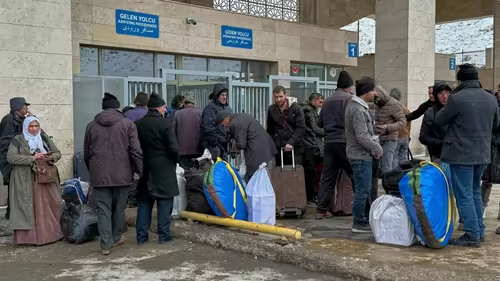
Imagine being miles from home, in a foreign country gripped by unrest, with your phone showing just one bar of signal. Now imagine your parents haven’t heard from you in days—not because you don’t care, but because the government has shut down the internet. This isn’t a scene from a thriller. It’s the reality for dozens of Indian students stranded in Iran as the nation enforces curfews and digital blackouts following recent civil unrest.
Table of Contents
- The Situation on the Ground: Curfews and Connectivity Collapse
- Who Are the Affected Students?
- Communication Challenges: One Bar and a Prayer
- Indian Government’s Response and Evacuation Efforts
- Parental Anxiety Reaches Fever Pitch
- Campus Safety vs. National Chaos
- What Families Can Do: Practical Steps
- Conclusion: A Test of Resilience and Diplomacy
- Sources
The Situation on the Ground: Curfews and Connectivity Collapse
In recent weeks, parts of Iran—especially regions close to the Iraq border—have been placed under strict curfew following widespread protests and security operations. In response, Iranian authorities have imposed a near-total internet shutdown, cutting off social media, messaging apps, and even basic mobile data services .
For international students, this digital blackout has turned a tense situation into a nightmare. Many rely on WhatsApp, Telegram, or video calls to stay in touch with their families. Now, they’re reduced to hunting for fleeting pockets of 2G signal—often at odd hours—to send a single “I’m okay” text before the connection vanishes again.
Who Are the Affected Students?
The majority of the Indian students stranded in Iran are enrolled in medical and engineering colleges in cities like Ahvaz, Kermanshah, and Sanandaj—areas within 100–200 kilometers of the Iraq border. These institutions, often chosen for their affordability and English-medium instruction, have become unintentional epicenters of geopolitical tension.
While some students opted to return home early due to growing uncertainty, others remain on campus, citing academic commitments and the logistical difficulty of last-minute travel. According to initial reports, over 50 Indian students were directly impacted by the communication blackout, with numbers still being verified by Indian diplomatic missions .
Communication Challenges: One Bar and a Prayer
Parents in India describe agonizing waits—sometimes stretching 48 to 72 hours—between messages. “My son sent a voice note at 3 a.m. saying he was safe, but then nothing for two days,” shared Ramesh Patel, a father from Gujarat. “We don’t know if he’s eating, sleeping, or even allowed to leave his dorm.”
This sporadic connectivity isn’t just emotionally taxing—it’s dangerous. In an emergency, delayed communication could mean delayed help. The lack of real-time updates also fuels misinformation, with rumors spreading rapidly on Indian social media about mass detentions or campus raids—none of which have been substantiated by official sources.
Indian Government’s Response and Evacuation Efforts
The Ministry of External Affairs (MEA) has activated its crisis response protocol. The Indian Embassy in Tehran and the Consulate in Mashhad are in regular contact with university authorities and local police to monitor student welfare .
As of January 17, 2026, the MEA confirmed that:
- A dedicated helpline has been set up for distressed families.
- Embassy officials have conducted physical visits to campuses hosting Indian students.
- Students who wish to return are being assisted with flight bookings and exit permits, though commercial flights from western Iran remain limited.
For the latest official updates, families are urged to check the MEA’s website or follow their verified social media channels—a trusted source during information blackouts.
Parental Anxiety Reaches Fever Pitch
Across India, WhatsApp groups for parents of students studying in Iran have become hubs of collective panic and support. Some families have even approached their local MPs, demanding immediate evacuation flights similar to those deployed during the Ukraine crisis or Lebanon conflicts.
“We sent our children for education, not to be hostages in a political storm,” said Sunita Mehta, whose daughter studies in Ahvaz. Her sentiment echoes a growing concern among middle-class Indian families who view overseas education as a path to upward mobility—but now question its hidden risks.
Campus Safety vs. National Chaos
Despite the national unrest, multiple students who managed to get messages through have reported that their campuses remain secure. University administrations have increased on-site security, restricted non-essential movement, and provided food and water reserves.
“The city is tense, but inside the college gates, it’s calm,” wrote one student in a rare SMS received by his family in Delhi. “We’re told not to go out, and we’re obeying.”
This localized stability offers a sliver of reassurance, but it doesn’t eliminate the broader vulnerability of being a foreign national in a country experiencing civil disruption.
What Families Can Do: Practical Steps
If you have a loved one studying in Iran, here’s what experts recommend:
- Register with the MEA’s MADAD portal for real-time consular assistance.
- Agree on a communication schedule—even if it’s just a missed call at a set time.
- Avoid spreading unverified news; stick to official channels like the Indian Embassy.
- Prepare for possible evacuation by keeping passports and academic documents ready.
For more on staying safe while studying abroad, see our guide on [INTERNAL_LINK:student-safety-abroad-checklist].
Conclusion: A Test of Resilience and Diplomacy
The plight of Indian students stranded in Iran is more than a logistical challenge—it’s a human story of isolation, fear, and resilience. While the Indian government works behind the scenes to ensure their safety, the incident underscores a critical gap: the need for better pre-departure risk awareness and emergency protocols for students heading to politically sensitive regions. As internet access slowly returns in parts of Iran, families around India are holding their breath, hoping for that next text—however brief—that says, “I’m still okay.”
Sources
- Times of India: Indian students stranded amid Iran’s internet blackout, unrest
- Ministry of External Affairs, Government of India: Official Website
- Reuters: Iran imposes internet restrictions amid unrest