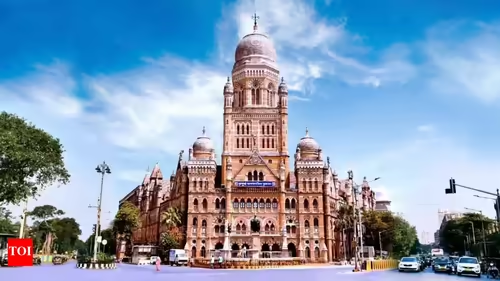
Forget high-stakes primaries or public campaigns. In India’s financial capital, the race to become mayor isn’t decided by voters—it’s shaped by a **lottery**, backroom deals, and the loyalty of 227 municipal corporators. On January 28, 2026, Mumbai will finally elect its next mayor after months of delay, uncertainty, and intense political maneuvering .
But here’s the twist: no one knew which community the post would be reserved for until a random draw was conducted just weeks ago. That single act of chance has reshaped party strategies, candidate lineups, and alliance dynamics overnight. Welcome to the unusual, opaque, yet deeply consequential world of the Mumbai mayor election.
Table of Contents
- Why the Mayor Post Was Vacant
- Mumbai Mayor Election: How Reservation Works
- The Voting Process: A Simple Majority Game
- Political Stakes: BJP vs Shiv Sena Tensions
- The Kingmakers: Nominated Corporators
- What the Mayor Actually Does
- Conclusion: A Symbolic Post with Real Power
- Sources
Why the Mayor Post Was Vacant
Mumbai hasn’t had a full-time mayor since early 2024. The position remained vacant due to legal challenges, delays in BMC elections, and internal rifts within the ruling BJP-Shiv Sena (Shinde faction) alliance. While an acting mayor handled ceremonial duties, key decisions—like approving civic budgets or chairing standing committees—were stalled or delegated to the Municipal Commissioner .
This prolonged vacuum frustrated citizens, especially as monsoon preparedness, waste management, and infrastructure projects suffered from leadership gaps.
Mumbai Mayor Election: How Reservation Works
Unlike most elected offices, the Mumbai mayoral post doesn’t follow a fixed rotation. Instead, it’s determined by a **random lottery** conducted by the Maharashtra State Election Commission. Here’s how it works:
- The state maintains a roster of categories: Women (General), SC, ST, OBC, etc.
- A sealed chit is drawn from a box during a public ceremony.
- Whichever category is selected becomes the only eligible pool for candidates.
- Parties then nominate someone from that group—often within 48 hours.
In 2026, the draw landed on **“Women from the General Category”**—a result that immediately ruled out dozens of male contenders and forced parties to scramble for qualified female nominees .
The Voting Process: A Simple Majority Game
The election itself is straightforward but high-pressure:
- All 227 elected corporators + 5 nominated members = 232 total voters.
- Voting is done via secret ballot.
- The candidate with the most votes wins—no runoff required.
- In case of a tie, the Municipal Commissioner casts the deciding vote.
Given that the BJP-Shinde Sena alliance holds around 165 seats, they should easily secure victory. But recent reports suggest internal dissent—especially among Shiv Sena corporators uneasy about ceding the post to the BJP again . This is where the five nominated corporators could play a decisive role.
Political Stakes: BJP vs Shiv Sena Tensions
Traditionally, the BJP and Shiv Sena shared the mayorship under their pre-2022 alliance. But since Eknath Shinde split from Uddhav Thackeray and allied with the BJP, trust has eroded. Many Shinde loyalists feel the BJP dominates decision-making, including civic appointments.
Now, with the post reserved for a woman, both parties have floated names—but behind closed doors, negotiations are tense. If even 10–15 Shiv Sena corporators abstain or defect, the BJP’s candidate could lose, triggering a major political crisis .
The Kingmakers: Nominated Corporators
Often overlooked, the five corporators nominated by the state government (typically from fields like education, arts, or social work) hold disproportionate influence in tight races.
Since they’re appointed—not elected—they aren’t bound by party whips. In past BMC elections, their votes have swung outcomes. This year, all eyes are on whether they align with the ruling alliance or side with opposition parties like Shiv Sena (UBT) or Congress, who together command about 60 votes .
What the Mayor Actually Does
Despite being called the “first citizen of Mumbai,” the mayor’s powers are largely ceremonial:
- Presides over BMC meetings.
- Approves agendas and minutes.
- Represents the city at official functions.
- Can propose welfare schemes (subject to committee approval).
Real administrative power lies with the Municipal Commissioner—a senior IAS officer appointed by the state. Yet, the mayor’s platform offers immense visibility, media access, and grassroots connect—making it a crucial springboard for higher office, especially ahead of Maharashtra’s 2029 assembly elections.
Conclusion: A Symbolic Post with Real Power
The Mumbai mayor election may seem like a bureaucratic formality, but it’s a microcosm of Maharashtra’s volatile politics. A lottery decides eligibility, alliances hang by a thread, and five unelected voices could tip the balance. On January 28, when the ballots are counted, Mumbai won’t just get a new mayor—it will reveal whether the BJP-Shinde partnership can survive its latest test of unity.
Sources
- Times of India – Mumbai set for mayor polls on January 28
- Brihanmumbai Municipal Corporation (BMC) Act, 1888 – Official BMC Governance Framework
- Maharashtra State Election Commission – Reservation & Election Guidelines for Urban Local Bodies