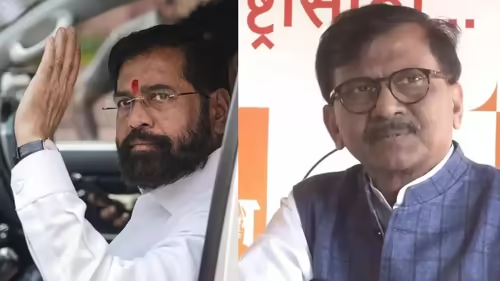
It’s not every day that a luxury hotel in South Mumbai becomes the epicenter of a political storm—but that’s exactly what’s unfolding in the high-stakes Mumbai mayor battle. Shiv Sena (UBT) MP Sanjay Raut has dropped a bombshell, alleging that Chief Minister Eknath Shinde has effectively turned a five-star hotel into a “jail” to hold his own party corporators in “captivity” .
The accusation comes amid tense negotiations between the BJP and Shinde-led Shiv Sena over who will occupy the mayor’s chair in India’s financial capital. With the ruling alliance holding a clear majority in the Brihanmumbai Municipal Corporation (BMC), the expectation was a smooth transition. But behind the scenes, cracks are widening—and Raut’s claim suggests a deeper rebellion within Shinde’s camp .
Table of Contents
- The Allegation: Hotel as a Political Prison
- Mumbai Mayor Battle: The Power Struggle Explained
- Who Really Controls the BMC? The Numbers Game
- Historical Context: Mayor Rotations and Alliances
- What This Means for Mumbai’s Governance
- Conclusion: A City Held Hostage by Politics?
- Sources
The Allegation: Hotel as a Political Prison
Speaking to reporters on January 18, 2026, Sanjay Raut didn’t mince words. “They have turned a hotel into a jail,” he declared, referring to reports that dozens of Shinde-aligned corporators are being housed at a luxury property in Nariman Point . According to Raut, these elected representatives are being “isolated” to prevent them from communicating with opposition parties—or even expressing dissent within their own ranks.
More provocatively, Raut claimed that many of these corporators actually oppose the idea of a BJP mayor and are in secret contact with his UBT faction. “They want to break free,” he said, suggesting an internal revolt is brewing against Shinde’s leadership and his alliance with the BJP .
While no corporator has publicly confirmed these claims, the image of elected officials being sequestered in a hotel—away from families, media, and constituents—has fueled public skepticism about the democratic process in the BMC.
Mumbai Mayor Battle: The Power Struggle Explained
The post of Mumbai mayor, though largely ceremonial, carries immense symbolic weight. It’s a platform that influences civic discourse, controls key committees, and offers visibility ahead of state elections. Traditionally, the BJP and Shiv Sena had an informal understanding to rotate the position.
However, since the 2022 split in Shiv Sena—when Eknath Shinde broke away with a majority of MLAs to form a new government with BJP backing—the dynamics have shifted. Now, the BJP is pushing hard for its candidate, arguing it’s their turn. But sources suggest that many Shinde loyalists, rooted in local Marathi identity politics, are uneasy about ceding the mayorship entirely to the BJP .
This internal friction is what Raut appears to be exploiting—painting Shinde as a puppet of the BJP and positioning UBT as the true voice of Mumbai’s grassroots.
Who Really Controls the BMC? The Numbers Game
Let’s look at the math. The BMC has 236 elected seats:
- BJP: ~95 seats
- Shinde-led Shiv Sena: ~70 seats
- Shiv Sena (UBT): ~40 seats
- Others (NCP, Congress, Independents): ~31 seats
Together, the BJP-Shinde alliance commands a comfortable majority of over 160 seats—more than enough to elect a mayor unopposed. So why the drama?
The answer lies in loyalty. If even 10–15 Shinde corporators defect or abstain, the BJP’s candidate could lose. That’s likely why, according to Raut, they’re being “kept under watch.” It’s not about numbers—it’s about trust .
Historical Context: Mayor Rotations and Alliances
Since 2017, the mayor’s post has been shared between the two parties:
- 2017–2019: BJP’s Vishwanath Mahadeshwar
- 2019–2022: Shiv Sena’s Kishori Pednekar
- 2022–2024: Vacant due to legal battles and delays
- 2024–2026: BJP’s expected turn—but stalled
The current deadlock breaks this fragile tradition. For Shinde, denying the BJP could fracture his alliance. For the BJP, accepting delay signals weakness. And for Raut’s UBT, the chaos is a golden opportunity to portray the Shinde faction as undemocratic and disconnected from its base .
What This Means for Mumbai’s Governance
While politicians feud, Mumbai’s civic issues pile up: flooding, waste management, housing shortages, and crumbling infrastructure. The prolonged absence of a functional mayor’s office has already delayed critical decisions on urban development projects and disaster preparedness .
More alarmingly, the “hotel jail” narrative erodes public trust. When elected representatives are allegedly hidden from view, it raises serious questions about transparency and accountability in one of Asia’s largest cities.
Conclusion: A City Held Hostage by Politics?
The Mumbai mayor battle has transcended a simple power-sharing dispute. It’s now a referendum on internal democracy, alliance loyalty, and the very integrity of local governance. Sanjay Raut’s explosive claim may be politically motivated—but it has spotlighted a troubling reality: when parties prioritize control over consultation, it’s the citizens who pay the price.
As the standoff continues, all eyes are on that luxury hotel. Will it remain a gilded cage—or will its occupants finally step out and speak for themselves?
Sources
- Times of India – ‘Hotel turned into jail’: Raut’s big charge against Shinde
- Hindustan Times – Mumbai Mayor Election Delays Explained
- Brihanmumbai Municipal Corporation (BMC) Official Portal – BMC Structure and Functions