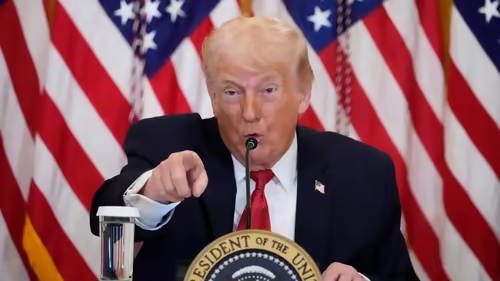
Imagine a new world order where global peace isn’t negotiated through decades-old diplomacy—but bought with a $1 billion check. That’s the startling claim swirling around former U.S. President Donald Trump’s alleged proposal for a “Board of Peace,” a body that would operate outside the United Nations and be chaired solely by Trump himself .
According to a draft charter reported by major outlets, countries seeking permanent membership in this elite group would need to contribute at least $1 billion—a fee critics call a “pay-to-play” scheme for geopolitical influence . The idea has sparked immediate backlash from diplomats, policy experts, and allies who fear it could undermine multilateralism and turn global security into a transactional commodity.
Yet, in a swift rebuttal, the White House has labeled these reports “misleading,” denying any fixed entry fee and insisting that permanent membership would be reserved for “committed partners” based on strategic alignment—not financial contribution . So, what’s really going on? Let’s unpack the facts, the fiction, and the far-reaching implications of the Trump Board of Peace concept.
Table of Contents
- What Is the Trump Board of Peace?
- Trump Board of Peace: The Billion-Dollar Controversy
- White House Response: Denial and Damage Control
- How It Compares to the United Nations
- Global Reactions and Strategic Implications
- Conclusion: A New World Order or Political Theater?
- Sources
What Is the Trump Board of Peace?
The “Board of Peace” is reportedly a concept floated by Donald Trump during private discussions with advisors and foreign leaders in recent months. Described as a streamlined, results-oriented alternative to the United Nations, the board would focus exclusively on conflict resolution, counterterrorism, and economic stability—with Trump serving as its permanent chair .
Unlike the UN Security Council, which includes five permanent members with veto power, this new body would allegedly grant permanent status only to nations willing to make substantial financial and strategic commitments. Membership would be renewable annually “at the discretion of the chair”—a provision that places unprecedented personal authority in Trump’s hands .
Trump Board of Peace: The Billion-Dollar Controversy
The most explosive detail comes from a purported draft charter, which states: “Permanent membership requires a minimum annual contribution of $1 billion USD to the Board’s operational and humanitarian fund” . If true, this would make the Trump Board of Peace the most expensive diplomatic club in history.
Critics argue this model risks creating a two-tier global system:
- Wealthy nations (like the U.S., Saudi Arabia, or UAE) could buy influence and shape global agendas.
- Smaller or poorer nations—even those deeply affected by conflict—would be excluded from decision-making.
- Accountability would vanish, as the chair (Trump) holds unilateral power over renewals.
One European diplomat anonymously told Reuters, “This isn’t peace-building—it’s a vanity project disguised as diplomacy” .
White House Response: Denial and Damage Control
Facing mounting scrutiny, the White House moved quickly to distance itself from the $1 billion narrative. A senior official stated: “There is no minimum fee. Permanent membership is for nations demonstrably committed to peace, security, and shared values—not their bank balance” .
The administration clarified that while voluntary contributions would support the board’s initiatives, they would not be a prerequisite for membership. Instead, eligibility would be based on a country’s track record in counterterrorism, defense cooperation, and economic partnership with the U.S. .
However, skeptics note that even without a formal fee, the expectation of “substantial support” could functionally serve the same purpose—creating an informal paywall for access.
How It Compares to the United Nations
To understand the stakes, consider how the UN operates:
| Feature | United Nations | Trump Board of Peace (Proposed) |
|---|---|---|
| Leadership | Secretary-General (elected) | Chair: Donald Trump (permanent) |
| Membership | 193 sovereign states | Limited, invitation-only |
| Funding | Assessed & voluntary contributions | Alleged $1B fee (denied) |
| Decision Power | Security Council + General Assembly | Chair’s discretion |
The UN, despite its flaws, embodies the principle of sovereign equality. The Trump Board of Peace, as described, replaces that with a meritocratic—but financially gated—model that prioritizes loyalty and resources over representation.
Global Reactions and Strategic Implications
Reactions have been sharply divided:
- Allies like the UK and Germany expressed concern over undermining the UN’s legitimacy.
- Nations like India and Brazil questioned how emerging powers would be included without exorbitant costs.
- Some Gulf states, however, are reportedly “intrigued” by the prospect of direct access to U.S. leadership outside bureaucratic channels .
If realized, such a body could fracture global consensus, encouraging other powers—like China or Russia—to launch competing institutions, leading to a fragmented and less stable international order.
Conclusion: A New World Order or Political Theater?
Whether the Trump Board of Peace becomes reality or remains a provocative talking point, it reflects a deeper shift in global politics: the rise of personalized, transactional diplomacy over institutional multilateralism. While the White House denies the $1 billion fee, the mere discussion of such a model signals a willingness to rethink century-old norms.
For now, the world watches closely. Because if peace truly has a price tag, it may cost more than money—it could cost the very idea of equal sovereignty among nations.
Sources
- Times of India – $1 billion entry fee? Trump wants countries to pay to stay in his ‘board of peace’
- Reuters – Trump proposes new global peace body, report says
- United Nations Official Site – UN Charter and Structure
- White House Briefing Transcript (Jan 17, 2026) – On International Security Initiatives