India Open Badminton in Chaos: Bird’s Nest Debris Halts Semifinal—Is the Venue Fit for a BWF Event?
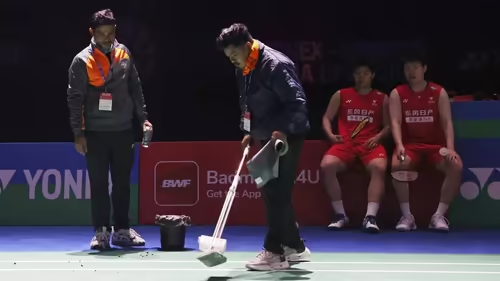
Just when you thought it couldn’t get worse, the India Open badminton tournament delivered another jaw-dropping moment of administrative failure. During a high-stakes women’s doubles semifinal at the KD Jadhav Indoor Hall in New Delhi, play was abruptly halted—not due to injury or protest—but because chunks of a bird’s nest came crashing down onto the court .
This isn’t just a quirky mishap. It’s the latest in a string of embarrassing incidents that have cast serious doubt on whether India’s flagship badminton event is being run to the standards expected of a BWF World Tour Super 750 tournament—a tier just below the Olympics and World Championships .
Table of Contents
- The Semifinal Stoppage: When Nature Interrupted Sport
- A Pattern of Neglect: From Droppings to Debris
- Player Reactions: Frustration and Safety Concerns
- Who’s Responsible? Organizers Under Fire
- What This Means for Indian Badminton’s Global Image
- Conclusion: Time for Serious Reforms
- Sources
The Semifinal Stoppage: When Nature Interrupted Sport
The incident occurred during the clash between Treesa Jolly and Gayatri Gopichand (India) and Chen Qingchen and Jia Yifan (China)—a marquee match featuring Olympic-level talent . Mid-rally, spectators and players alike looked up in alarm as dry twigs, feathers, and nesting material began falling from the ceiling near Court 1.
Officials immediately suspended play. Umpires and tournament referees rushed to inspect the area, while cleaners scrambled to sweep up the debris. The delay lasted several minutes, disrupting the athletes’ rhythm and focus during one of the most critical phases of the tournament .
Adding insult to injury, this wasn’t the first time birds caused chaos. Just days earlier, multiple matches were paused due to bird droppings landing on the court—a recurring issue that players had already flagged as unhygienic and unprofessional .
A Pattern of Neglect: From Droppings to Debris
The repeated bird-related disruptions point to a deeper problem: inadequate venue preparation. The KD Jadhav Hall, named after India’s first Olympic wrestling medalist, has long been used for national events. But hosting a global BWF Super 750 event demands world-class infrastructure—including proper netting, sealed ceilings, and pest control measures to prevent wildlife intrusion .
Evidently, those basic precautions were either ignored or poorly executed. Experts note that indoor arenas hosting international tournaments routinely install fine mesh netting beneath rafters to block birds—a standard practice for decades. The fact that nests were allowed to form inside an active competition venue suggests a shocking level of oversight failure.
Player Reactions: Frustration and Safety Concerns
Athletes didn’t hold back. Several players, speaking off the record, expressed frustration over what they described as “amateurish” conditions. One European player told reporters, “We train for years to compete at this level. To have your match interrupted by bird poop—it’s disrespectful to the sport.”
Beyond hygiene, there are genuine safety concerns. Falling debris could cause eye injuries or slips. And constant distractions undermine the mental composure required in elite badminton, where split-second decisions determine victory.
Even Indian stars like P.V. Sindhu and Lakshya Sen, while diplomatic in public, are said to be privately embarrassed by the situation—especially since India is positioning itself as a potential future host for even bigger events like the Thomas & Uber Cup or BWF World Championships .
Who’s Responsible? Organizers Under Fire
The blame falls squarely on the Badminton Association of India (BAI) and local organizing committees. As the national governing body recognized by the BWF, BAI is contractually obligated to ensure venues meet strict technical and safety standards .
Yet, despite clear warnings from past editions—and even from BWF officials—the same issues persist year after year. Critics argue this reflects a broader culture of complacency, where securing hosting rights matters more than execution quality.
[INTERNAL_LINK:india-sports-infrastructure-crisis] This isn’t isolated to badminton. Similar complaints have surfaced during tennis, table tennis, and athletics events in India—highlighting a systemic gap in sports infrastructure management.
What This Means for Indian Badminton’s Global Image
India has made remarkable strides in badminton. With Olympic medals, World Championship titles, and a growing fanbase, the country is now seen as a powerhouse in the sport. But reputation is fragile.
Repeated organizational blunders risk damaging India’s credibility with the BWF. If top players start skipping the India Open due to poor conditions—as some have hinted—the tournament could lose its Super 750 status, reducing prize money, ranking points, and global prestige .
Moreover, it sends the wrong message to young athletes: that excellence on the court isn’t matched by professionalism off it.
Conclusion: Time for Serious Reforms
The falling bird’s nest at the India Open badminton semifinal is more than a viral oddity—it’s a symptom of deeper institutional failure. For a nation aspiring to lead in global sports, such lapses are unacceptable.
BAI must act decisively: invest in permanent venue upgrades, enforce BWF protocols rigorously, and hold organizers accountable. Otherwise, the India Open may soon be remembered not for thrilling rallies, but for its chronic embarrassments.
Sources
- Times of India: Another embarrassment: Falling bird’s nest debris halts India Open semifinal
- BWF Official Website: BWF Tournament Regulations
- Olympics.com: How India Became a Badminton Powerhouse