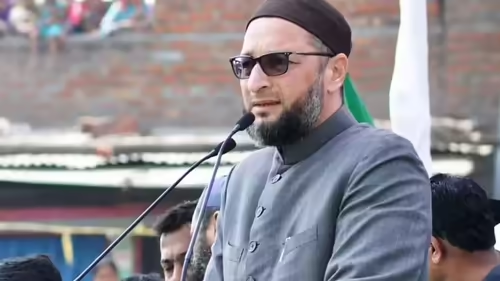
Owaisi Slams Door Shut on BJP-NDA Tie-Up: ‘Not Now, Not Ever’
Speculation about a potential political realignment in Maharashtra has been decisively quashed by one of India’s most vocal opposition figures. AIMIM president Asaduddin Owaisi has issued a firm and unequivocal statement: there will be **no alliance—now or ever—with the BJP or the NDA**. This declaration comes in the wake of a controversial local incident in Maharashtra that sparked rumors of a backdoor understanding between his party and the ruling bloc at the Centre.
Table of Contents
- The Maharashtra Incident That Sparked the Fire
- Owaisi’s Forceful Rejection and Disciplinary Action
- The Unbridgeable Ideological Divide Between AIMIM and BJP
- What This Means for Maharashtra’s Electoral Chessboard
- Broader Implications for Opposition Unity
- Conclusion: A Line in the Sand
- Sources
The Maharashtra Incident That Sparked the Fire
The controversy originated from a municipal-level election in Maharashtra, where a few AIMIM corporators were seen supporting a BJP-backed candidate. In India’s complex local governance structure, such cross-party support isn’t unheard of—but in this case, it ignited a firestorm of speculation .
Political observers and media outlets quickly began buzzing with theories of a secret “Maha poll tie-up” between the All India Majlis-e-Ittehadul Muslimeen (AIMIM) and the Bharatiya Janata Party (BJP). Given the high stakes of Maharashtra’s political landscape—a key state often seen as a national bellwether—any hint of an unusual alliance draws intense scrutiny .
For a party like AIMIM, which has built its identity on being a staunch critic of the BJP’s Hindutva politics, even the perception of collaboration was politically dangerous.
Owaisi’s Forceful Rejection and Disciplinary Action
Asaduddin Owaisi wasted no time in putting out the fire. In a public statement, he didn’t just deny the rumors—he **categorically ruled out any possibility of an alliance with the BJP or the NDA**, calling it a non-starter on ideological grounds .
More importantly, he took concrete disciplinary action. The AIMIM leadership issued **show-cause notices** to the corporators involved in the Maharashtra episode, making it clear that such actions were unauthorized and against party policy .
“Only the party leadership decides on alliances,” Owaisi emphasized, reinforcing centralized control and rejecting any notion that local functionaries could set national political direction . This move was both a corrective measure and a strong signal to his base: the party’s core principles are non-negotiable.
The Unbridgeable Ideological Divide Between AIMIM and BJP
At the heart of Owaisi’s rejection lies a deep and well-documented ideological chasm. The BJP champions a majoritarian Hindu nationalist agenda, while AIMIM positions itself as a defender of minority rights, secularism, and constitutional values—particularly for India’s Muslim community .
Owaisi has consistently framed the BJP as a threat to India’s pluralistic fabric. Over the years, he has been one of the most vocal critics of policies like the Citizenship Amendment Act (CAA) and the National Register of Citizens (NRC), which he argues target Muslims .
In this context, any form of electoral understanding—even tactical or temporary—would be seen as a betrayal by his core supporters. His statement wasn’t just political posturing; it was a reaffirmation of the party’s foundational identity.
What This Means for Maharashtra’s Electoral Chessboard
Maharashtra’s political scene is famously fragmented, with the Maha Vikas Aghadi (MVA)—a coalition of Shiv Sena (UBT), NCP (Sharad Pawar), and Congress—locked in a bitter battle with the BJP-Shiv Sena (Eknath Shinde) alliance.
While AIMIM holds limited seats statewide, it can be a kingmaker in specific urban constituencies with significant Muslim populations, such as parts of Mumbai, Aurangabad, and Malegaon. By publicly shutting the door on the BJP, Owaisi is likely signaling openness to dialogue with secular opposition forces—though he has also been critical of Congress and NCP for their own failures .
This stance allows him to maintain leverage without compromising his ideological brand. It’s a delicate balancing act, but one he’s mastered over the years.
Broader Implications for Opposition Unity
Owaisi’s statement also carries weight beyond Maharashtra. As national elections loom, the question of a united opposition front against the BJP remains fraught with challenges. Regional parties like AIMIM, TMC, DMK, and others are crucial to any anti-BJP coalition.
By taking a principled stand, Owaisi is sending a message to other opposition leaders: unity must be based on shared democratic and secular values, not just opportunistic arithmetic. His discipline of local leaders also shows he’s serious about maintaining party coherence—a quality many larger opposition parties lack .
However, critics argue that Owaisi’s confrontational style sometimes alienates potential allies. Yet, his consistent messaging has earned him a loyal following and a distinct voice in India’s increasingly polarized political discourse.
Conclusion: A Line in the Sand
Asaduddin Owaisi’s rejection of a Owaisi BJP alliance is more than a political statement—it’s a reaffirmation of identity in an era of fluid loyalties. By swiftly disciplining errant corporators and publicly denouncing any link with the NDA, he has drawn a clear line in the sand.
For voters, especially minorities wary of majoritarian politics, this clarity is valuable. For Maharashtra’s opposition, it’s a reminder that any future coalition must respect ideological boundaries. And for the BJP, it’s confirmation that despite its dominance, some doors remain firmly closed.
Sources
- Times of India: Maha poll ‘tie-up’ talk: Owaisi rules out BJP-NDA alliance
- Election Commission of India: Official Website
- The Hindu: Owaisi reiterates AIMIM will not align with BJP