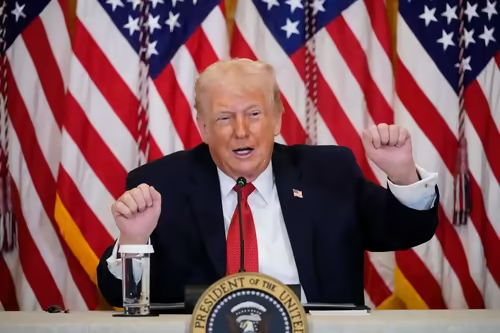
In a move that has sent shockwaves through the transatlantic alliance, former President Donald Trump has announced a new wave of Trump tariffs targeting eight key European nations. The proposed 10% levy, set to take effect on February 1, 2026, is not just a trade policy—it’s a geopolitical ultimatum tied directly to the future of Greenland. The response from Europe? A resounding and unified “no.”
European leaders, from Paris to Stockholm, have slammed the plan as “unacceptable” and a form of outright blackmail, drawing a hard line on issues of national sovereignty and Arctic security. This isn’t just about economics; it’s about the fundamental principles of international cooperation in the 21st century.
Table of Contents
- The Details of Trump’s Tariff Plan
- Macron’s ‘Unacceptable’ Rebuke
- Sweden’s Stark Warning Against Blackmail
- The EU’s United Front and Strategic Response
- What’s at Stake for US-EU Trade Relations?
- Conclusion: Sovereignty Over Coercion
- Sources
The Details of Trump’s Tariff Plan
The core of Trump’s announcement is a blunt instrument: a 10% tariff on all goods imported from Denmark, Norway, Sweden, France, Germany, the United Kingdom, the Netherlands, and Finland . This initial penalty is just the opening salvo. The plan stipulates that these Trump tariffs will escalate to a staggering 25% on June 1, 2026, unless a specific condition is met: an agreement for the United States to purchase Greenland from Denmark .
This unprecedented linkage of trade policy to the acquisition of sovereign territory has been widely condemned as a relic of a bygone imperial era. The targeted nations represent a significant portion of the US’s closest allies and largest trading partners, making the threat both economically potent and diplomatically jarring.
Macron’s ‘Unacceptable’ Rebuke
French President Emmanuel Macron has emerged as one of the most vocal critics of the plan. He has publicly denounced the Trump tariffs as “unacceptable,” framing them not as a legitimate trade negotiation tactic but as a direct assault on European sovereignty .
In a powerful social media post, Macron drew a clear line in the sand, stating, “No intimidation or threat will influence us—neither in Ukraine, nor in Greenland, nor anywhere else in the world when we are confronted with such coercion” . His message was clear: Europe will not be bullied on matters of its own security or the sovereignty of its partners. For Macron, this issue transcends trade; it’s a test of the West’s resolve against coercive diplomacy .
Sweden’s Stark Warning Against Blackmail
Swedish Prime Minister Ulf Kristersson echoed Macron’s defiance, delivering a sharp rebuke of his own. He characterized the US threat as nothing short of “blackmail” and firmly declared, “We will not allow ourselves to be blackmailed” .
Kristersson further emphasized the principle at stake, noting that “Only Denmark and Greenland decide on matters concerning Greenland” . His statement reinforced the European consensus that the internal affairs of a sovereign nation and its territories are not a bargaining chip for international trade deals. He also stressed that this was not just a bilateral issue between the US and Denmark, but an “EU matter” that affects the entire bloc’s stance on sovereignty .
The EU’s United Front and Strategic Response
Beyond individual national responses, the European Union is preparing a coordinated counter-strategy. The threat has galvanized the bloc, with officials vowing a “united and coordinated manner” of response . One of the most significant potential consequences is the halting of a major pending EU-US trade deal. Lawmakers have explicitly stated that given Trump’s threats regarding Greenland, approval of the trade agreement “is not possible at this stage” .
This potential freeze on a colossal trade pact serves as Europe’s primary leverage, signaling that the cost of Trump’s coercion could be far higher than he anticipates. The EU’s strategy appears to be one of collective resilience, refusing to let economic pressure fracture their unity on a core principle.
What’s at Stake for US-EU Trade Relations?
The stakes in this confrontation are immense. The US and EU share the world’s largest bilateral trade and investment relationship, with total goods and services trade reaching a staggering $1.4 trillion in 2023 . The imposition of these Trump tariffs would disrupt this deeply integrated economic ecosystem, harming businesses and consumers on both sides of the Atlantic.
Historically, the transatlantic partnership has been governed by frameworks like the 1995 New Transatlantic Agenda, which aimed to foster cooperation and resolve disputes through dialogue . Trump’s current approach represents a stark departure from this decades-long tradition, potentially unraveling years of careful diplomatic and economic work. The future of this critical relationship now hinges on whether a path back to mutual respect can be found.
Conclusion: Sovereignty Over Coercion
The European backlash against Trump’s proposed tariffs is more than a trade dispute; it’s a powerful affirmation of a rules-based international order. From Macron’s fiery denunciation to Kristersson’s firm rejection of blackmail, the message from Europe is unified and clear: sovereignty is not for sale, and economic coercion will not be tolerated. As the February 1 deadline looms, the world watches to see if this transatlantic rift can be healed or if it will mark a new, more confrontational chapter in US-EU relations. For now, Europe stands firm on the principle that some lines should never be crossed.
Sources
- Times of India: Trump’s 10% tariffs: Macron slams ‘unacceptable’ threats; EU warns against blackmailing
- Various news reports on Trump’s tariff announcement [[1], [2], [9]]
- Statements from Emmanuel Macron [[5], [7], [8]]
- Statements from Ulf Kristersson [[19], [20], [21]]
- EU official responses [[10], [14]]
- US-EU trade data and history [[23], [24]]