Table of Contents
- Why Are There Greenland Protests?
- Trump’s Greenland Takeover Threat, Explained
- Greenland’s Fight for Self-Rule
- Global Reactions and Economic Consequences
- What Happens Next? The Future of Greenland
Why Are There Greenland Protests?
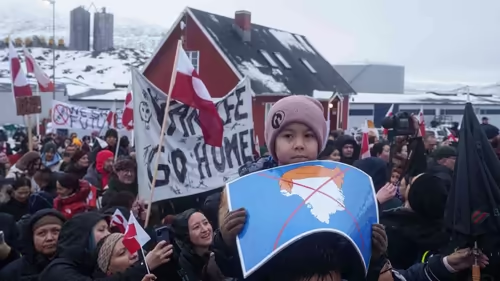
The icy streets of Nuuk were filled with a fiery spirit of defiance this past week. In an unprecedented show of unity, thousands of Greenlanders—representing a significant portion of the island’s small population—marched under the banner “Not going down without a fight” . Their message was clear, direct, and resolute: Greenland is not for sale.
These Greenland protests are a direct response to a series of aggressive statements and actions from U.S. President Donald Trump, who has reignited his long-standing desire to purchase the autonomous Danish territory. The demonstrations weren’t just local; they echoed in other towns across the island, with even Greenland’s Prime Minister Múte Bourup Egede joining the crowds, signaling that this is a matter of national sovereignty, not just political posturing .
Trump’s Greenland Takeover Threat, Explained
This isn’t the first time Trump has expressed interest in acquiring Greenland. However, during his second presidency, which began in 2025, his rhetoric has shifted from casual curiosity to a matter of policy. He has framed the potential acquisition as essential for “American expansionism” and national security in the strategically vital Arctic region .
In a stark warning issued on January 9, 2026, Trump declared, “I would like to make a deal the easy way but if we don’t do it the easy way, we’re going to do it the hard way,” . This statement was followed by a concrete economic threat: the announcement of a 10% tariff on goods from eight European Union countries that oppose the US’s ambitions over Greenland . This move has escalated the situation from a diplomatic oddity to a serious geopolitical flashpoint.
Greenland’s Fight for Self-Rule
To understand the depth of anger behind these protests, one must look at Greenland’s unique political status. While part of the Kingdom of Denmark, Greenland is not a colony or a simple province. It is a self-governing nation with its own parliament, language, and a distinct cultural identity that has been fighting for greater autonomy for decades.
The current framework, established by the Self-Government Act of 2009, grants Greenland extensive control over its internal affairs, including policing, justice, and natural resources . The Act itself is a recognition of the Greenlandic people’s right to self-determination . A 2008 referendum saw an overwhelming majority of voters approve this path toward greater independence from Denmark .
The idea that their homeland could be treated as a piece of real estate to be bought and sold is not just offensive; it’s a direct assault on their hard-won autonomy and their future as a nation. As one protester in Nuuk put it, they are defending their home, their culture, and their children’s right to decide their own destiny.
Global Reactions and Economic Consequences
The international community has watched these developments with growing concern. The European Union, whose members are directly targeted by Trump’s new tariffs, has condemned the coercive tactics. Denmark, while maintaining its constitutional ties to Greenland, has firmly stated that the island is not Danish property to be sold.
The economic implications are also significant. Greenland’s economy, while small, is rich in untapped mineral resources, making it a key player in the future of critical minerals needed for green technology. Any attempt to force a change in its status could destabilize global supply chains and investment in the Arctic. For readers interested in the broader economic landscape, our analysis on [INTERNAL_LINK:arctic-mineral-rush] provides deeper context.
What Happens Next? The Future of Greenland
The massive Greenland protests have sent a powerful message to Washington, Copenhagen, and the world. They have demonstrated that any discussion about Greenland’s future must include the Greenlandic people as the primary decision-makers, not as a bargaining chip.
While Trump’s administration may continue to apply pressure through tariffs and diplomatic channels, the resolve shown on the streets of Nuuk suggests that a forced acquisition is politically impossible. The path forward is more likely to involve complex negotiations between the US, Denmark, and crucially, the Greenlandic government itself, regarding security cooperation and resource development—on Greenland’s terms.
Conclusion
The recent wave of Greenland protests is far more than a reaction to a single political threat. It is a profound assertion of national identity, a defense of self-determination, and a clear declaration that the era of treating sovereign peoples as commodities is over. The world is watching to see if this small Arctic nation can successfully stand its ground against a superpower’s ambition.
Sources
- Thousands join ‘Hands off Greenland’ protests amid Trump’s takeover threats. Times of India.
- Trump says 8 EU countries to be charged 10% tariff for opposing US control of Greenland. The Associated Press, January 17, 2026.
- Protesters rally in Greenland against Trump annexation threat.
- Political system, Greenland Self-Government Act.
- The Legal Debate Surrounding Greenland and Denmark, January 24, 2025.
- Proposed United States acquisition of Greenland.
- Trump says to make deal to acquire Greenland in ‘easy way’, January 9, 2026.