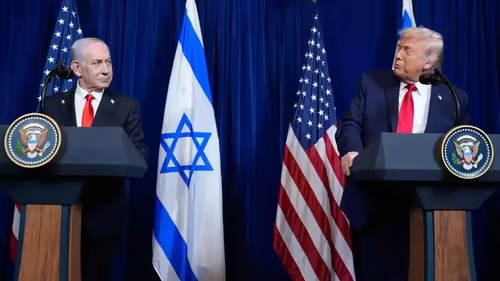
A major diplomatic storm is brewing between two of the world’s closest allies. Israeli Prime Minister Benjamin Netanyahu has launched an unprecedented public critique of a U.S.-endorsed plan to establish a new governing body for post-war Gaza—the so-called “Gaza Executive Board.” His objections aren’t just procedural; they cut to the heart of who gets to shape the future of one of the world’s most contested territories.
Netanyahu’s core grievances? A complete lack of prior consultation with Israel and the proposed inclusion of figures like Turkey’s Foreign Minister Hakan Fidan—someone Israel views as hostile to its security interests . This isn’t just bureaucratic friction; it’s a fundamental clash over vision, trust, and control in the aftermath of a devastating war.
Table of Contents
- What Is the Gaza Executive Board?
- Netanyahu’s Public Rebuke: Breaking the Silence
- Why Turkey Is a Red Line for Israel
- The US-Israel Relationship at a Crossroads
- What Happens Next for Gaza Governance?
- Conclusion
- Sources
What Is the Gaza Executive Board?
The “Gaza Executive Board” is a newly announced international initiative, reportedly backed by the Trump administration, aimed at creating a temporary civilian authority to manage reconstruction, humanitarian aid, and basic governance in Gaza following the ongoing conflict . The goal is to prevent a security vacuum and lay the groundwork for long-term stability.
However, from Israel’s perspective, the plan was developed entirely in a vacuum—one that excluded its primary stakeholder. Netanyahu’s office confirmed he was not consulted during the board’s formation, a fact that has fueled deep resentment in Jerusalem .
Netanyahu’s Public Rebuke: Breaking the Silence
In a move that breaks with decades of diplomatic protocol, Netanyahu didn’t just voice his concerns privately. He went public, instructing his Foreign Minister to formally raise Israel’s “serious reservations” with U.S. Secretary of State Marco Rubio . This open airing of grievances is a stark signal of just how alarmed the Israeli government is by the proposal.
“Israel will not accept any plan for Gaza that does not include ironclad security guarantees and excludes actors who support terrorism,” a senior Israeli official stated, in a clear reference to Turkey’s potential role . This public stance transforms what could have been a behind-closed-doors negotiation into a high-stakes political confrontation.
Why Turkey Is a Red Line for Israel
The inclusion of Turkish Foreign Minister Hakan Fidan is the single biggest point of contention. Relations between Israel and Turkey have been volatile for years, with Ankara frequently criticizing Israel’s military actions and hosting leaders of Hamas, which Israel, the U.S., and the EU designate as a terrorist organization .
For Israel, allowing a representative from a nation that provides a platform for its sworn enemies to have a say in Gaza’s future is simply non-negotiable. It’s seen as a direct threat to its national security and a betrayal of the alliance with the United States.
Key reasons for Israel’s opposition to Turkey’s involvement:
- Hamas Ties: Turkey has long been a safe haven for senior Hamas political figures.
- Rhetorical Hostility: President Erdogan has repeatedly used inflammatory language against Israel.
- Strategic Rivalry: Both nations vie for influence in the Eastern Mediterranean, creating a backdrop of geopolitical competition.
The US-Israel Relationship at a Crossroads
This dispute over the Gaza Executive Board is more than a policy disagreement; it’s a stress test for the entire U.S.-Israel alliance. While the Biden administration had its own tensions with Netanyahu, the Trump administration was historically seen as Israel’s strongest ally in the White House .
The fact that such a rift is emerging now suggests a significant shift. It highlights a potential disconnect between Washington’s desire for a swift, internationally-backed solution and Jerusalem’s insistence on maintaining absolute control over Gaza’s security architecture. This moment could redefine the terms of their partnership for years to come. For deeper analysis on Middle East alliances, see our feature on [INTERNAL_LINK:future-of-us-middle-east-policy].
What Happens Next for Gaza Governance?
The path forward is now fraught with uncertainty. The U.S. will likely be forced to return to the drawing board, either by removing Turkey from the equation or by finding a way to bring Israel into the planning process as a genuine partner.
Netanyahu’s firm stance makes it clear that any viable plan must meet two non-negotiable conditions: full Israeli security oversight and the exclusion of any state or entity perceived as sympathetic to anti-Israel groups. Without these, the “Board of Peace” may remain a concept in chaos, unable to gain the traction needed to rebuild a shattered territory.
Conclusion
The controversy surrounding the Gaza Executive Board is a stark reminder that even the most well-intentioned international plans can founder on the rocks of regional politics and historical animosities. Netanyahu’s forceful pushback has thrown a wrench into the U.S. strategy, forcing a critical reassessment of who gets to decide Gaza’s future. The coming weeks will be crucial in determining whether this rift can be healed or if it marks the beginning of a new, more complicated chapter in the U.S.-Israel relationship. For authoritative updates on global diplomacy, refer to the U.S. Department of State.