Introduction: When Tariffs Target an Ice-Covered Island
It started with a tweet. Then came the executive order. Now, the world is scrambling to understand what on earth—literally—Donald Trump meant by announcing Greenland tariffs. On the surface, it sounds almost absurd: slapping import duties on a sparsely populated, autonomous Danish territory covered in ice. But as with most things in Trump’s playbook, the real target isn’t Greenland—it’s Europe.
This latest salvo, framed as retaliation against what Trump calls “unfair European trade practices,” is a masterclass in political theater with serious geopolitical undertones. It’s not just about balancing trade deficits; it’s about sending a message that the U.S. is reclaiming its dominance in the rapidly warming Arctic—a region rich in untapped resources and strategic shipping lanes. Let’s break down what’s really going on beneath the headlines.
Table of Contents
- What Are the Greenland Tariffs?
- Why Greenland? A Frozen Chess Piece
- Europe Reacts: Outrage and Anxiety
- The Bigger Picture: Trump’s Arctic Ambitions
- Market and Geopolitical Fallout
- Conclusion: More Than Just a Tariff
- Sources
What Are the Greenland Tariffs?
Officially, the Greenland tariffs are a set of new import duties imposed by the U.S. on select goods originating from the Kingdom of Denmark, which includes Greenland. While the immediate economic impact is minimal—Greenland’s total exports to the U.S. are negligible—the symbolic weight is enormous .
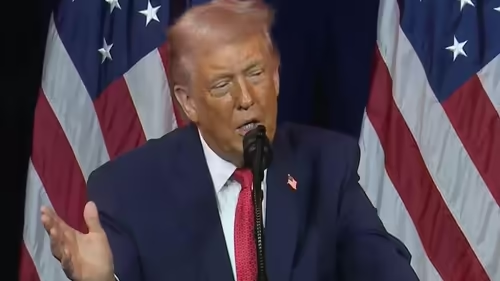
Trump’s announcement, made during a rally in Ohio, was laced with his trademark bluster: “Europe thinks they can take advantage of us while we protect their borders and their economies. Not anymore. We’re putting tariffs on Greenland because Denmark can’t control its own backyard—and neither can Brussels.”
Analysts interpret this as a thinly veiled threat aimed at the European Union, using Greenland as a proxy. The move echoes Trump’s 2019 attempt to buy Greenland, which was swiftly rejected by Denmark’s prime minister as “an absurd idea” . This new tariff gambit appears to be a continuation of that frustrated ambition, now repackaged as trade policy.
Why Greenland? A Frozen Chess Piece
To dismiss Greenland as just a barren island is to miss the point entirely. Its strategic value is skyrocketing due to climate change:
- Resource Wealth: Greenland sits atop vast reserves of rare earth minerals, critical for manufacturing everything from smartphones to missile guidance systems. China has already invested heavily in Greenlandic mining projects .
- Arctic Shipping Routes: As sea ice melts, the Northwest Passage and Northern Sea Route are becoming viable alternatives to the Suez Canal, potentially reshaping global trade flows .
- Military Significance: The U.S. already operates Thule Air Base in northern Greenland, a key node in its missile defense and space surveillance network. Control over the island ensures dominance in the High North .
By invoking Greenland, Trump is signaling that the U.S. will not cede influence in the Arctic to rivals like China or a fragmented Europe. It’s a declaration that the next frontier of global power is frozen—and America intends to own it.
Europe Reacts: Outrage and Anxiety
The European response has been swift and unified in its condemnation. The European Commission called the move “economically irrational and politically provocative” . Denmark’s foreign minister stated, “Greenland is not a bargaining chip. It is part of our kingdom, and its people decide their own future.”
But beneath the diplomatic language lies genuine anxiety. The EU fears this could be the opening salvo in a broader trade war, especially as U.S.-EU tensions simmer over digital taxes, agricultural subsidies, and defense spending. Some European leaders worry that Trump is deliberately destabilizing transatlantic relations to force concessions ahead of the 2028 U.S. election cycle .
The Bigger Picture: Trump’s Arctic Ambitions
This isn’t just about one tariff. It’s part of a larger, long-term strategy. In his first term, Trump pushed NATO allies to focus on Arctic security. He relaunched the U.S. Arctic Strategic Framework, and he consistently warned about Chinese and Russian expansion in the region .
The Greenland tariffs are a pressure tactic designed to achieve multiple goals at once: rally his domestic base with a tough-on-trade stance, remind Europe of U.S. leverage, and assert American primacy in a region that will define the 21st century. For more on how climate change is reshaping global power dynamics, see our analysis on [INTERNAL_LINK:climate-change-geopolitics].
Market and Geopolitical Fallout
While the direct economic impact of these tariffs is limited, the ripple effects could be significant:
- Investor Uncertainty: Markets hate unpredictability. Any escalation in U.S.-EU trade tensions could spook investors and weaken the euro.
- Accelerated EU Strategic Autonomy: This move may push the EU to fast-track its own defense and resource independence initiatives, reducing reliance on the U.S.
- Opportunity for China: If the West is distracted by internal squabbles, Beijing could deepen its economic foothold in Greenland and the wider Arctic under the guise of “scientific cooperation.”
Conclusion: More Than Just a Tariff
Donald Trump’s announcement of Greenland tariffs is classic Trumpian strategy: use a seemingly bizarre action to dominate the news cycle, apply maximum pressure, and shift the narrative. But behind the theatrics lies a calculated effort to secure America’s position in the Arctic—a region that will be central to economic and military power for decades to come.
Whether this leads to a full-blown trade war or simply serves as a negotiating ploy remains to be seen. One thing is certain: in the new Great Game of the Arctic, no piece on the board—no matter how icy—is too small to be ignored.
Sources
- Times of India: Lashing out at Europe, Trump announces ‘Greenland tariffs’
- European Commission Press Release: Statement on U.S. Tariffs Targeting Danish Territory
- BBC News: Trump’s Greenland purchase idea: What happened next?
- Financial Times: The Scramble for the Arctic: How Climate Change is Redrawing the Map
- U.S. Department of Defense: Department of Defense Arctic Strategy (2024)