In a world where every naval movement is scrutinized for hidden signals, India’s absence from the recent BRICS maritime exercise off the coast of South Africa has sparked intense debate. Was it a snub? A strategic retreat? Or simply a matter of principle?
The official answer from New Delhi is clear and firm: India skipped the BRICS naval drill because it was never a formal BRICS event to begin with. “It was purely a South African initiative,” stated India’s Ministry of External Affairs, emphasizing that not all BRICS members even participated .
But behind this diplomatic phrasing lies a complex web of geopolitical realities—especially India’s growing discomfort with deepening military cooperation between China and Russia, two fellow BRICS members with whom India shares tense borders and strategic rivalries. In an era of shifting alliances, India’s non-participation may be its loudest statement yet.
Table of Contents
- What Was the BRICS Naval Drill?
- Why India Skips BRICS Naval Drill: Official Stance
- The Unspoken Tensions: China, Russia, and India
- South Africa’s Role as BRICS Host
- How Other BRICS Nations Responded
- India’s Balancing Act in a Polarized World
- Conclusion: A Calculated Absence
- Sources
What Was the BRICS Naval Drill?
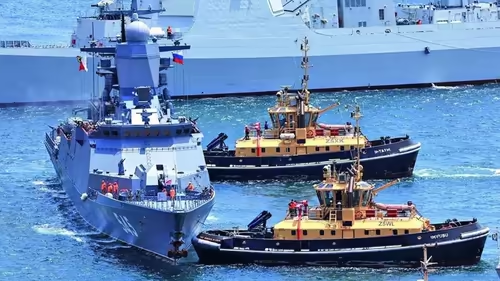
Held in late January 2026 off the coast of Durban, South Africa, the maritime exercise involved naval vessels from South Africa, China, and Russia. Dubbed a “BRICS drill” in media reports, the event featured coordinated maneuvers, search-and-rescue simulations, and communication drills.
However, crucially, neither Brazil nor India—the other two founding BRICS members—sent ships or personnel. This immediately raised questions about the exercise’s legitimacy as a multilateral BRICS endeavor. South Africa framed it as an opportunity to “strengthen maritime cooperation among friendly nations,” but the optics leaned heavily toward a trilateral engagement between Pretoria, Beijing, and Moscow .
Why India Skips BRICS Naval Drill: Official Stance
India’s Ministry of External Affairs (MEA) moved swiftly to clarify its position. In a rare public statement on a military-diplomatic matter, the MEA stressed that the drill was “purely a South African initiative” and that “not all BRICS countries took part” .
This framing serves two purposes:
- It distances India from any perception of military alignment with China and Russia, especially at a time when border tensions with China remain unresolved and Russia’s war in Ukraine continues to strain global order.
- It upholds India’s long-standing principle of strategic autonomy, avoiding entanglement in exercises that could be interpreted as anti-Western or bloc-based.
For more on India’s foreign policy doctrine, see our analysis on [INTERNAL_LINK:strategic-autonomy-indian-foreign-policy].
The Unspoken Tensions: China, Russia, and India
The elephant in the room is the deepening Sino-Russian partnership. Since 2022, China and Russia have conducted multiple joint naval drills in the Pacific, Indian Ocean, and even near Alaska—often seen as direct challenges to U.S. and allied dominance.
For India, participating in a drill alongside these two powers would send mixed signals. On one hand, India maintains strong defense ties with Russia (its historic arms supplier). On the other, it is increasingly aligned with the U.S., Japan, and Australia through the Quad—a grouping explicitly aimed at countering Chinese assertiveness in the Indo-Pacific .
Being on the same deck as Chinese and Russian warships—even under a BRICS banner—could undermine India’s credibility as a neutral balancer.
South Africa’s Role as BRICS Host
As the 2026 BRICS chair, South Africa has been eager to showcase the bloc’s unity and global relevance. Hosting a naval drill was likely intended to project BRICS as a cohesive security actor. However, the absence of India and Brazil exposed the group’s internal fractures.
South Africa’s own foreign policy has drawn criticism for its perceived tilt toward Moscow—evident in its refusal to condemn Russia’s invasion of Ukraine and its hosting of a trilateral naval exercise with Russia and China in 2023 . This latest drill appears to be a continuation of that trend.
How Other BRICS Nations Responded
Brazil, like India, opted out—citing budget constraints and lack of strategic interest in distant naval exercises. This left only three participants: South Africa, China, and Russia. Far from a BRICS show of force, the event highlighted the bloc’s divergent security priorities.
China’s state media, however, portrayed the drill as a “symbol of multipolar cooperation,” while Russian outlets praised South Africa’s “anti-imperialist solidarity.” The narrative gap between participants and non-participants couldn’t be starker.
India’s Balancing Act in a Polarized World
India’s decision reflects a broader recalibration. While it remains a committed member of BRICS for economic and developmental dialogue, it is drawing a hard line when it comes to military or quasi-military activities that could compromise its strategic interests.
This aligns with Prime Minister Modi’s vision of “Vishwa Mitra” (friend of the world)—engaging with all powers without being captive to any alliance. As the U.S. State Department noted in its 2025 Indo-Pacific Strategy Report, “India’s independent stance enhances regional stability” .
Conclusion: A Calculated Absence
India’s choice to skip the BRICS naval drill was never about logistics or timing—it was a deliberate, high-stakes signal. By declining to participate in what it rightly labeled a “South African initiative,” New Delhi reaffirmed its commitment to strategic autonomy and avoided legitimizing a Sino-Russian naval axis under a multilateral guise. In the chess game of global power, sometimes the most powerful move is to stay off the board altogether. And in this case, India skips BRICS naval drill not out of weakness, but out of calculated strength.
Sources
[1] Times of India: India defends decision to skip BRICS naval drill
[2] South African Department of Defence: Press Release on Maritime Exercise 2026
[4] U.S. Department of State: Indo-Pacific Strategy Report (2025)
[5] Reuters: South Africa faces scrutiny over Russia ties after 2023 naval drill
[6] Ministry of External Affairs, Government of India: Statement on BRICS and Multilateralism