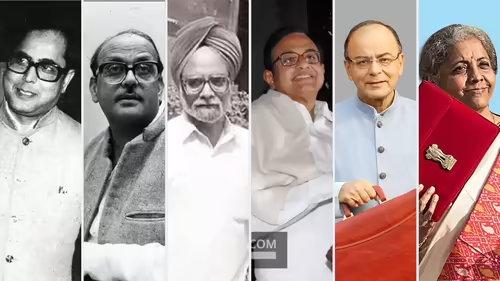
For most of us, the Union Budget is a yearly event filled with tax slabs, allocations, and political promises. But what if we told you it’s been India’s most potent, yet quiet, instrument of revolution? Over the past four decades, the Budget hasn’t just managed money—it has systematically torn down archaic structures and erected the very foundations of our modern market economy.
This isn’t about routine accounting; it’s about institutional engineering. Let’s dive into the story of how a financial document became the blueprint for a new India.
Table of Contents
- The Budget as a Tool of Change
- The Epochal 1991 Budget: Ending the Licence Raj
- The FRBM Act: Institutionalizing Fiscal Discipline
- The GST Budget: Unifying a Nation of Markets
- Why the Budget Remains India’s Key Reform Vehicle
- Conclusion: The Enduring Legacy of Reformist Budgets
- Sources
The Budget as a Tool of Change
Historically, budgets worldwide are meant for revenue and expenditure planning. In India, however, the Union Budget evolved into something far more strategic. Faced with a complex political environment where sweeping legislative changes were often impossible, Finance Ministers found a powerful workaround: embed structural reforms directly into the annual financial statement.
This approach allowed them to bypass prolonged parliamentary debates on individual bills and instead implement a package of changes under the umbrella of fiscal necessity. It was a masterstroke of political economy, using the one event every government must deliver to push through its most ambitious agenda.
The Epochal 1991 Budget: Ending the Licence Raj
No discussion on transformative budgets is complete without Dr. Manmohan Singh’s legendary 1991 speech. Presented on July 24, 1991, amidst a severe balance of payments crisis, this wasn’t just a budget—it was a declaration of war against decades of stifling state control .
The infamous “Licence Raj,” a web of permits and approvals that strangled private enterprise, was its primary target. The 1991 Union Budget began its systematic dismantling by:
- Abolishing industrial licensing for most industries, freeing businesses from bureaucratic shackles .
- Slashing peak customs duties from a crippling 220% to 150%, opening the economy to global competition .
- De-reserving industries previously reserved for the public sector, inviting private investment .
- Liberalizing foreign direct investment (FDI) policies to attract much-needed capital .
Dr. Singh’s famous line, “Let the whole world hear it loud and clear…,” wasn’t just rhetoric; it was a signal to the global market that India was open for business . This single budget set the country on a path of liberalization, privatization, and globalization (LPG) that continues to define its economic trajectory .
The FRBM Act: Institutionalizing Fiscal Discipline
If the 1991 budget was about unleashing growth, the early 2000s focused on ensuring it was sustainable. The problem? Chronic fiscal deficits that threatened macroeconomic stability.
The solution came in the form of the Fiscal Responsibility and Budget Management (FRBM) Act, 2003. While the Act itself was passed by Parliament, its genesis and framework were deeply rooted in the budgetary process and the recommendations of the Kelkar Task Force, which was specifically constituted to advise on its implementation .
The FRBM Act was a revolutionary attempt to bind future governments to fiscal prudence. Its core objectives, often reflected in subsequent budgets, were to:
- Eliminate the revenue deficit of the Central Government.
- Bring down the fiscal deficit to a manageable 3% of GDP.
- Create a transparent system of fiscal management .
By embedding these rules into law, the budget process was no longer just about spending, but about adhering to a long-term fiscal contract with the nation. It institutionalized discipline, making reckless spending a harder political choice.
The GST Budget: Unifying a Nation of Markets
Decades after liberalization, a new barrier remained: a fragmented, complex web of state and central indirect taxes that acted as a tax on doing business across India. The answer was the Goods and Services Tax (GST), and the 2017 Union Budget was its final launchpad.
While the constitutional amendment for GST was passed earlier, the 2017 budget, presented by Arun Jaitley, was crucial in reaffirming the government’s absolute commitment to its rollout on July 1, 2017 . The budget laid the groundwork by:
- Providing a clear timeline and roadmap for the transition.
- Outlining the compensation mechanism for states for any potential revenue loss in the first five years .
- Creating the necessary fiscal space to manage the initial disruption.
The successful implementation of GST, as confirmed by its launch on July 1, 2017 , was arguably the single largest tax reform since independence. It transformed India from a collection of separate markets into a true common national market, boosting efficiency and formalization—a direct legacy of a strategically crafted budget.
Why the Budget Remains India’s Key Reform Vehicle
So why do Finance Ministers keep returning to the budget as their primary tool for deep reform? The reasons are both practical and political:
- Certainty of Delivery: A government must present a budget every year. This guarantees a platform for announcing major changes.
- Comprehensive Scope: The budget covers taxation, expenditure, and regulation, allowing for a holistic package of reforms.
- Political Cover: Tough decisions can be framed as necessary for national economic health, providing a shield against short-term political backlash.
- Institutional Memory: A landmark budget creates a powerful precedent, setting a new normal that future governments find hard to reverse.
This legacy is why today’s debates on capital expenditure-led growth or direct tax reforms are still deeply connected to the institutional pathways carved out by these historic budgets .
Conclusion: The Enduring Legacy of Reformist Budgets
The history of India’s Union Budget is not a dry chronicle of numbers. It’s a thrilling narrative of courage, vision, and strategic statecraft. From Manmohan Singh’s bold moves in 1991 to the disciplined framework of the FRBM Act and the unifying force of GST, these documents have been the silent architects of modern India.
They remind us that sometimes, the most powerful revolutions don’t happen on the streets, but in the meticulous pages of a financial statement. The next time you hear the budget speech, listen not just for your tax rates, but for the echoes of a nation being rebuilt, one fiscal decision at a time.
Sources
[INTERNAL_LINK:indian-economic-policy-history]
[INTERNAL_LINK:gst-impact-on-indian-economy]
International Monetary Fund (IMF) on FRBM Act
Times of India: History of India’s Union Budgets