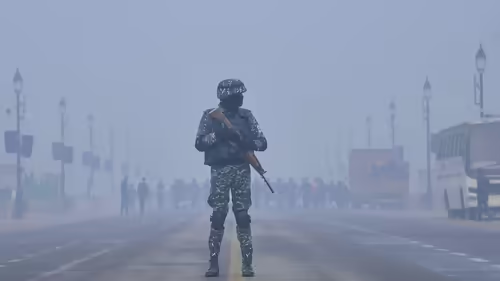
It’s that time of year again. The sun struggles to pierce through the thick, grey haze, your eyes sting, and every breath feels like a gamble. Delhi-NCR’s air quality has nosedived into the ‘severe’ category, prompting the Commission for Air Quality Management (CAQM) to pull out its most stringent emergency protocol: GRAP-IV. But what does this actually mean for residents, commuters, and the city’s future? Let’s break it down.
Table of Contents
- What is GRAP-IV and Why Has It Been Reimposed?
- Key Restrictions Under the GRAP-IV Protocol
- The Dire Health Implications of ‘Severe’ Air
- Beyond the Bans: Is GRAP-IV Enough?
- Conclusion: Breathing Easier or Just a Temporary Fix?
- Sources
What is GRAP-IV and Why Has It Been Reimposed?
The Graded Response Action Plan (GRAP) is a set of emergency measures designed to combat the toxic cocktail of pollutants that engulf the National Capital Region every winter. Managed by the CAQM, GRAP is activated in stages based on the Air Quality Index (AQI). With the AQI soaring past the 450 mark and settling into the ‘severe’ category (401-500), the CAQM had no choice but to escalate from GRAP-III to the final stage: GRAP-IV .
This isn’t just a bureaucratic formality. A ‘severe’ AQI means the air is so polluted that it poses a serious health risk to everyone, not just those with pre-existing conditions. The re-imposition of GRAP-IV is a stark reminder that despite years of warnings and action plans, Delhi’s battle against air pollution remains an uphill climb .
Key Restrictions Under the GRAP-IV Protocol
Stage IV of GRAP is essentially the capital’s emergency shutdown mode. Its primary goal is to eliminate any activity that could add even a single particle to the already choking atmosphere. Here’s a comprehensive look at what’s banned and what’s allowed:
- Vehicle Ban: A complete ban on BS-III petrol and BS-IV diesel vehicles from plying on the roads. Only BS-VI, CNG, and electric vehicles are permitted, with exceptions for essential services like emergency vehicles, public transport, and vehicles carrying perishable goods .
- Industrial Shutdown: All industries not running on clean fuels like natural gas or electricity are ordered to shut down immediately.
- Construction Halt: All construction and demolition activities are completely prohibited across the NCR, a major source of dust pollution .
- Work From Home: The government strongly advises all private offices to implement a work-from-home policy to reduce vehicular traffic.
- Entry Ban: A ban on the entry of trucks into Delhi, except for those transporting essential commodities like food, fuel, and medical supplies .
These measures are not suggestions; they are legally enforceable directives from the CAQM. Violations can lead to significant penalties.
The Dire Health Implications of ‘Severe’ Air
Living under a GRAP-IV alert is more than just an inconvenience; it’s a public health emergency. Medical experts warn that prolonged exposure to the fine particulate matter (PM2.5 and PM10) prevalent in ‘severe’ air can have devastating consequences .
Here’s what the science tells us about the immediate and long-term effects:
- Respiratory System Damage: The tiny particles can penetrate deep into your lungs, causing inflammation, aggravating asthma, and leading to chronic bronchitis.
- Increased Heart Risk: Studies have shown a direct correlation between high pollution days and a spike in heart attacks and strokes .
- Weakened Immunity: Your body’s ability to fight off infections is significantly compromised.
- Potential for Premature Death: Shockingly, one study estimates that on a day with a ‘severe’ AQI, Delhi could see up to 40 additional deaths attributed directly to the poor air quality .
If you’re in Delhi right now, it’s crucial to limit outdoor activities, especially for children, the elderly, and those with existing health issues. Using a high-quality N95 mask and an air purifier at home is no longer optional—it’s a necessity.
Beyond the Bans: Is GRAP-IV Enough?
While GRAP-IV is a critical emergency response, it’s fundamentally a band-aid solution. It tackles the symptoms of the pollution crisis—the immediate sources of emissions—but not the root causes. The perennial villains remain: stubble burning in neighboring states, unchecked industrial emissions, a massive vehicle population, and systemic waste management failures.
There’s a growing debate among environmentalists and urban planners about whether these cyclical emergency measures are creating a false sense of security. Are we becoming complacent, waiting for the government to impose bans instead of demanding permanent, structural changes? The effectiveness of GRAP is undeniable—one study suggests it may have prevented 60% more severe air days—but it cannot be the cornerstone of a long-term strategy .
For a sustainable future, Delhi needs a multi-pronged attack that includes a massive investment in public transport, a rapid transition to renewable energy, and robust, year-round enforcement of environmental laws, not just during a crisis. [INTERNAL_LINK:delhi-sustainable-transport-future] explores some of these long-term solutions in greater detail.
Conclusion: Breathing Easier or Just a Temporary Fix?
The reimposition of GRAP-IV in Delhi is a necessary but sobering event. It’s a clear signal that the city’s air quality management is still reactive rather than proactive. While the current restrictions will provide some immediate, albeit temporary, relief, they underscore a deeper, more systemic failure. For the residents of Delhi-NCR, the message is clear: protect your health now, but keep demanding a cleaner, more sustainable future for the capital. The air you breathe depends on it.
Sources
- Commission for Air Quality Management (CAQM). (2025). Direction on GRAP Stage-IV. Retrieved from https://caqm.nic.in
- Times of India. (2026). Pollution crisis: GRAP-IV reimposed in Delhi-NCR; air quality slips to ‘severe’ category.
- India Today. (2025). GRAP Stage 4: Full List Of Bans If Delhi AQI Hits 451
- The Hindu. (2025). Delhi-NCR pollution: GRAP-IV imposed as AQI crosses 450
- NDTV. (2025). GRAP Stage 4 Enforced in Delhi as AQI Touches 600+
- Down To Earth. (2025). Delhi Air Pollution: GRAP Revision and Urgent Health Advisory
- World Health Organization (WHO). (2021). Air quality and health. Retrieved from https://www.who.int/news-room/fact-sheets/detail/air-pollution