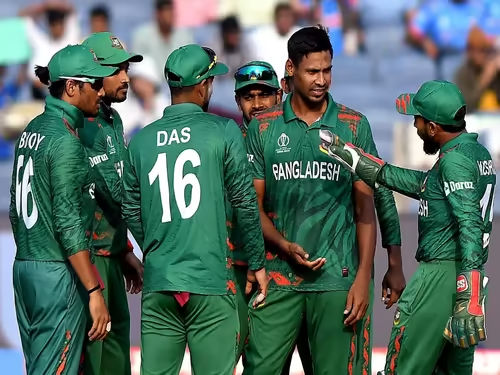
In a dramatic turn of events that has sent shockwaves through the cricketing world, the International Cricket Council (ICC) has officially shut down the Bangladesh Cricket Board’s (BCB) urgent request to relocate its T20 World Cup 2026 matches from India to Sri Lanka. The BCB, citing serious security concerns, had formally asked the ICC to swap its group with Ireland’s, a move that would have fundamentally altered the tournament’s landscape .
This high-stakes standoff between a major cricketing nation and the sport’s global governing body raises critical questions about player safety, geopolitical tensions, and the integrity of a multi-billion dollar sporting event. Let’s break down exactly what happened, why it matters, and what comes next.
Table of Contents
- The BCB’s Bold Request: A Last-Minute Gamble
- Why Security Concerns in India?
- The ICC’s Firm Rejection and Reasoning
- What the Group Swap Would Have Meant
- The Future of Bangladesh’s Participation
- Conclusion: A Tournament in Turmoil
- Sources
The BCB’s Bold Request: A Last-Minute Gamble
With the T20 World Cup 2026 scheduled to kick off on February 7th, the BCB made a stunning and unprecedented move. They formally requested that the ICC allow them to swap their entire group stage schedule with Ireland’s. This wasn’t just a simple venue change; it was a complete overhaul of their competitive path in the tournament .
Their goal was clear: to avoid playing any matches on Indian soil. Instead, they wanted to play all their group games in Sri Lanka, where Ireland is currently slated to compete. An ICC delegation even flew to Dhaka for emergency talks, but the BCB held its ground, refusing to budge on its core demand .
Why Security Concerns in India?
The BCB has been tight-lipped about the specific nature of the “security concerns” that prompted this drastic action. However, the request comes amid a complex and sensitive geopolitical backdrop in the region. While the ICC and the Board of Control for Cricket in India (BCCI) have provided extensive security guarantees, the BCB appears to be operating under a different set of risk assessments.
It’s worth noting that the tournament will be co-hosted by India and Sri Lanka, with marquee venues like Eden Gardens in Kolkata, Wankhede in Mumbai, and the Narendra Modi Stadium in Ahmedabad all set to host key matches . The fact that a full member nation is unwilling to participate in matches at these iconic grounds is a significant development.
T20 World Cup 2026: The ICC’s Firm Rejection and Reasoning
The ICC has now delivered its final verdict: the request is denied. In a decisive move, the council stated that the tournament schedule, which has been public for months, cannot be altered at this late stage .
Their reasoning is rooted in fairness and logistical practicality. Changing the groups would not only disrupt the carefully balanced competition but also create an unfair advantage or disadvantage for other teams. Ireland, for instance, has been preparing for a group that includes powerhouses like Australia and co-hosts Sri Lanka, a completely different challenge than facing England and the West Indies in Group C .
What the Group Swap Would Have Meant
To understand the magnitude of the BCB’s ask, let’s look at the current group structure:
| Group | Teams | Primary Host Nation |
|---|---|---|
| Group B | Australia, Sri Lanka, Ireland, Zimbabwe, Oman | Sri Lanka |
| Group C | England, West Indies, Bangladesh, Nepal, Italy | India |
A swap would have meant Bangladesh playing in Colombo against Australia and Sri Lanka, while Ireland would have been shipped to India to face England and the West Indies. The logistical nightmare for travel, accommodation, and fan engagement would have been immense, not to mention the competitive imbalance it could introduce .
The Future of Bangladesh’s Participation
With the ICC’s door now firmly closed on a group swap, the ball is entirely in the BCB’s court. They are left with two stark choices:
- Accept the ICC’s decision and participate in the tournament as scheduled in India. This would mean their players travel to venues like Eden Gardens in Kolkata for their opening match against England .
- Boycott their matches in India, which would likely lead to forfeits and potential sanctions from the ICC. This would be a nuclear option with severe consequences for Bangladesh’s standing in international cricket and its relationship with the ICC.
Reports suggest the BCB is still in a state of deadlock, refusing to confirm their participation in the Indian leg of the tournament . This uncertainty casts a long shadow over the event, leaving fans and organizers in limbo.
Conclusion: A Tournament in Turmoil
The ICC’s rejection of Bangladesh’s request has not resolved the crisis; it has merely escalated it. The T20 World Cup 2026, one of the most anticipated events in the cricketing calendar, is now overshadowed by a major political and security dispute. The coming days will be critical as the BCB must decide whether to prioritize its players’ perceived safety or its commitment to the global game. For now, the beautiful game finds itself entangled in a web of geopolitics, leaving everyone wondering if the show can truly go on. Stay tuned to [INTERNAL_LINK:cricket-news] for all the latest updates on this developing story.
Sources
- ICC rejects Bangladesh’s request to shift its Men’s T20 World Cup 2026 Group C matches from India to Sri Lanka.
- Bangladesh asks ICC for group swap with Ireland in T20 World Cup 2026.
- Bangladesh’s T20 World Cup 2026 row takes fresh turn as BCB refuses to travel to India.
- BCB reiterates formal request to ICC to relocate Bangladesh’s matches to Sri Lanka.
- ICC T20 World Cup 2026: Schedule, Host Countries & Team List.
- ICC T20 World Cup 2026: Schedule, Groups, Teams.
- Bangladesh want to swap T20 World Cup 2026 group with Ireland.
- Ireland announce squad for ICC Men’s T20 World Cup 2026.