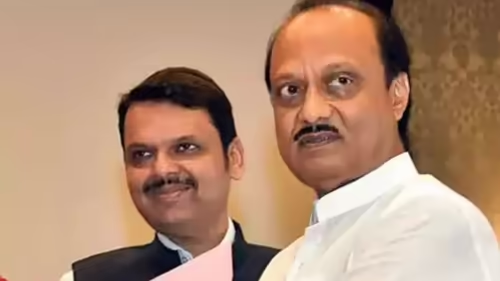
In the high-stakes world of Maharashtra politics, a single statement can shift the narrative for an entire alliance. Following a significant electoral win in Pune, Chief Minister Devendra Fadnavis has made a bold declaration that is reverberating across the political landscape: “People haven’t rejected Ajit Dada, rather they have accepted him.” This isn’t just a defense of his deputy; it’s a strategic affirmation of the Mahayuti coalition’s stability and a direct nod to the overarching influence of Prime Minister Narendra Modi’s leadership.
The comment comes at a crucial juncture, aimed at quelling any internal dissent and silencing external critics who have questioned the durability of the BJP-NCP (Ajit Pawar faction) partnership. Fadnavis’s message is clear: the electorate has spoken, and their verdict is in favor of unity under the NDA banner.
Table of Contents
- The Pune Victory and Its Significance
- Fadnavis on Ajit Pawar: A Strategic Alliance Defended
- The Modi Factor in Maharashtra’s Political Calculus
- What This Means for the Future of Maharashtra Politics
- Conclusion: A Unified Front Ahead of 2029?
- Sources
The Pune Victory and Its Significance
The recent win in Pune is more than just another notch on the Mahayuti’s belt. It’s a symbolic stronghold, a city that often reflects the state’s broader political mood. Securing this seat sends a strong signal about the coalition’s grassroots appeal and its ability to mobilize voters beyond traditional party lines. For Fadnavis, this victory is tangible proof that his government’s development agenda and stable administration are resonating with the public.
Fadnavis on Ajit Pawar: A Strategic Alliance Defended
Fadnavis’s statement, “People haven’t rejected Ajit Dada,” is a masterstroke of political messaging. It directly addresses the elephant in the room: the controversial split in the Nationalist Congress Party (NCP) and Ajit Pawar’s decision to join hands with the BJP in 2023. Critics had long speculated that this move would alienate the NCP’s core base, but the Pune result suggests otherwise .
By publicly and affectionately referring to him as “Ajit Dada,” Fadnavis is not only showing respect but also reinforcing the personal and political bond between the two leaders. This public display of unity is crucial for maintaining the cohesion of their alliance. It tells their combined voter base that the partnership is solid, functional, and, most importantly, endorsed by the people themselves. This is a classic example of turning a defensive position into a narrative of popular mandate.
The Modi Factor in Maharashtra’s Political Calculus
No discussion of the Mahayuti’s success is complete without acknowledging the towering presence of Prime Minister Narendra Modi. Fadnavis was quick to pivot from his defense of Ajit Pawar to a full-throated endorsement of the Prime Minister’s leadership style. He credited Modi’s vision of “Sabka Saath, Sabka Vikas” as the foundational philosophy driving their government’s policies .
Modi’s national popularity and his image as a decisive, development-oriented leader provide a powerful umbrella under which regional allies like Ajit Pawar can operate. For many voters, supporting the BJP-led alliance in Maharashtra is synonymous with supporting the Prime Minister’s national agenda. Fadnavis’s praise for Modi serves a dual purpose: it aligns his state government with a winning national brand and provides a unifying ideology that transcends individual party interests.
This strategy has been effective before. The BJP’s ability to project Modi as its central campaign figure has been a key driver of its electoral successes across India, and Maharashtra is no exception. By tying their local victories to Modi’s national leadership, Fadnavis and his allies can tap into a much larger reservoir of goodwill and trust.
What This Means for the Future of Maharashtra Politics
The implications of Fadnavis’s statement and the Pune victory are far-reaching:
- Consolidation of the Mahayuti:** The alliance is likely to grow stronger, with both the BJP and Ajit Pawar’s NCP faction working to present a united front against the opposition Maha Vikas Aghadi (MVA).
- Ajit Pawar’s Legitimacy:** The win provides a significant boost to Ajit Pawar’s political legitimacy, helping him solidify his position as the true heir to the NCP legacy in the eyes of his supporters .
- Opposition in Disarray:** The MVA, comprising the Shiv Sena (UBT), the undivided NCP (Sharad Pawar), and the Congress, faces an uphill battle to counter the narrative of a stable, development-focused government backed by a popular Prime Minister.
Looking ahead, this dynamic sets the stage for the 2029 state assembly elections. The Mahayuti will aim to replicate this formula of local leadership backed by national charisma, while the opposition must find a compelling counter-narrative that can break through the Modi-Fadnavis-Pawar triumvirate.
Conclusion: A Unified Front Ahead of 2029?
Devendra Fadnavis’s post-victory remarks are more than just celebratory rhetoric. They are a carefully crafted political strategy designed to cement his alliance with Ajit Pawar and leverage the immense popularity of Prime Minister Modi. By framing the Pune win as a public endorsement of their partnership and a validation of Modi’s leadership model, Fadnavis has successfully shifted the narrative in his favor. For now, the Mahayuti appears to be a formidable and unified force, with its eyes firmly set on a long-term hold on power in Maharashtra. Whether this unity can withstand future political storms remains to be seen, but for the moment, the message from Pune is one of confidence and consolidation.
Sources
[INTERNAL_LINK:maharashtra-politics-explained] | [INTERNAL_LINK:modi-leadership-style-analysis]
External sources:
Times of India: ‘People haven’t rejected Ajit dada, rather … ‘: Fadnavis on Pune win
Prime Minister of India: On Leadership