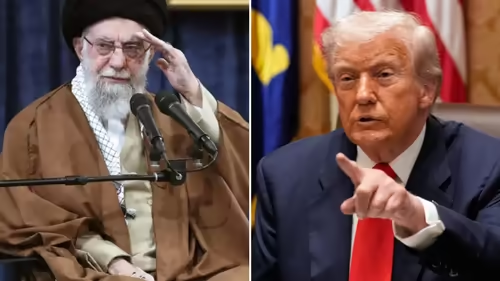
In a stunning and incendiary declaration that has sent shockwaves through global diplomatic circles, Iran’s Supreme Leader, Ayatollah Ali Khamenei, has laid the blame for the deaths of Iranian protesters squarely at the feet of former US President Donald Trump. His message was clear, direct, and laced with decades of historical grievance: the recent wave of deadly unrest sweeping across Iran is nothing short of an American plot.
This isn’t just political posturing; it’s a calculated narrative designed to rally domestic support and reframe a complex internal crisis as an act of foreign aggression. But what exactly did Khamenei say, and what does this mean for the already volatile relationship between Tehran and Washington?
Table of Contents
- Khamenei’s Explosive Accusation: “Trump is a Criminal”
- The Context of Iran’s Unrest
- A History of Distrust: US-Iran Relations
- Why Khamenei is Pointing the Finger at America
- Global Reactions and Potential Consequences
- Conclusion: A Dangerous New Chapter
- Sources
Khamenei’s Explosive Accusation: “Trump is a Criminal”
During a major public address on Saturday, January 17, 2026, Ayatollah Khamenei delivered his most forceful condemnation yet of US involvement in Iran’s internal affairs. He didn’t mince words, labeling Donald Trump a “criminal” and holding him personally accountable for the casualties and destruction witnessed during the recent protests .
“We do consider the US president a criminal, because of casualties and damages, because of accusations against the Iranian nation,” Khamenei declared .
His central thesis is that the United States, under Trump’s influence, orchestrated the protests with the ultimate goal of regime change. “It was clearly an American sedition. The Americans had planned it,” he stated, adding ominously, “America’s goal is to swallow up Iran” . This rhetoric serves to delegitimize the protesters, painting them not as citizens with grievances but as unwitting pawns or willing agents of a foreign enemy.
The Context of Iran’s Unrest
The protests Khamenei is referring to are part of a larger, ongoing wave of civil disobedience that has gripped Iran since late 2025. These demonstrations were initially sparked by economic hardship and have since evolved to include broader demands for political reform and social freedoms. The government’s response has been widely criticized by international human rights organizations for its severity.
Khamenei’s speech notably made no mention of the thousands of civilian deaths reported by various monitoring groups during these protests . Instead, he shifted the entire narrative, suggesting that any violence was a direct result of American instigation, not state policy. He even claimed that Trump’s hands are “stained with the blood of more than a thousand Iranians,” a reference that appears to conflate the protest deaths with other regional conflicts .
A History of Distrust: US-Iran Relations
To understand Khamenei’s accusation, one must look back at the long and fraught history between the two nations. The relationship has been hostile since the 1979 Islamic Revolution, which overthrew the US-backed Shah. Key flashpoints include the CIA-backed coup in 1953, the hostage crisis, and decades of economic sanctions .
The situation reached a new low in 2025 when the US and Israel conducted strikes on Iranian nuclear facilities, a move that marked a significant escalation . Even a brief period of negotiations in April 2025 aimed at a nuclear peace agreement ultimately failed to yield a lasting solution . This deep-seated animosity provides the perfect backdrop for Khamenei’s claims of an “American plot,” as it resonates with a population that has been conditioned for decades to view the US as the “Great Satan.”
Why Khamenei is Pointing the Finger at America
From a strategic standpoint, Khamenei’s move is a classic deflection tactic with several key objectives:
- Consolidate Domestic Power: By framing the protests as a foreign attack on the nation itself, he unites the populace against a common external enemy, diverting attention from internal government failures.
- Discredit the Protesters: Labeling demonstrators as tools of the US strips their movement of its legitimacy and moral authority in the eyes of many Iranians.
- Justify a Crackdown: If the unrest is an act of war by a foreign power, then a harsh security response is not repression—it’s national defense.
- Send a Message to Washington: It’s a stark warning to the US (and its allies) that any perceived interference will be met with maximum resistance and could lead to further destabilization.
This strategy has been used before, but the direct naming of Trump as a “criminal” adds a deeply personal and inflammatory layer to the conflict .
Global Reactions and Potential Consequences
The international community is now watching closely. While the US State Department has yet to issue a formal response to Khamenei’s latest remarks, the accusation is certain to further poison an already toxic relationship. For more on the official US stance on Iran, you can refer to the US Department of State’s page on Iran.
The potential consequences are severe. This could lead to:
- An even more brutal crackdown on dissent within Iran.
- A complete shutdown of any remaining back-channel communications between the two countries.
- Increased cyber warfare or proxy conflicts in the region.
- Further isolation of Iran on the global stage.
For those following the situation, our coverage on [INTERNAL_LINK:middle-east-politics] provides deeper context on the region’s complex dynamics.
Conclusion: A Dangerous New Chapter
Ayatollah Khamenei’s decision to explicitly Khamenei blames Trump for the deaths of his own citizens is a pivotal and perilous moment. It represents a hardening of Iran’s position and a deliberate choice to escalate tensions rather than seek de-escalation. By weaving a narrative of an “American plot,” he is betting that nationalist fervor will override popular discontent. Whether this gamble pays off for the regime or plunges the country into an even deeper crisis remains to be seen, but one thing is certain: the path to any reconciliation between Iran and the United States has just become significantly more treacherous.
Sources
- Times of India: ‘Unrest an American plot’: Khamenei blames Trump for protester’s deaths; issues big warning
- Council on Foreign Relations: Timeline of U.S.-Iran Relations
- US Department of State: U.S. Relations With Iran