Table of Contents
- The AR Rahman Controversy Sparks Industry Firestorm
- Javed Akhtar & Shobhaa De Push Back Hard
- What AR Rahman Actually Said
- Is There a Communal Bias in Bollywood?
- The Real Issue: Power vs. Creativity
- How the Industry Has Changed Since Rahman’s Peak
- Conclusion
- Sources
The AR Rahman Controversy Sparks Industry Firestorm
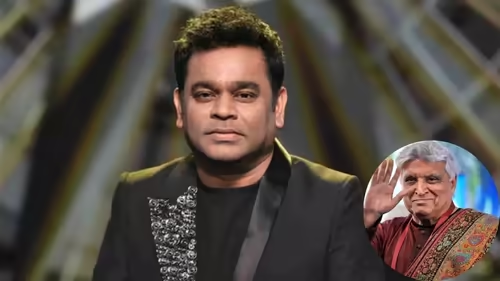
When AR Rahman—the man who redefined Indian film music with Roja, Dil Se, and Slumdog Millionaire—hinted that his reduced presence in Bollywood might stem from “communal” reasons, it didn’t just raise eyebrows. It ignited a full-blown cultural debate .
In a candid interview, the two-time Oscar winner suggested that decision-makers in the Hindi film industry may be avoiding him due to his Muslim identity. The statement landed like a thunderclap in an already polarized media landscape—and quickly drew sharp responses from some of Bollywood’s most respected voices.
Javed Akhtar & Shobhaa De Push Back Hard
Veteran lyricist and screenwriter Javed Akhtar was among the first to respond—and he didn’t mince words. Calling Rahman’s claim “unfounded,” Akhtar argued that the real reason producers hesitate isn’t religion, but something far more pragmatic: fear.
“People aren’t scared of your faith—they’re scared of your genius,” Akhtar reportedly said. He elaborated that Rahman’s legendary status and exacting creative standards make him intimidating for today’s risk-averse, budget-conscious filmmakers who prefer quick, formulaic background scores over deeply collaborative musical journeys .
Columnist and author Shobhaa De echoed this sentiment, labeling Rahman’s remark as “dangerous” not because it’s false, but because it risks oversimplifying a complex industry shift. “It’s not about communalism—it’s about control,” she wrote. “Today’s Bollywood is run by marketers, not musicians. And geniuses like Rahman don’t fit neatly into their Excel sheets.”
What AR Rahman Actually Said
To be fair, Rahman never outright accused anyone of discrimination. In his original comments, he mused: “Maybe there’s a communal angle… or maybe people just find it hard to work with someone who has a certain stature.” He also pointed to a broader trend: a power shift in Bollywood where “non-creative individuals” now call the shots, sidelining artists who demand creative freedom .
This nuance got lost in headlines—but it’s crucial. Rahman wasn’t crying victim; he was diagnosing a systemic problem: the devaluation of artistry in favor of commercial predictability.
Is There a Communal Bias in Bollywood?
Let’s address the elephant in the room. Has Bollywood become less inclusive for Muslim artists?
Data is scarce, but anecdotal evidence suggests a chilling effect post-2014. Several Muslim actors, writers, and composers have reported being offered fewer roles or asked to “tone down” their identities. A 2022 report by the Centre for Equity Studies noted a decline in prominent Muslim representation across mainstream Hindi cinema .
However, applying this broadly to AR Rahman—a global icon with a massive fanbase—may not hold water. His recent Hindi projects include Ponniyin Selvan’s dubbed version and collaborations with A.R. Murugadoss. If anything, his selective involvement seems more strategic than forced.
The Real Issue: Power vs. Creativity
The heart of the AR Rahman controversy isn’t religion—it’s relevance in a transformed ecosystem.
Consider this: In the 1990s and early 2000s, music directors like Rahman, Shankar-Ehsaan-Loy, and Pritam were central to a film’s success. Albums sold millions. Songs made or broke movies.
Today? Background scores are often outsourced to anonymous studios. Title tracks are commissioned from TikTok-famous indie artists. The music budget is slashed to fund VFX or star salaries.
Why Producers Hesitate to Hire Rahman
- Cost: Rahman’s fees are premium—often ₹5–10 crore per film.
- Time: He takes months to perfect a score; modern shoots operate on 60-day timelines.
- Creative Control: He insists on being involved from script stage—something few new-age directors allow.
- ROI Uncertainty: With streaming killing album sales, producers question if his music still “moves the needle.”
How the Industry Has Changed Since Rahman’s Peak
Bollywood in 2026 looks nothing like the one that embraced Lagaan or Rang De Basanti. Franchise films, pan-India releases, and algorithm-driven content dominate. In this world, a composer who spends weeks crafting a single raga-based melody is seen as “old-school”—not because of his faith, but because his process clashes with the industry’s new speed-and-scale mantra.
Ironically, Rahman remains wildly active—just not always in Hindi cinema. He’s scoring Tamil epics, producing international documentaries, and mentoring young artists through his KM Music Conservatory in Chennai . His absence from Bollywood may be less about exclusion and more about choice.
Conclusion
The AR Rahman controversy has done one good thing: it’s forced a long-overdue conversation about creativity, commerce, and inclusion in Indian cinema. While Javed Akhtar and Shobhaa De rightly challenge the communal narrative, they also confirm a painful truth—today’s Bollywood often sidelines depth for convenience. Rahman isn’t being erased because of who he is, but because of what he represents: uncompromising artistry in an age of shortcuts. For fans of meaningful cinema, that’s the real loss. Want more insights into Bollywood’s evolving landscape? Don’t miss our deep dive on [INTERNAL_LINK:bollywood-music-evolution-last-decade].