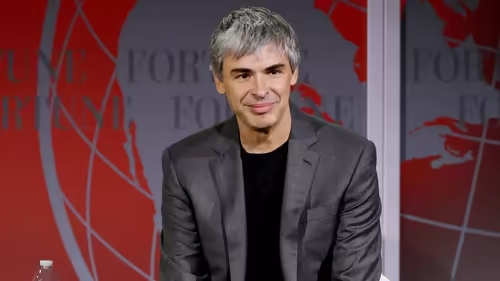
Larry Page Flees California Wealth Tax: $170M Miami Move Sparks Tech Exodus Debate
In a move that’s sending shockwaves through Silicon Valley and state capitals alike, Google co-founder Larry Page has quietly exited California—purchasing two sprawling waterfront estates in Miami’s exclusive Coconut Grove neighborhood for a combined $170 million. The timing couldn’t be more telling: this high-profile relocation comes just as California lawmakers push forward with an aggressive California wealth tax proposal targeting its ultra-rich residents. For many, Page’s departure isn’t just a lifestyle upgrade—it’s a political statement and a potential harbinger of a broader tech elite exodus.
Table of Contents
- The Miami Purchase: A Billionaire’s New Playground
- What Is the Proposed California Wealth Tax?
- Tech Titans on the Move: A Growing Trend
- Economic Impact: What California Stands to Lose
- Why Florida? The No-Income-Tax Advantage
- Conclusion: A Warning Sign for High-Tax States?
- Sources
The Miami Purchase: A Billionaire’s New Playground
Public records reveal that Larry Page, who stepped down from Alphabet’s board in 2019 but remains one of the world’s wealthiest individuals (net worth estimated at over $120 billion), acquired two adjacent properties totaling nearly 5 acres along Biscayne Bay . The deal, finalized in late 2025, includes a main mansion with panoramic ocean views, private docks, and extensive security infrastructure—classic hallmarks of billionaire relocations in today’s volatile tax climate .
Notably, Page has severed ties with his longtime Palo Alto residence, where he helped build Google from a garage startup into a global tech empire. His move follows a pattern seen among other Silicon Valley luminaries—including Elon Musk (who moved to Texas) and Peter Thiel (now based in New Hampshire)—all seeking lower taxes, less regulation, and greater personal freedom .
What Is the Proposed California Wealth Tax?
The catalyst behind this migration wave is California’s controversial proposal to impose a 1.5% annual tax on net worth exceeding $100 million, with a higher 2.5% rate for fortunes above $1 billion . Dubbed the “Wealth Tax Act,” the measure aims to generate up to $22 billion annually to fund housing, healthcare, and climate initiatives.
Proponents argue it’s a matter of fairness: “The ultra-rich have benefited enormously from California’s ecosystem—they should pay their fair share,” said State Senator Scott Wiener, a key backer of the bill .
But critics warn of unintended consequences. “You can’t tax mobility,” says Dr. Erica York, Senior Economist at the nonpartisan Tax Foundation. “When you penalize success, capital—and people—simply leave.”
Tech Titans on the Move: A Growing Trend
Larry Page isn’t alone. A growing list of tech leaders are voting with their feet:
- Elon Musk: Relocated Tesla’s HQ to Texas in 2021, citing regulatory hostility and high taxes.
- Joe Lonsdale (Palantir): Moved to Austin, calling California “anti-business.”
- Chamath Palihapitiya: Now splits time between Miami and Puerto Rico, both low-tax jurisdictions.
Miami, in particular, has emerged as a magnet for crypto entrepreneurs, venture capitalists, and tech founders—dubbed “Silicon Beach” by boosters like Mayor Francis Suarez, who actively courts relocating businesses with promises of no state income tax and streamlined permits .
Economic Impact: What California Stands to Lose
If the California wealth tax passes, the state risks more than just headlines. According to a 2024 Stanford University study, a 1% wealth tax could trigger the departure of 15–20% of ultra-high-net-worth households, resulting in a net revenue loss due to reduced income, sales, and property tax collections .
Beyond dollars, California could lose innovation capital, angel investment, and philanthropic funding—all traditionally driven by its resident billionaires. “These individuals don’t just pay taxes; they fund startups, universities, and cultural institutions,” notes urban economist Richard Florida .
Why Florida? The No-Income-Tax Advantage
Florida’s appeal is straightforward: no state income tax, no estate tax, and minimal wealth taxation. Combined with warm weather, strong property rights, and business-friendly policies, it’s become the go-to destination for the mobile wealthy.
Miami’s transformation—from a retirement haven to a tech and finance hub—is being turbocharged by these arrivals. Real estate prices in neighborhoods like Coconut Grove and Brickell have surged, while local governments welcome the influx of high-spending residents .
Conclusion: A Warning Sign for High-Tax States?
Larry Page’s $170 million bet on Miami is more than a real estate transaction—it’s a stark signal about the limits of progressive taxation in a globally mobile economy. While California seeks to address inequality through its proposed California wealth tax, it may inadvertently accelerate a brain and capital drain that could undermine its own economic engine. As more billionaires follow Page’s lead, policymakers face a tough choice: double down on redistribution or reform to retain their most prosperous residents. For now, the palm trees of Florida are looking greener than ever. Stay updated on tax migration trends with [INTERNAL_LINK:US_state_tax_comparisons].
Sources
- Times of India: Google co-founder Larry Page buys Florida property
- Tax Foundation: Do Wealth Taxes Cause Capital Flight?
- Stanford Institute for Economic Policy Research: Research on High-Income Migration