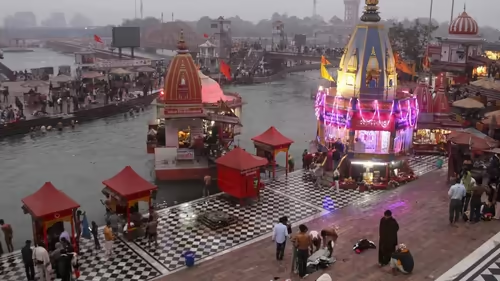
Har ki Pauri ‘No Entry for Non-Hindus’ Controversy: What the 1916 Bylaw Really Says
A wave of controversy has swept through the holy city of Haridwar after new notice boards appeared at the sacred Har ki Pauri ghat, boldly declaring “No entry for non-Hindus.” The move, spearheaded by the Ganga Sabha, has sparked a national debate on religious freedom, historical precedent, and the role of civic authorities in managing public spaces. At the heart of this Har ki Pauri controversy lies a set of municipal bylaws drafted over a century ago. But are these rules still enforceable today?
Table of Contents
- The Boards and the Bylaw: A Century-Old Rule Resurfaces
- The Ganga Sabha’s Stance: Preserving Sanctity or Exclusion?
- The Official Response: Law vs. Legacy
- Historical Context: Why Was the 1916 Bylaw Created?
- Broader Implications for Religious Sites in India
- Conclusion: A Complex Tension Between Faith and Law
- Sources
The Boards and the Bylaw: A Century-Old Rule Resurfaces
The Shri Ganga Sabha, the body responsible for managing the Har ki Pauri ghat, has installed prominent signage citing its own bylaws framed in 1916. These boards state that only individuals connected to Sanatan Dharma (Hinduism) are permitted to enter the sacred precincts . The Ganga Sabha argues that this rule is not new but a long-standing regulation designed to protect the religious dignity and sanctity of one of Hinduism’s most revered sites .
According to the Sabha, the 1916 bylaws were established during British rule under the guidance of the esteemed Congress leader and educationist, Pandit Madan Mohan Malaviya, who was also the founder of the Ganga Sabha itself . The original intent was to prevent any perceived desecration of the holy site and to maintain its spiritual atmosphere .
The Ganga Sabha’s Stance: Preserving Sanctity or Exclusion?
Ganga Sabha president Nitin Gautam has been vocal in his support for the wider implementation of these rules. He contends that the 1916 bylaws are still valid and should be strictly enforced to preserve the purity of Har ki Pauri and other major ghats in Haridwar . The Sabha’s position is that this is not about discrimination but about upholding the specific religious character of a designated sacred space, much like how certain areas within other religious institutions worldwide have restricted access.
Their demands extend beyond just visitors; they have also called for a ban on non-Hindu officials and journalists from entering these areas unless on essential, official duty . This push has been part of a larger campaign by the organization to see these century-old regulations applied consistently across all religious zones in the city .
The Official Response: Law vs. Legacy
While the Ganga Sabha champions the 1916 bylaw, district and civic authorities have taken a more cautious and legally grounded stance. Officials have clarified that there is no fresh government order backing this restriction. The onus of enforcement, they state, lies with the civic authorities, who must act within the framework of the current Indian Constitution and existing laws .
Haridwar Municipal Commissioner Nandan Kumar has acknowledged the existence of the 1916 bylaws, which do prohibit non-Hindu entry into the Har Ki Pauri area . However, he and other officials have stopped short of confirming that these colonial-era rules can be actively enforced in modern, democratic India without a formal legal process. This creates a significant grey area where a historical claim meets contemporary legal and constitutional realities.
Historical Context: Why Was the 1916 Bylaw Created?
To understand the origin of this rule, one must look back to the socio-political climate of 1916. India was under British colonial rule, and there was a strong movement among Hindu leaders to assert control over their own religious sites and practices, which they felt were being undermined or disrespected. The formation of the Ganga Sabha by Pt. Madan Mohan Malaviya was itself a direct response to these concerns .
The bylaws were likely a protective measure, born out of a desire to shield the ghat from activities deemed incompatible with its religious purpose. It’s important to note that the rule reportedly included an exception for officials on duty, suggesting a pragmatic understanding even then that absolute exclusion was not always feasible .
Broader Implications for Religious Sites in India
This Har ki Pauri controversy is not an isolated incident. It touches on a larger, ongoing national conversation about the management of religious places in a secular democracy. Key questions arise:
- Can a private religious trust enforce entry restrictions based on faith in a public space?
- How do we balance the right of a religious community to manage its own affairs with the fundamental right to equality and freedom of movement for all citizens?
- What is the legal validity of bylaws created before the Indian Constitution came into force?
These are complex issues that require careful legal and social deliberation, far beyond a simple signboard.
Conclusion: A Complex Tension Between Faith and Law
The appearance of the ‘No entry for non-Hindus’ boards at Har ki Pauri has successfully brought a century-old bylaw into the harsh light of the 21st century. While the Ganga Sabha’s desire to protect the sanctity of their holy site is rooted in a long history, its enforcement in today’s India is fraught with legal and constitutional challenges. For now, the situation remains in a state of flux, with the Ganga Sabha pushing for a return to its historical rules and civic authorities emphasizing adherence to the current law of the land. This controversy is a stark reminder of the delicate and often tense relationship between tradition, faith, and the modern legal framework in our diverse society. For more on the legal landscape of religious sites, see [INTERNAL_LINK:India_religious_freedom_laws].